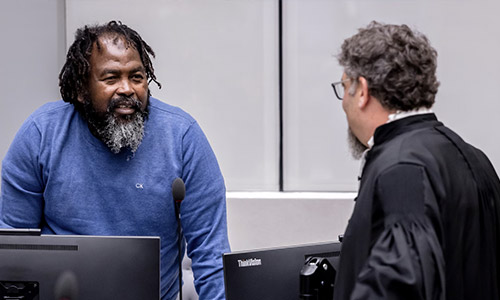
The International Criminal Court has convicted former Central African Republic rebel commander Mahamat Said Abdel Kani on four counts of crimes against humanity for abuses committed against detainees in Bangui in 2013, while acquitting him of three war-crimes charges.

Trial Chamber VI of the ICC delivered the judgment on Wednesday, September 23, 2026, finding Said guilty beyond reasonable doubt of imprisonment or other severe deprivation of physical liberty, torture, persecution and other inhumane acts committed at the Central Office for the Repression of Banditry, known by its French acronym OCRB, between April 12 and August 30, 2013.
The court held that Said, 56, was a Seleka commander in charge of the OCRB and acted with the necessary intent and knowledge in the commission of the crimes, making him directly responsible as a co-perpetrator.
The judges, however, acquitted him of the war crimes of torture, cruel treatment and outrages upon personal dignity because they were not satisfied beyond reasonable doubt that the armed conflict required for those offences was continuing during the relevant period.
A separate proceeding will determine Said’s sentence. Under the ICC’s legal framework, a convicted person may ordinarily receive imprisonment of up to 30 years, while life imprisonment is available in exceptional circumstances depending on the gravity of the crime and the individual circumstances of the convicted person.
Presiding Judge Miatta Maria Samba said Said and others oversaw the beating and torture of detainees as part of a campaign directed at persons perceived to be supporters of then-President François Bozizé following Seleka’s seizure of power.
The prosecution’s case centred on conditions at the OCRB detention facility in the capital, Bangui, where persons suspected of supporting Bozizé were detained.
Evidence presented during the trial described prisoners being whipped and waterboarded and subjected to a method known as “Arbatacher,” in which a detainee’s hands, elbows and feet were tied together behind the body.
Other detainees were confined in overcrowded or underground cells, including a windowless room beneath the floor of Said’s office.
The court heard evidence describing cells whose walls bore signs of violence and prisoners who were beaten severely. Some detainees were held in areas without proper sanitation, bathrooms or showers, while evidence was also given that inmates were deprived of adequate food and water.
Samba said one of the detention areas was covered in human waste and smelled of urine and faeces. Witnesses also testified about the lasting physical and psychological effects of the treatment they suffered.
Said had pleaded not guilty to the charges and denied responsibility throughout the proceedings.
He was surrendered to the ICC by authorities in the Central African Republic on January 24, 2021, pursuant to an arrest warrant originally issued under seal in January 2019. His initial appearance followed later that month, while the confirmation-of-charges hearing took place in October 2021.
On December 9, 2021, the ICC partially confirmed charges against him and committed him for trial. The substantive trial opened before Trial Chamber VI on September 26, 2022.
The case subsequently ran for four years.
Across 130 trial hearings, the Chamber heard 58 prosecution witnesses and three defence witnesses, while 3,863 items were formally admitted into evidence. Thirty-two victims, represented by legal counsel, were authorised to participate in the proceedings.
The prosecution completed presentation of its evidence in November 2024. The defence called its first witness in March 2025 and concluded its evidence in September 2025, while closing statements were heard between November 25 and 27, 2025.
The panel was composed of Presiding Judge Miatta Maria Samba, Judge María del Socorro Flores Liera and Judge Sergio Gerardo Ugalde Godínez, with Judge Keebong Paek serving as alternate judge.
Said’s conviction is significant because he is the first member of the Seleka coalition to be convicted by the ICC over atrocities committed during the Central African Republic conflict.
The predominantly Muslim Seleka coalition overthrew President Bozizé in 2013 and seized Bangui during a period of widespread violence. Its rise was followed by the emergence of predominantly Christian and animist anti-Balaka militias, and the ensuing conflict resulted in widespread killings, displacement and other abuses.
The ICC opened its second investigation into the Central African Republic situation in September 2014 following a referral from the country’s authorities concerning crimes allegedly committed from 2012 onwards.
Two senior anti-Balaka figures — former parliamentarian Alfred Yekatom and former football official and government minister Patrice-Edouard Ngaïssona — were previously convicted by the ICC in connection with crimes committed during the conflict. Said’s case marked the Court’s first conviction on the Seleka side of that conflict.
The September 23 verdict drew reactions from victims and human-rights organisations.
Marius Olivier Trésor Poussinga, who said he was tortured at the OCRB facility, described the judgment as international recognition of what victims suffered and said he could now “sleep easier” because the court had acknowledged his suffering.
Central African Republic Justice Minister Arnaud Djoubaye Abazène also welcomed the judgment, saying victims should not be abandoned and accountability should be pursued at every level.
Human Rights Watch described the conviction as an important measure of long-awaited justice for victims of Seleka abuses. Lewis Mudge, the organisation’s Central Africa director, said the judgment was significant in efforts against impunity but stressed the continuing need for domestic and international accountability mechanisms.
Justice efforts are also continuing inside the Central African Republic through the Special Criminal Court, a hybrid tribunal staffed by Central African and international judges and supported by the United Nations.
Among its major current proceedings is the trial of former President François Bozizé and three former military officials over alleged crimes against humanity connected with abuses committed between 2009 and 2013. Bozizé, who lives in exile in Guinea-Bissau, is being tried in absentia and remains presumed innocent of those charges.
The Special Criminal Court has, however, faced serious funding difficulties. Amnesty International reported that U.S. funding was suspended in January 2025, leaving millions of dollars in outstanding commitments and contributing to fears that the tribunal could struggle to continue operating without additional international support.
[A MUST HAVE] Evidence Act Demystified With Recent And Contemporary Cases And Materials

Available now for NGN 40,000 at ASC Publications, 10, Boyle Street, Onikan, Lagos. Beside High Court, TBS. Email publications@ayindesanni.com or WhatsApp +2347056667384. Purchase Link: https://paystack.com/buy/evidence-act-complete-annotation
______________________________________________________________________ “Enhance Legal Practice With Authoritative Reports” — Alexander Payne Offers Comprehensive Law Reports, Spanning Over A Century Of Nigerian Jurisprudence Interested buyers are encouraged to place their orders and enquiries via:
0704 444 4777, 0704 444 4999, 0818 199 9888
Website: www.alexandernigeria.com
Interested buyers are encouraged to place their orders and enquiries via:
0704 444 4777, 0704 444 4999, 0818 199 9888
Website: www.alexandernigeria.com