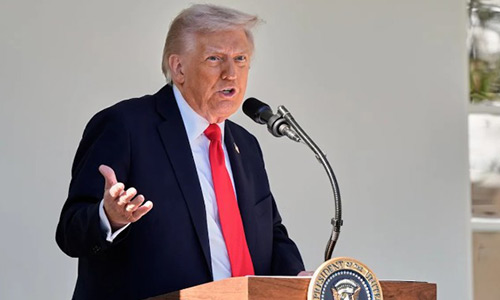
The Democratic Party has secured control of the United States Senate and is projected to take over the House of Representatives following sweeping victories in the November 3, 2026, midterm elections, dealing a major political setback to President Donald Trump and his Republican Party.

The results, projected by major American news organisations, including NBC News and ABC News, followed Democratic victories in several traditionally Republican states, including South Carolina, Texas, Ohio, Kansas, Iowa and North Carolina.
The outcome means that Democrats are positioned to control both chambers of Congress when the newly elected lawmakers take office in January 2027, substantially changing the balance of power in Washington during the remaining two years of Trump’s presidency.
The Democratic gains came amid widespread voter dissatisfaction over the cost of living, government corruption, immigration enforcement, the war involving Iran and concerns about the exercise of presidential power.
The results also represent a reversal for Republicans, who entered the midterm elections controlling both chambers of Congress and had sought to preserve their majorities through an intensive campaign involving Trump and senior party figures.
NBC News projected that Democrats had secured control of Congress after victories in several highly contested races, including states that had overwhelmingly supported Trump in the 2024 presidential election.
The party’s success in the Senate followed an earlier projection that it had won control of the House, where Democrats are expected to secure one of their largest majorities in nearly two decades.
Although the final composition of both chambers will depend on the completion of outstanding vote counts and official certification, the projections indicate that Republicans will lose their legislative majorities when the new Congress convenes.
The Democratic victories were particularly striking in the Senate, where the party secured Republican-held seats in states that had traditionally been considered difficult electoral territory.
In Texas, Democratic State Representative James Talarico defeated Republican Attorney-General Ken Paxton, despite substantial Republican campaign spending and Trump’s endorsement of Paxton.
The result ended a longstanding period of Republican dominance in Texas Senate elections and represented an important breakthrough for Democrats in a state that supported Trump by a double-digit margin in 2024.
Paxton had faced political and legal controversies during his career, including impeachment proceedings in 2023 and securities fraud charges.
Nevertheless, Trump and Republican organisations invested heavily in the contest in an attempt to retain the seat.
In Ohio, former Democratic Senator Sherrod Brown defeated Republican incumbent Jon Husted, returning to the Senate after losing his seat in the 2024 election.
Brown’s victory was another setback for Republicans in a state where Trump had previously recorded strong electoral support.
South Carolina also produced one of the night’s biggest surprises, as Democrat Annie Andrews defeated Republican Senator Darline Graham.
Andrews’ victory ended a prolonged period of Republican dominance in the state’s Senate elections and demonstrated the extent of Democratic gains in traditionally conservative areas.
Graham had received Trump’s support, but the endorsement was insufficient to prevent the Republican defeat.
The Democratic advance extended to North Carolina, where former Governor Roy Cooper defeated his Republican opponent in the Senate contest.
Democrats also recorded victories in Kansas and Iowa, giving the party the additional seats required to regain control of the upper chamber.
The party retained important Senate seats in Georgia and New Hampshire, strengthening its position as the contest for control of Congress was decided.
In Georgia, Democratic Senator Jon Ossoff was projected to retain his seat.
Reacting to the outcome, Ossoff described the results as a rejection of Trump’s leadership.
“In sweeping and decisive victories, the American people have rebuked the depravity, corruption and incompetence of the man named President Donald J. Trump,” he told supporters at a victory gathering.
The Democratic gains in several Republican strongholds were especially notable because Trump had actively campaigned for his party’s candidates and encouraged supporters to vote as though he were personally contesting the elections.
During the final month of the campaign, the President maintained a demanding schedule of rallies and public appearances aimed at protecting the Republican majorities.
He repeatedly urged his supporters to treat the midterm elections as a referendum on his presidency and the direction of his administration.
However, as the results increasingly pointed towards Republican defeats, Trump distanced himself from the outcome.
In a social media post on Tuesday night, he argued that Republicans had lost because he was not personally on the ballot.
“I wasn’t on the Ballot and if I was, we would have won IN A LANDSLIDE! Thank you for your attention to this matter,” Trump wrote.
His remarks contrasted with his earlier campaign message encouraging voters to consider him a central factor in their electoral decisions.
The President had also sought to blame his predecessor, Joe Biden, for rising prices and continuing economic difficulties.
However, voter surveys suggested that many Americans remained dissatisfied with the economic situation under the current administration.
The rising cost of groceries, housing, energy and other essential services featured prominently among the issues influencing voters.
Petrol prices had also increased following the outbreak of the war involving the United States, Israel and Iran in February 2026.
The conflict became another source of political pressure on the administration, with voters expressing dissatisfaction over its handling and the economic consequences.
An NBC News exit poll showed that 43 per cent of voters identified opposition to Trump as one reason for their decisions at the ballot box.
The figure reflected widespread dissatisfaction with the President’s performance and was higher than the proportion recorded during the 2018 midterm elections in his first presidency.
The survey also indicated that 71 per cent of voters believed Congress had not exercised sufficient oversight of Trump.
That view included 41 per cent of Republican respondents, suggesting that concerns about congressional accountability extended beyond Democratic voters.
Other major issues influencing the electorate included corruption, immigration, affordability and the war in Iran.
Separate exit polling showed that approximately three-quarters of respondents were either angry or dissatisfied with the direction of the United States.
About 70 per cent also expressed support for stronger congressional checks and balances on presidential authority.
The results followed months of Democratic efforts to make the elections a referendum on the administration’s handling of economic conditions and the exercise of executive power.
Democrats also benefited from changing voting patterns among minority communities.
Latino voters, who had contributed to Trump’s political comeback in the 2024 presidential election, showed increased support for Democrats during the midterm campaign.
An NBC News poll published shortly before the elections placed Democrats 27 percentage points ahead among Latino voters, reflecting dissatisfaction with rising living costs and the administration’s immigration enforcement policies.
The movement of voters away from Republican candidates contributed to Democratic victories in several competitive states.
In Florida, however, Republicans retained an important Senate seat, with Senator Ashley Moody defeating Democratic challenger Angie Nixon.
The contest was relatively close, with Moody winning by approximately three percentage points in a state Trump had carried by a considerably wider margin in 2024.
Democrats also retained three congressional districts in Florida that Republican lawmakers had redrawn.
The districts had previously supported Trump in the presidential election, illustrating the difficulties Republicans faced in translating presidential voting patterns into congressional victories.
The outcome of the midterm elections is expected to have far-reaching consequences for the remainder of Trump’s second term.
With Democrats set to control Congress, the President will face a legislature capable of exercising stronger oversight over the executive branch.
The party will acquire the authority to chair congressional committees, schedule investigations, conduct oversight hearings and issue subpoenas.
Democratic lawmakers have already indicated that they intend to examine the administration’s policies and activities, including the conduct of immigration enforcement agencies, public expenditure and potential conflicts of interest involving individuals connected to the President.
Among those expected to play leading roles are Representative Robert Garcia of California, the senior Democrat on the House Oversight Committee, and Representative Jamie Raskin of Maryland, the senior Democrat on the House Judiciary Committee.
Garcia has outlined plans to examine allegations concerning the Trump family’s business dealings and the growth of the President’s wealth since the 2024 campaign.
Other potential areas of investigation include matters connected with Jeffrey Epstein, immigration enforcement operations and government decisions involving public resources.
Democrats have also identified the activities of Immigration and Customs Enforcement (ICE) and the Department of Homeland Security as areas requiring stronger congressional scrutiny.
The administration’s renovation projects at the White House and other government landmarks in Washington have also been identified as possible subjects of oversight.
The House Judiciary Committee’s Democratic members have raised concerns about presidential pardons involving wealthy offenders and political allies.
They have also indicated interest in examining allegations of foreign influence connected with gifts, financial transactions and cryptocurrency businesses associated with the Trump family.
These matters remain proposed areas of investigation, and the allegations involved would require examination through the appropriate congressional processes.
House Democratic Leader Hakeem Jeffries has maintained that the party’s immediate priorities include lowering living costs, addressing corruption and restoring congressional accountability.
Before the election, Jeffries accused Republicans of failing to respond adequately to the economic difficulties confronting American families.
“The cost of living is way too high, and Donald Trump — along with his Republican sycophantic members of Congress — have actually decided not to do anything about it because so many of them are so focused on enriching themselves, their family members, their friends and their donors. There is a cost to corruption,” he said.
He also promised that matters requiring scrutiny would be investigated when Democrats assumed control.
“These are all things that are going to need to be thoroughly investigated as part of our pledge to hold the crooks accountable, beginning on day one,” Jeffries stated.
Although Democrats have discussed potential investigations involving the President, Jeffries has said that impeachment is not the party’s immediate focus.
He has, however, declined to rule out that possibility.
Trump was impeached twice during his first administration but was acquitted by the Senate on both occasions.
The incoming Democratic majority could also produce a historic change in the leadership of the House of Representatives.
Jeffries is positioned to become the first Black Speaker of the United States House of Representatives if he secures the required votes when the new Congress convenes.
Democrats are expected to hold their internal leadership elections during the week beginning November 16, 2026, with Jeffries expected to emerge as the party’s nominee for Speaker.
He would then need to secure the necessary majority in the House leadership election when the new Congress convenes on January 3, 2027.
The position would place him second in the presidential line of succession after the Vice President.
In the Senate, Democratic Leader Chuck Schumer is also expected to seek a return to the position of Senate Majority Leader, which he previously occupied for four years.
Schumer had outlined his party’s priorities before the election, emphasising the cost of living, corruption and the conduct of government.
“What we’re going to do is lower costs, end all this rampant corruption and end the chaos. Plain and simple,” he said.
Democratic control of the Senate would also affect the President’s ability to secure confirmation of nominees for senior federal positions.
The chamber is responsible for confirming federal judges, including nominees to the United States Supreme Court.
Several Democratic senators have indicated that they would be unwilling to support future Supreme Court nominees put forward by Trump during the remaining two years of his presidency.
Senator Richard Blumenthal of Connecticut, a member of the Senate Judiciary Committee, expressed that position before the election.
“Well, given the history of Trump nominees, I think it is slim to none that we would support a nominee from this administration,” he said.
He accused previous Trump judicial appointees of adopting positions that aligned too closely with the President’s political preferences.
Democratic control of the Senate would therefore give the party greater influence over future judicial appointments and could complicate any attempt by Trump to fill a Supreme Court vacancy.
The election results may also affect the President’s legislative programme.
Republicans had previously relied on their congressional majorities to advance spending, taxation and other policy initiatives.
With Democrats assuming control, the administration may face more difficult negotiations over legislation, government expenditure, immigration policy and presidential powers.
The constitutional arrangement between Congress and the presidency could consequently face a period of intense legislative and political confrontation.
Democrats have signalled their intention to challenge aspects of Trump’s exercise of executive authority, while the President has continued to defend his administration’s policies.
The outcome has drawn comparisons with earlier midterm elections in which voters transferred control of Congress to the party opposing the sitting President.
The last time a minority party captured both chambers of Congress in a single midterm election was in 2006, when Democrats gained control during the presidency of George W. Bush.
The result was widely associated with public dissatisfaction over the Iraq War and the administration’s performance.
Bush subsequently described that defeat as “a thumping.”
The 2026 results have similarly placed pressure on the Republican Party to examine its political direction ahead of the 2028 presidential election.
Vice President JD Vance has been widely discussed as a possible contender for the Republican presidential nomination in 2028.
However, the scale of the party’s midterm defeats could intensify internal debate about its leadership, policy priorities and continued association with Trump’s political approach.
The future of senior Republican congressional leaders has also become uncertain.
Senate Majority Leader John Thune of South Dakota would need to secure the support of Republican senators if he intends to remain their leader after the party moves into the minority.
Thune has experienced disagreements with Trump, including over the President’s demand to abolish the Senate filibuster to facilitate passage of the proposed SAVE America Act, which seeks changes to federal election laws.
Similarly, House Speaker Mike Johnson of Louisiana faces questions about his political future following the Republican defeat.
Johnson could seek to remain the party’s leader in the House, but the extent of Republican losses may encourage some lawmakers to demand a change in leadership.
Before Democrats formally assume control in January, Republicans may attempt to advance outstanding legislative priorities during the final session of the outgoing Congress.
Possible measures include another budget reconciliation package covering spending and taxation, as well as legislation addressing the federal debt ceiling ahead of a 2027 deadline.
Meanwhile, concerns about election monitoring and possible challenges to the results emerged during voting.
The United States Department of Justice disclosed that it deployed approximately 1,000 election monitors and observers across all 50 states.
The department described the exercise as the largest Election Day monitoring operation in its history.
According to the Justice Department, the deployment was intended to monitor compliance with federal voting rights laws and strengthen public confidence in the electoral process.
However, Democratic politicians and voting rights advocates expressed concern that the presence of federal observers could intimidate voters.
A Reuters examination of the deployment found that approximately two-thirds of the jurisdictions selected for monitoring had supported Democratic presidential candidate Kamala Harris during the 2024 election.
The findings prompted questions about the geographic distribution of the observers and the possible implications for voter participation.
Election officials in several states nevertheless reported no major problems associated with the monitoring operation.
In New Mexico, the Secretary of State’s office disclosed receiving reports that federal monitors had asked unusual questions in one county.
The Justice Department reportedly assured state officials that the conduct would be addressed.
Concerns about the possibility of election disputes were heightened by Trump’s previous claims concerning electoral fraud and the prospect of challenges to unfavourable results.
However, the President subsequently indicated in an interview that he would accept the election outcome and work with Democrats.
“I am absolutely willing to accept those results,” Trump said, adding that his administration would seek ways to work with the incoming Democratic leadership.
The midterm results will now determine the political environment in Washington during the final two years of Trump’s presidency.
For Democrats, the victories provide an opportunity to advance their legislative priorities, strengthen congressional oversight and influence federal appointments.
For Republicans, the outcome presents the challenge of rebuilding electoral support, reassessing campaign strategies and determining how to advance their policy objectives without control of Congress.
The elections have also placed renewed attention on the role of Congress in checking presidential authority, particularly where one political party controls the White House and another controls the legislature.
With Democrats winning the Senate and projected to secure the House, the United States is set to enter a new period of divided government.
The final political and legislative consequences will depend on how the incoming Democratic majorities exercise their authority, how Trump responds to congressional oversight and whether both parties can reach agreements on the economic and national issues that featured prominently in the November 3 elections.
[A MUST HAVE] Evidence Act Demystified With Recent And Contemporary Cases And Materials

Available now for NGN 40,000 at ASC Publications, 10, Boyle Street, Onikan, Lagos. Beside High Court, TBS. Email publications@ayindesanni.com or WhatsApp +2347056667384. Purchase Link: https://paystack.com/buy/evidence-act-complete-annotation
______________________________________________________________________ “Enhance Legal Practice With Authoritative Reports” — Alexander Payne Offers Comprehensive Law Reports, Spanning Over A Century Of Nigerian Jurisprudence Interested buyers are encouraged to place their orders and enquiries via:
0704 444 4777, 0704 444 4999, 0818 199 9888
Website: www.alexandernigeria.com