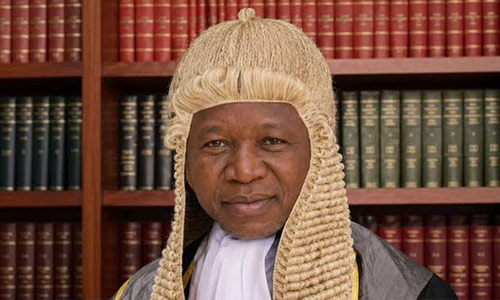
*Says “We Are Targets Because We Convict Bandits In The Courts, Yet We Have No Security At Our Residences”

Justice Faruk Hassan Bunza of the Kebbi State High Court, abducted from his residence and held for nine days before regaining his freedom, has given a detailed account of his captivity, saying he was kept at a camp of fewer than 20 armed men some 49 kilometres from his home, that his abductors monitored news reports of his own kidnapping, and that judges are left exposed because they are provided no security at their residences.
The judge spoke at his residence at Unguwar Chaki quarters, Bunza, where he was still recuperating after undergoing medical checks following his release.
Justice Bunza was seized from his home in the early hours of Saturday, 26 July 2026, and regained his freedom on Monday, 3 August. Five armed men stormed the residence at about midnight, fired several shots into the air to scare residents, and took him away in an operation lasting only a few minutes. No one was killed or injured.
The following day the abductors contacted his family and demanded N200 million. After negotiations the sum was reduced to N50 million, and it was gathered from relatives that the ransom was paid on 3 August, after which the bandits abandoned the judge on a hill and deserted their camp.
The judge described the route by which he was taken.
“When the five armed men stormed my residence and asked me to follow them, I didn’t resist. We came out and moved east through a road adjacent to my house, passing behind other residences. From there we turned north toward a small irrigation site, Fadama. We trekked for a few metres, turned west and returned to the main road. We crossed it and headed to the hill on the western part of Bunza town,” he said.
“On getting to the hill, we moved south toward the Bunza-Kamba Road. We crossed the road and continued trekking. After trekking for about 25km barefooted, we arrived at Tungar Bandan junction, where they parked their motorcycles to avoid detection. From there we rode for about 24km before arriving at Dutsen Bandan, their main camp in Dakin Gari, headquarters of Suru LGA. In all, I was kept about 49km away from my family for nine days.”
He added: “I suspect my abductors had been monitoring me for a long time. They have informants who gave them details about me.”
The camp is on a hill behind the National Youth Service Corps permanent orientation camp in Dakin Gari, Suru Local Government Area. A resident of Bunza, who asked not to be named, said Dutsen Bandan is a known hideout and that people have complained about the movement of suspected bandits around the hill.
At the camp, the judge said, he met two other captives.
“I was asked to climb the hill. I had trekked 25km barefooted, so it was difficult, but they didn’t care. On top of the hill, I met two other Fulani men who had also been kidnapped. Five armed bandits guarded us while the rest stayed with their families down the hill.”
He continued: “The next day, Sunday, they brought two photographs — mine and that of the chairman of Bugudu LGA in Zamfara State, Nura Umar Abdullahi. They asked if it was me and said they were ordered to kidnap both of us, but they didn’t mention who gave the order.”
He said the group followed coverage of his abduction. “They also showed me a newspaper report about my abduction. They said they heard President Bola Ahmed Tinubu had directed that N200m be paid for my release, but someone stopped it. That shows they monitor news and social media.”
Justice Bunza said the camp functioned as a settlement.
“At the Dutsen Bandan camp, I observed that the bandits sleep, cook and interact with their families there just as we do in our houses,” he said.
On religious observance, he said: “Unfortunately, the bandits do not observe the five daily prayers. When it was time for prayer, I prayed alone. I performed dry ablution, Tayammum, and observed my prayers. However, I could hear them reciting the Holy Qur’an every day. I could hear the five bandits guarding us reciting the Qur’an daily, but they did not pray at all.”
He described the structure of the group. “The bandits were not more than 20 at the camp. So the government can easily crush them. They rely on informants who bring them information from town. Most of these informants are young children of bandits. From my observation, roles among the bandits depend on age. While the younger ones serve as informants and errand boys, the adults are the foot soldiers. They carry arms and actively participate in operations.”
He said the men were armed but nervous. “Though the bandits were armed, they were always fearful and on high alert. They warned us kidnap victims to remain quiet and calm. There was a day they warned me to stop coughing. They were very scared because they thought I was coughing to alert people to our location. At night, they would hide a few metres away from us and remain vigilant.”
The judge said he was not maltreated, and described a marked difference in how he and the other captives were treated.
“They were friendly throughout the nine days. They never humiliated me. The only things that troubled me were climbing the hill and the long trek,” he said.
“My face was covered anytime I ate so I wouldn’t see them. I was asked what food I wanted and I chose tuwon shinkafa or semo with okra soup. They fed me twice daily with bottled water and Maltina. Whenever they brought me food, they would tell me to eat to my satisfaction. And anytime I didn’t finish, they would say I shouldn’t be shy to eat it all because it was meant for me.”
He added: “However, the two Fulani men were not given any food. Whenever they asked for drinking water, they were given dirty water from the stream. They were always told that only I would get proper meals and clean drinking water.”
He said his face remained covered throughout. “Whenever it was time to eat, they would hide behind me and ask me to uncover my face so I wouldn’t see them. After I finished eating, they would ask me to cover my face again.”
Justice Bunza offered two explanations for his abduction.
“One, as a judge I handle high-profile criminal cases including banditry and kidnapping. For that reason alone, the bandits might have targeted me. Two, they are money mongers looking for rich people. I was told they were informed I am one of the richest people in Bunza with five cars, several houses and farmlands.”
He said his captors told him he was reported to be a wealthy man with “plenty of money and assets, including landed properties.”
He concluded: “Based on my interaction with them, I fully understood that my abduction was purely for ransom. My abductors were just money mongers. They had no intention to kill me. Their target was to collect money.”
The judge used the interview to press for protection for judicial officers.
“When I was a magistrate and chief magistrate, I had permanent security at my house. Now I don’t. Security is on a shift basis. Despite the risk of our job, we are not provided with security at our residences. We are prone to attack. It is unfortunate, and the government must do something urgently,” he said.
He added: “Though Allah is our ultimate protector, it is good if the government can provide quarters for judges with adequate security. Every judge should have security at his residence, at least at night. We are targets because we convict bandits in the courts. Due to the nature of our job, we are at high risk of attack by the terrorists.”
Describing his release, the judge said the two other captives escaped on Saturday, 1 August, and that on Monday, 3 August, after the ransom was collected, most of the group left the camp, leaving two men to guard him.
“I overheard them arguing. One said the other should shoot me, but he didn’t, probably to avoid attracting security operatives or passersby. They eventually abandoned me and ran away,” he said.
“Around 5 to 6pm, I realised that I was alone. I then removed the covering from my face and came down from the hill. I trekked until I got to a village at night but feared it might be occupied by bandits, so I hid until morning.”
He continued: “In the morning, I continued trekking until I got to Kwanar Bandan and met some villagers. I asked for a commercial motorcyclist that would take me to Bunza. I got one and he asked for N8,000. Then a tinted commercial Toyota Corolla with three passengers arrived. The driver agreed to take me for N2,000.”
He described how he secured a ride to his door. “At Dakingari junction I bought firewood for N3,000. I did that in order to convince the driver to take me directly to my house. We finally agreed on N3,000. When I got home, relatives and other sympathisers were outside. Because of the tinted glass, no one recognised me until I came out from the car. Then people started jubilating.”
He credited prayers for his release. “Relatives, friends and well-wishers from within Bunza, Kebbi State and even beyond prayed for me. People prayed fervently for my release and, by God’s infinite mercy, He answered our prayers. Here I am today a free man. I’m hale and hearty; nothing worries me. While in captivity, I always told myself that my captors were ignorant about Almighty Allah. If they knew God, they wouldn’t involve themselves in this evil.”
Asked whether the ordeal would affect his commitment to his work, the judge was emphatic.
“Never. I swear to Almighty Allah, nothing on this earth can change my attitude and commitment to my duties as a judge. Remember, I am under oath. So nothing can make me change my mind toward discharging my responsibilities as a judge.”
He added: “In fact, this experience will only motivate me to double my commitment to discharging my duties. I can assure you, Wallahi, nothing on this earth can make me deviate from what is right. I have learnt many lessons from this incident and I will continue to keep many things to myself.”
On how the menace can be ended, Justice Bunza returned first to the size of the camp.
“As I said earlier, the bandits at the camp where I was kept are not many. They could be easily crushed if our security operatives are allowed to confront them squarely.”
He then set out what he described as the underlying causes. “From my observation, poverty and illiteracy are the main factors driving these terrorists into banditry and kidnapping. If the government can provide adequate job opportunities for citizens and create a conducive environment for educating the young generation, both Islamic and Western education, that will greatly help in addressing the situation.”
He continued: “The government should invest heavily in education. Teachers and other stakeholders should be equipped to impart knowledge on the people. The issue of unemployment must also be addressed. Citizens should be provided with adequate job opportunities so that money can circulate among the majority, not just among the few as it is now.”
He concluded: “If government tackles the problems of poverty, unemployment and education, the menace of banditry and kidnapping will be drastically reduced, if not completely wiped out.”
Three things in this account carry beyond one judge’s ordeal.
The first is the operational detail, which is unusually specific for a first-hand account. A camp of fewer than 20 men, at a named location on a hill behind an NYSC orientation camp, in a place local residents say is a known hideout, sustained by informants drawn from the group’s own children. The judge’s own inference that a force of that size could be dealt with if operatives were permitted to confront it — is a question for the security agencies rather than for him, but it is a question his account puts squarely on the table. The presence of families at the camp also complicates any operation, which is precisely the kind of fact that operational planning requires and that seldom reaches the public.
The second is the phrase the judge himself flags and does not resolve: that his captors produced two photographs and said they had been ordered to take both men, without naming who gave the order. That converts the episode from opportunistic banditry into something closer to a commissioned abduction, and it is the single most consequential line in the interview. It also sits uneasily beside his own conclusion that the motive was purely ransom. Both may be true a group can be paid to take a target it also expects to monetise but the question of who selected him is now a live investigative one, particularly given that the second photograph was of a serving local government chairman in another state.
The third is the differential treatment he describes: proper meals and bottled water for the judge, stream water and no food for the two other captives. That is not incidental cruelty; it is a calculation about which hostage has a family able to raise N50 million. It is also the clearest indication in the account that the enterprise is a commercial one operating on assessed value, and it is a reminder that the captives whose release attracts no coverage are held in materially worse conditions.
His central request is modest and specific. Judges who try banditry and terrorism cases are given security on a shift basis or none at all at their homes, while magistrates in his own earlier experience had permanent protection. That is an administrative gap the National Judicial Council, the state judiciary and the state government can close without new legislation, and it is the recommendation most likely to prevent the next abduction.
[A MUST HAVE] Evidence Act Demystified With Recent And Contemporary Cases And Materials

Available now for NGN 40,000 at ASC Publications, 10, Boyle Street, Onikan, Lagos. Beside High Court, TBS. Email publications@ayindesanni.com or WhatsApp +2347056667384. Purchase Link: https://paystack.com/buy/evidence-act-complete-annotation
______________________________________________________________________ “Enhance Legal Practice With Authoritative Reports” — Alexander Payne Offers Comprehensive Law Reports, Spanning Over A Century Of Nigerian Jurisprudence Interested buyers are encouraged to place their orders and enquiries via:
0704 444 4777, 0704 444 4999, 0818 199 9888
Website: www.alexandernigeria.com
Interested buyers are encouraged to place their orders and enquiries via:
0704 444 4777, 0704 444 4999, 0818 199 9888
Website: www.alexandernigeria.com