A chieftain of the Nigeria Democratic Congress (NDC), Alhaji Buba Galadima, has expressed satisfaction that opposition political parties failed to merge into a single platform ahead of the 2027 general elections, arguing that the leadership crisis currently confronting the African Democratic Congress (ADC) demonstrates the dangers of concentrating the entire opposition in one party.

Galadima also criticised former Kogi West Senator Dino Melaye and other ADC members over what he described as their apparent excitement about unconfirmed reports that Justice Peter Lifu of the Federal High Court had fallen ill and might travel abroad for medical treatment.
Speaking during an interview on Africa Independent Television (AIT), Galadima warned that any prolonged absence of the judge could complicate the transmission of court records required for the appellate proceedings arising from his judgment against the ADC leadership.
He maintained that opposition politicians celebrating such reports, if true, had failed to consider the possible consequences for their own legal challenge.
The NDC chieftain’s comments followed the November 5, 2026 judgment delivered by Justice Lifu in the leadership dispute involving the ADC, Senator David Mark, former Minister of Interior Rauf Aregbesola and Hon. Nafiu Bala Gombe.
The Federal High Court had set aside the resolutions of the party’s 99th National Executive Committee meeting of July 29, 2025, through which Mark and Aregbesola emerged as national officers.
The court held that their emergence had not been shown to comply with the democratic election requirements of Section 82(3) of the Electoral Act 2022.
Justice Lifu consequently restrained the Independent National Electoral Commission (INEC) from recognising or dealing with the affected persons as national officers of the party.
Reacting to the controversy surrounding the judgment, Galadima referred to Melaye’s announcement that the ADC had obtained its certified true copy.
“There was a judgment against ADC. Okay. Isn’t it? Yes. And I’ve just heard you read something that Dino Melaye said they’ve got a true certified copy of the judgment,” Galadima said.
He then expressed concern over reports that some members of the opposition party were celebrating claims concerning the judge’s health.
“And I know of some ADC people are jumping up and down that the judge who gave a ruling, Peter Lifu, against them, has fallen ill and is supposed to be taken to hospital in Europe,” he stated.
Galadima questioned the reasoning behind such reactions, arguing that the absence of a judge could create difficulties in processing an appeal.
“I just found out that maybe there aren’t intelligent people in the ADC. They didn’t know that if that is true, it is deliberate to deny them appeal,” he said.
Explaining his position, the politician claimed that the judge’s absence from Nigeria could prevent the required records of proceedings from being signed and transmitted for appellate consideration.
“Because if the judge goes to London or Europe or anywhere and outside the country, the records of proceedings from his judgment cannot be signed by any judge, so no appeal could be heard until he’s back,” Galadima argued.
He accused politicians who were pleased by the reports of failing to appreciate the legal difficulties that might arise.
“They are playing on their intelligence. And that’s why Nigerian politicians, they are lazy. They don’t think,” he stated.
When asked whether his criticism also applied to members of the opposition, Galadima questioned why anyone challenging the judgment would welcome developments that could potentially delay judicial proceedings.
“How can you be happy that Peter Lifu has fallen ill and is being taken to Europe? You don’t know that they are denying you justice?” he asked.
The claims concerning Justice Lifu’s health and possible travel were not independently substantiated in the account of the interview. Galadima’s comments about the potential consequences for an appeal also represented his interpretation of the situation, rather than a judicial determination that appellate proceedings could not continue.
Turning to the proposed coalition of opposition parties ahead of the 2027 elections, Galadima said he was relieved that the arrangement did not result in every major opposition group joining the ADC.
The interviewer had asked whether the opposition would have been better positioned to challenge the ruling All Progressives Congress (APC) if plans to form a united coalition and support a single presidential candidate had succeeded.
Galadima responded:
“I want to tell you that I’m glad that it didn’t work.”
Asked why he welcomed the failure of the proposed arrangement despite belonging to an opposition party, he replied:
“So if all of us now were in the ADC, what would be our fate?”
He maintained that the current leadership litigation demonstrated the vulnerability that could arise if opposition parties abandoned their separate political platforms and became dependent on a single organisation.
According to him, such an arrangement could leave voters without a viable alternative if that party became entangled in a leadership crisis or faced restrictive judicial orders.
Galadima recalled that he had previously warned that President Bola Tinubu did not favour political competition.
He alleged that the President would prefer an electoral contest in which he faced no meaningful opposition.
The politician referred to Tinubu as wanting to contest as a single candidate, describing the situation as “Tilo, one, Taya, alone.”
He argued that if all opposition parties had joined the ADC before Justice Lifu delivered his judgment, the resulting legal uncertainty could have affected the entire opposition movement.
Galadima therefore maintained that the existence of different opposition political parties remained important for preserving alternative platforms ahead of the 2027 elections.
He also rejected the suggestion that earlier opposition cooperation necessarily required every participating party to merge into one organisation.
Referring to political arrangements discussed around 2013 and 2014, he said the understanding was that opposition parties should support a common candidate against the ruling party.
According to him, supporting a common presidential candidate was different from dissolving existing party structures into a single political organisation.
Galadima further alleged that powerful political interests could use legal proceedings to frustrate opposition activities.
During the interview, he suggested, without presenting supporting evidence in the supplied excerpts, that the judiciary was being influenced to make decisions favourable to the ruling party.
When the presenter asked whether he was alleging that President Tinubu had directed the judiciary to nullify the leadership of an opposition party, Galadima responded:
“What we hear, what we hear, if I were to put it on the table, the country will burn.”
He also alleged that litigants facing members of the APC could be subjected to unfair judicial treatment.
“If you have any case against APC or any APC person, what we learned is that the judges will go to your opponent and ask him what type of judgment he will give,” he claimed.
The allegations were made by Galadima during the interview and were not accompanied by evidence establishing that President Tinubu or any judicial officer had interfered with the ADC proceedings.
The NDC chieftain also raised concerns about developments in Kano State, referring to a legal dispute involving an application to restrain INEC from recognising a candidate.
He questioned the use of court orders affecting electoral candidates and referred to provisions of the Electoral Act concerning judicial interference in electoral processes.
However, the available transcript did not clearly identify the parties, the court or the specific order involved in the Kano matter.
Beyond the ADC leadership dispute, Galadima criticised what he regarded as the declining quality of political leadership in Nigeria.
Asked to compare the political environment when he began his career with the present situation, the politician, who said he had spent approximately 48 years in politics, argued that public service had increasingly been replaced by personal ambition and the pursuit of wealth.
“We don’t have politicians now. We have selfish people, self-centered people, because people at 90 are still amassing wealth or stealing public funds,” he said.
He contrasted the situation with his understanding of politics in previous decades, when he said public office holders sought recognition through their service to communities and the country.
“Then it was service to the people. Every politician aspires and struggles to showcase his service to community, his service to his fatherland,” Galadima stated.
He also expressed concern over the independence of the judiciary, arguing that an institution constitutionally empowered to check the executive must remain impartial.
Galadima maintained that the judiciary previously enjoyed a reputation for independence and integrity, but questioned whether that standard was being maintained.
He expressed frustration about the political situation, saying he would consider relocating if neighbouring countries such as Cameroon, Benin Republic, Chad or Niger were willing to accept him as a citizen.
The NDC chieftain also questioned whether Nigeria’s political environment remained consistent with democratic principles.
“Are we doing democracy or fascism?” he asked.
He argued that every registered political party should be able to canvass for votes and participate in lawful political activities without unnecessary restrictions.
Galadima also referred to constitutional protections allowing Nigerians to reside, travel and conduct lawful business in any part of the country, questioning whether those rights were being respected in practice.
In another part of the interview, he complained about what he described as unequal access to government-owned broadcasting platforms.
Galadima said that although he could appear on privately owned television stations such as AIT, opposition politicians faced difficulties obtaining access to the Nigerian Television Authority (NTA).
He maintained that citizens and political figures should be able to access public broadcasters irrespective of party affiliation.
“I want to assure you that no human being outside APC could be granted an audience even though the law says they should, but they will not because there is no law in Nigeria,” he alleged.
He also referred to his previous political engagements, including an invitation involving former Vice President Atiku Abubakar in 2019, while discussing access to media platforms.
The NDC chieftain further questioned the state of governance and national security, responding to discussions about military efforts against insecurity by asking what circumstances would qualify a country as a failed state.
His remarks came amid continuing disagreement within the opposition over the implications of Justice Lifu’s judgment and preparations for the 2027 general elections.
The ADC has challenged the Federal High Court decision, while Melaye announced on November 11 that the party had received its certified true copy.
Melaye also maintained that the judgment did not expressly mention Atiku Abubakar or any other presidential candidate.
However, the broader legal consequences of the orders affecting the disputed ADC leadership remain separate from whether individual candidates were expressly named in the judgment.
For Galadima, the controversy illustrated both the difficulties facing opposition parties and the importance of maintaining alternative political platforms rather than concentrating opposition activities in one party.
He maintained that the opposition should recognise the potential consequences of judicial disputes, defend its right to political participation and avoid celebrating developments that might complicate access to justice.
[A MUST HAVE] Evidence Act Demystified With Recent And Contemporary Cases And Materials

Available now for NGN 40,000 at ASC Publications, 10, Boyle Street, Onikan, Lagos. Beside High Court, TBS. Email publications@ayindesanni.com or WhatsApp +2347056667384. Purchase Link: https://paystack.com/buy/evidence-act-complete-annotation
______________________________________________________________________ “Enhance Legal Practice With Authoritative Reports” — Alexander Payne Offers Comprehensive Law Reports, Spanning Over A Century Of Nigerian Jurisprudence Interested buyers are encouraged to place their orders and enquiries via:
0704 444 4777, 0704 444 4999, 0818 199 9888
Website: www.alexandernigeria.com
“A Comprehensive Guide To Evidence Law” — Releases Second Edition In Three Volumes, Covering 4,051 Cases
For enquiries and orders, contact: 08035526491 Email: jerryamadisilk@gmail.com
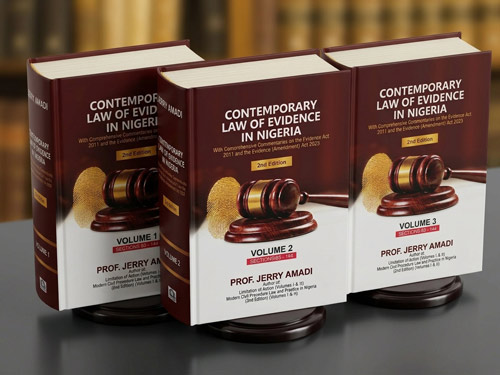 Prof. Jerry Amadi’s Evidence Law, Second Edition (2026), contains 3,314 pages in three volumes, covering the Evidence Act 2011, its 2023 amendment, and 4,051 Nigerian and English cases.