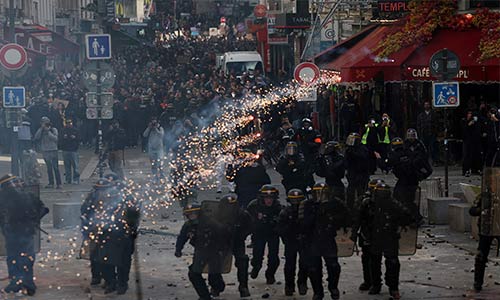
France has been hit by some of its most destructive unrest in years after nationwide protests over the rising cost of living, fuel prices, declining public services and deteriorating school conditions turned violent in several major cities.

Police and protesters clashed on Saturday in Paris, Marseille, Toulouse, Angers and Lyon, with officers deploying tear gas as some demonstrators set vehicles and other objects ablaze, damaged shops and public buildings and pushed into areas outside authorised protest routes.
The French Interior Ministry said at least 272 people had been arrested following violent incidents involving hooded individuals.
The demonstrations, which began as student-led protests over teacher shortages and poor school facilities, have broadened into a much wider movement involving students, teachers, trade unions, workers, farmers, retirees and supporters of the Yellow Vest movement.
The CGT trade union told Agence France-Presse that about 800,000 people participated in demonstrations across France, although the Interior Ministry did not immediately provide its own nationwide estimate.
Many demonstrators insisted that the majority of protesters had marched peacefully and blamed much of the violence on groups they said had deliberately joined the rallies to vandalise property and confront police.
One 19-year-old protester in Paris, identified as Lola, said demonstrators were protesting because ordinary people were finding living costs increasingly unbearable.
“We are fighting because the cost of living is too harsh, because the price of fuel is too high, because high school pupils are being violently attacked and hurt all over the country just for trying to protest and ask for more teachers and decent learning conditions,” she said.
In Paris, riot police fired tear gas during confrontations with predominantly young protesters, some dressed in black and wearing masks, goggles and hooded clothing.
By late afternoon, demonstrators had reached prominent areas including the Champs-Élysées, Concorde and La Madeleine, despite those locations being outside the authorised demonstration route.
As demonstrations continued into the evening, objects including at least one vehicle were set on fire.
Several shops and restaurants in the French capital had their windows smashed, while cars and rubbish bins were also set ablaze. Businesses near the Paris Opera hurriedly closed their premises as tear gas spread through surrounding streets, affecting tourists and other members of the public.
Violence was not confined to Paris.
In Lyon, protesters reportedly set fire to the city’s tourist office.
In Marseille, the town hall was vandalised, prompting Mayor Benoît Payan to announce that additional police officers were being deployed following discussions with the national government.
Prime Minister Sébastien Lecornu condemned the violence and said the government would not allow violent groups to dictate the country’s political agenda ahead of next year’s presidential election.
“To those who clearly want to use this violence as a ‘warm-up’ before the presidential election, I say clearly: We will not let ourselves be intimidated. No one will impose their political agenda through violence,” Lecornu said.
The Prime Minister blamed what he described as far-left groups and criminals for much of the unrest.
The protests have developed against a backdrop of mounting dissatisfaction over inequality, public spending, education, fuel costs and wider living standards.
The movement began last month in high schools located in poorer northern suburbs of Paris, where students protested against shortages of teachers and deteriorating facilities.
Those grievances subsequently expanded into broader anger about the economy and public services.
High-visibility yellow vests also reappeared during Saturday’s demonstrations, recalling the Yellow Vest protests that became one of the most serious political challenges of President Emmanuel Macron’s earlier years in office.
Macron, who had appealed for calm ahead of Saturday’s demonstrations, is approaching the end of his presidency amid growing economic and political pressure.
France has struggled to reduce its public debt, while government borrowing costs have reportedly risen to their highest levels in more than two decades.
The conduct of French police has also come under increasing scrutiny following injuries sustained by protesters during earlier demonstrations.
Among the incidents drawing attention was the case of a teenager who lost a hand after reportedly picking up a stun grenade.
At the same time, Lecornu has said that more than 900 police officers have been injured during previous demonstrations.
France’s police watchdog is investigating at least two dozen allegations of police violence arising from the protests.
The unrest is also spreading beyond France.
Several hundred mostly young demonstrators took to the streets in Brussels, Belgium, where some protesters clashed with police. Student groups there have complained about rising education costs and proposed reforms they fear could make higher education less accessible.
In Portugal, tens of thousands marched through Lisbon over housing and other living costs. Housing prices in the country have reportedly doubled since 2017, intensifying affordability concerns.
Demonstrations in Milan, Italy, also descended into disorder, with police using tear gas to clear the central Cathedral Square.
In Bologna, police reportedly used water cannon to disperse protesters, while seven arrests were made after another demonstration became violent.
Albania also witnessed renewed clashes, where police appeared to fire rubber bullets during a fifth consecutive day of mass student protests demanding the resignation of Prime Minister Edi Rama over allegations of corruption, unemployment and poor education standards.
[A MUST HAVE] Evidence Act Demystified With Recent And Contemporary Cases And Materials

Available now for NGN 40,000 at ASC Publications, 10, Boyle Street, Onikan, Lagos. Beside High Court, TBS. Email publications@ayindesanni.com or WhatsApp +2347056667384. Purchase Link: https://paystack.com/buy/evidence-act-complete-annotation
______________________________________________________________________ “Enhance Legal Practice With Authoritative Reports” — Alexander Payne Offers Comprehensive Law Reports, Spanning Over A Century Of Nigerian Jurisprudence Interested buyers are encouraged to place their orders and enquiries via:
0704 444 4777, 0704 444 4999, 0818 199 9888
Website: www.alexandernigeria.com
Interested buyers are encouraged to place their orders and enquiries via:
0704 444 4777, 0704 444 4999, 0818 199 9888
Website: www.alexandernigeria.com