

The Independent National Electoral Commission (INEC) has dismissed claims that officials can remotely log out of the Bimodal Voter Accreditation System (BVAS) before the conclusion of voting, clarifying that only the presiding officer operating the device has the authority to log in or out.

The Commission also refuted allegations that election results uploaded offline could disappear, explaining that such results remain securely stored on the BVAS device and are automatically transmitted to the INEC Result Viewing Portal (IReV) once internet connectivity is restored.
INEC made the clarification in a statement issued on Monday, November 16, 2026, through its official X account, in response to a viral Instagram video containing allegations about the operation of BVAS and the uploading of polling unit results ahead of the 2027 general elections.
In the video, a man who claimed to have previously worked as a presiding officer alleged that election officials could remotely log users out of BVAS before the close of polls and that results uploaded without internet connectivity could be lost.
The man consequently warned prospective election officials against uploading results offline, advising them to take screenshots of result sheets and wait until internet connectivity was available before attempting to upload them.
However, INEC rejected the allegations, describing them as “false, fabricated and misleading,” and urged Nigerians to disregard the information circulated in the video.
Explaining the operation of BVAS, the Commission disclosed that every polling unit is assigned unique login credentials, which are issued to the presiding officer on the eve of an election.
According to INEC, the credentials enable the presiding officer to access the BVAS device for voter accreditation on election day and subsequently upload the polling unit result sheet after voting has concluded.
The Commission maintained that no external individual or authority has the ability to remotely log out an official operating the device during voter accreditation or the result-uploading process.
“The claim that the BVAS can be remotely logged out before the conclusion of accreditation and voting is false. Only the Poll Official operating the device has the authority to log in or log out of the BVAS, whether during voter accreditation or the result upload process,” INEC stated.
The electoral body emphasised that the BVAS login and logout functions are controlled by the authorised polling official operating the device, contrary to the suggestion that someone elsewhere could terminate an active session remotely.
Addressing the allegation that election results uploaded offline could disappear, INEC explained that the offline upload feature was introduced following challenges experienced during the 2023 general elections.
It recalled that some presiding officers were held hostage at polling units because they were unable to upload election results due to poor or unavailable internet connectivity.
According to the Commission, those challenges prompted an upgrade of the IReV application to enable presiding officers operating in locations with weak or nonexistent network coverage to upload polling unit result sheets offline in the presence of relevant stakeholders.
INEC explained that once the offline upload process is completed, the result sheet remains securely stored on the BVAS device until internet connectivity becomes available.
“The uploaded result sheet remains securely stored on the BVAS pending successful transmission,” the Commission stated.
It further explained that when presiding officers leave their polling units and move towards ward collation centres, their devices automatically transmit the stored results to the IReV portal once they reconnect to the internet.
According to INEC, the transmission takes place without requiring any further manual intervention by the presiding officer.
The Commission maintained that the offline upload feature was designed to address connectivity challenges and prevent delays in the transmission of polling unit results, particularly in areas with poor network coverage.
INEC consequently rejected the suggestion that presiding officers should avoid the offline upload feature because of fears that results could disappear before transmission.
It assured Nigerians that the BVAS and IReV systems operate in accordance with established procedures designed to safeguard the integrity, transparency and credibility of the electoral process.
The Commission also urged members of the public, particularly those preparing to participate in the 2027 elections, to avoid creating or circulating unverified claims about its electoral technologies.
It advised Nigerians to rely on INEC’s official communication channels for accurate information concerning voter accreditation, result transmission and other electoral procedures.
[A MUST HAVE] Evidence Act Demystified With Recent And Contemporary Cases And Materials
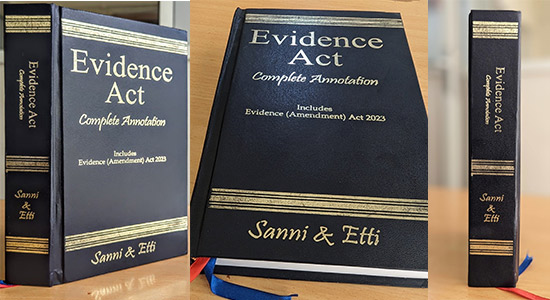
Available now for NGN 40,000 at ASC Publications, 10, Boyle Street, Onikan, Lagos. Beside High Court, TBS. Email publications@ayindesanni.com or WhatsApp +2347056667384. Purchase Link: https://paystack.com/buy/evidence-act-complete-annotation
______________________________________________________________________ “Enhance Legal Practice With Authoritative Reports” — Alexander Payne Offers Comprehensive Law Reports, Spanning Over A Century Of Nigerian Jurisprudence Interested buyers are encouraged to place their orders and enquiries via:
0704 444 4777, 0704 444 4999, 0818 199 9888
Website: www.alexandernigeria.com
“A Comprehensive Guide To Evidence Law” — Releases Second Edition In Three Volumes, Covering 4,051 Cases
For enquiries and orders, contact: 08035526491 Email: jerryamadisilk@gmail.com
 Prof. Jerry Amadi’s Evidence Law, Second Edition (2026), contains 3,314 pages in three volumes, covering the Evidence Act 2011, its 2023 amendment, and 4,051 Nigerian and English cases.