President Bola Tinubu has asked the House of Representatives to approve the implementation of the Federal Government’s ₦10.79 trillion external borrowing plan already provided for in the 2026 Appropriation Act.

The request, conveyed in a letter read by Speaker Tajudeen Abbas during Wednesday’s plenary, covers $7.71 billion at the budget exchange rate of ₦1,400 to the dollar.
Tinubu explained that the proposed borrowing would partly finance the Federal Government’s 2026 budget deficit and satisfy the requirements of Sections 21(1) and 27(1) of the Debt Management Office Establishment Act, 2003.
The President said the external borrowing was already captured in the 2026 Appropriation Act as part of the ₦29.22 trillion approved new borrowing for the year, comprising ₦18.28 trillion in domestic borrowing and ₦10.79 trillion in external financing.
“I write to request for the permission of the House of Representatives to implement the new external borrowing plan contained in the 2026 Appropriation Act in the sum of ₦10,790,366,835,481, which is equivalent to $7,707,404,882.49 at the budget exchange rate of $1 to ₦1,400, for the part-financing of the budget deficit,” Tinubu said.
The President told the House that the Federal Government would explore different financing options simultaneously, taking into consideration the cost to the country and the time required to access the funds.
He, however, indicated that greater emphasis would be placed on Eurobond issuance because it could be concluded relatively faster.
“All options will be pursued simultaneously considering the cost-benefit to the country as well as the time required to access the funds. In view of this, emphasis will be on the issuance of Eurobonds, which is typically faster to conclude,” he said.
Tinubu added that the final terms of any Eurobond issuance would depend on prevailing market conditions at the time the funds were raised.
He assured the House that the Ministry of Finance and the Debt Management Office would work to secure favourable terms in the international market.
According to the President, the proposed external loans would finance projects and programmes contained in the 2026 budget, particularly in defence and security, transportation, agriculture, power, education and health.
Tinubu also said the borrowing would help strengthen Nigeria’s external reserves and support the naira, with the proceeds to be received by the Central Bank of Nigeria on behalf of the Federal Government.
The President asked the House to authorise the government to raise the funds through multilateral and bilateral institutions, conventional and commercial lending windows, the International Monetary Fund, bridge-financing facilities and Eurobond issuance.
He also sought approval for the Minister of Finance and Coordinating Minister of the Economy, working with the DMO, to take the necessary steps to implement the borrowing arrangement.
However, Speaker Abbas clarified that the President was not seeking approval for a fresh borrowing plan.
He explained that the ₦10.79 trillion external component had already been approved by the National Assembly and provided for in the 2026 Appropriation Act.
According to Abbas, the latest request was intended to fulfil the statutory requirement that the terms and conditions of external borrowing be presented to the National Assembly for approval before implementation.
The Speaker cited Section 21(1) of the DMO Act, which requires the terms and conditions of external borrowing to be presented to the National Assembly for approval by resolution.
He also referred to Section 27(1), which provides for legislative approval of standard terms and conditions for negotiating and accepting external loans.
Abbas further distinguished the request from a separate borrowing proposal by the President, stressing that the two matters would be considered independently.
“For the avoidance of doubt, this request is distinct from the President’s other borrowing request. It neither supersedes nor withdraws that request, which remains subject to consideration on its own merit,” he said.
[A MUST HAVE] Evidence Act Demystified With Recent And Contemporary Cases And Materials

Available now for NGN 40,000 at ASC Publications, 10, Boyle Street, Onikan, Lagos. Beside High Court, TBS. Email publications@ayindesanni.com or WhatsApp +2347056667384. Purchase Link: https://paystack.com/buy/evidence-act-complete-annotation
______________________________________________________________________ “Enhance Legal Practice With Authoritative Reports” — Alexander Payne Offers Comprehensive Law Reports, Spanning Over A Century Of Nigerian Jurisprudence Interested buyers are encouraged to place their orders and enquiries via:
0704 444 4777, 0704 444 4999, 0818 199 9888
Website: www.alexandernigeria.com
“A Comprehensive Guide To Evidence Law” — Releases Second Edition In Three Volumes, Covering 4,051 Cases
For enquiries and orders, contact: 08035526491 Email: jerryamadisilk@gmail.com
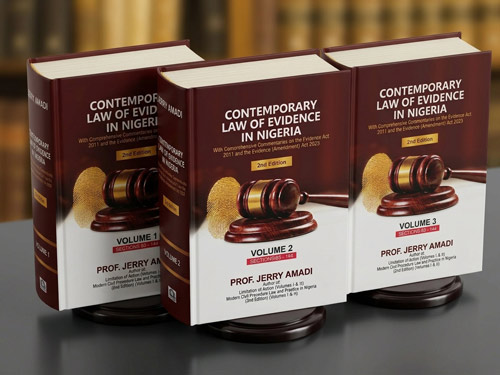 Prof. Jerry Amadi’s Evidence Law, Second Edition (2026), contains 3,314 pages in three volumes, covering the Evidence Act 2011, its 2023 amendment, and 4,051 Nigerian and English cases.