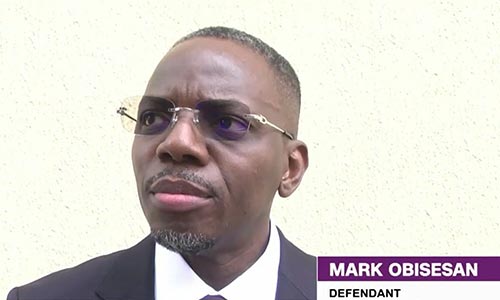
Justice Ismail O. Ijelu of the Lagos State High Court sitting in the Ikeja Judicial Division (Criminal Division) has discharged and acquitted a businessman, Mark Obisesan, and three other persons charged by the Economic and Financial Crimes Commission (EFCC) for purchasing forged bank notes and conspiracy.

The judgment, delivered on Thursday, September 26, 2024, in Charge No. ID/11251C/2020, dismissed all eleven counts preferred against the defendants after the court found that the EFCC was unable to prove its case beyond reasonable doubt.
Obisesan and his co-defendants — Olumide McIntosh, Bolaji Bakare, and Goodluck Bazunu — had been standing trial before the court since 2019 following allegations of possessing forged United States dollar traveller’s cheques and conspiracy to purchase forged bank notes.
Upon an amended Information dated January 22, 2020, the four defendants were charged for an eleven-count charge of Purchasing Forged Bank Notes contrary to Section 370 of the Criminal Law of Lagos State of Nigeria No. 11 of 2011 and Conspiracy to Purchase Forged Bank Notes contrary to Section 410 of the same law.
The first ten counts related to the alleged possession of forged United States dollar American Express Traveller’s Cheques with serial numbers GA908-981-564, GA908-981-566, GA908-981-560, GA908-981-558, GA908-981-548, GA908-981-547, and GA908-981-567, among others.
The eleventh count charged the defendants with conspiracy to purchase and possess forged United States dollar travellers cheques.
A fifth defendant, Josiah Ntekume, was listed in the charge as “at large.”
The defendants were re-arraigned on February 16, 2023, on an amended Information and pleaded Not Guilty. They were permitted to continue their earlier bail conditions granted by Solebo J. (retired), and the case was set down for trial. Trial commenced on April 3, 2023.
The prosecution called three witnesses and tendered 22 exhibits.
PW1: Olukinni Olufemi — PW1, an investigator with the EFCC, led the investigation into the defendants suspected of internet fraud. In December 2019, PW1 and his team searched the first defendant’s house, recovering items like traveller’s checks, a Ferrari car, phones, passports, and other documents.
The first defendant claimed the traveller’s checks were fake and purchased from the second defendant. PW1’s team arrested the second defendant, who stated that he obtained the traveller’s checks from the third defendant. The third defendant and fourth defendant were subsequently arrested.
PW1’s investigation involved writing to banks and the forensic department to verify the authenticity of the traveller’s checks. The findings revealed that the 10 American Express Traveller’s checks were fake, while a $100 Thomas Cook Traveler’s check was genuine.
During cross-examination by the first defendant’s counsel, PW1 acknowledged that they did not find conclusive evidence of internet fraud and had not prosecuted the first defendant for it. PW1 also admitted that they did not investigate the ownership of various items seized from the first defendant thoroughly and that some items might not belong to the first defendant.
PW1 further stated that they did not find any prior relationship between the first defendant and the third defendant, and did not find direct communication or connections between the first defendant and the third and fourth defendants, but noted an indirect chain relationship through the second defendant.
PW2: Ayotunde Solademu — PW2, a Foreign Service National Investigator with the FBI, received a letter from the EFCC requesting assistance in verifying the authenticity of 11 traveller’s checks. He worked with his team to send the checks to the American Express Traveler’s Cheque Authentication Center. After discussing the matter with the center’s fraud department, they confirmed that the checks were not genuine. The FBI sent a response to the EFCC, dated January 29, 2020, stating that the checks were not genuine and did not appear to be so.
During cross-examination by the first defendant’s counsel, PW2 confirmed that the FBI contacted the American Express Traveler’s Cheque Authentication Center to verify the checks and that they responded that the checks were not genuine. PW2 also stated that they could not have concluded the checks were fake without sending them for analysis.
During cross-examination by the second defendant’s counsel, PW2 stated that they do not personally conduct examinations and rely on experts. When shown the traveller’s checks (Exhibit P8 and P9), PW2 could not determine their authenticity without proper analysis.
During cross-examination by the third defendant’s counsel, PW2 replied that they did not receive the original checks, only photocopies. PW2 explained that they relied on the numbers and phone calls to the authentication center to determine the checks were fake.
PW3: Bamaiyi Haruna Meriga — PW3, a Forensic Document Examiner with the EFCC, analyzed 10 American Express traveler’s checks and 1 Mastercard traveler’s check. He found that the American Express checks were counterfeit, lacking security features such as watermarks, security threads, and microprints. In contrast, the Mastercard check possessed all the expected security features and was deemed genuine.
During cross-examination by the first defendant’s counsel, PW3 acknowledged that the manufacturers of the traveller’s checks may have their own procedures for authentication, different from those used by the witness. PW3 also stated that a normal person may not be able to determine authenticity by touch alone.
During cross-examination by the third defendant’s counsel, PW3 acknowledged that they had not consulted the FBI but had consulted the American Embassy, which was not reflected in the report.
The prosecution ended its case after PW3’s evidence.
On January 18, 2024, when the defence was to open, counsel to the fourth defendant informed the Court that the fourth defendant was deceased. Although the prosecutor said he would confirm the death of the fourth defendant, he never informed the Court of the result of his confirmation. Therefore, in the absence of any evidence to the contrary, the Court accepted as true that the fourth defendant is deceased. Consequently, his name was struck out of the charge.
DW1: Mark Obisesan — DW1, the first defendant, testified that he purchased traveller’s checks from DW2, paying him through bank transfers. He sent the checks to a friend in the UK, who reported that they were fake. DW1 then asked DW2 for a refund, but DW2 did not respond.
During cross-examination by the prosecution, DW1 admitted that he had no expertise in determining the authenticity of currency or traveller’s checks. He stated that he could not tell if the traveller’s checks or a 500 naira note were genuine or fake just by looking at them.
DW1 also acknowledged that he did not verify the authenticity of the checks before sending them to the UK, had no prior dealings with the second defendant before purchasing the traveller’s checks, did not know the third defendant and had no direct dealings with him, and did not report the incident to the police or EFCC.
DW2: Olumide McTouch — DW2 testified that he met the third defendant in Abuja, who introduced him to American Express traveller’s checks. He then contacted his longtime friend, Mark Obisesan (the first defendant), and advised him to purchase a small quantity to verify their authenticity.
During cross-examination by the prosecution, DW2 admitted that he had no previous experience in dealing with foreign negotiable instruments and was not registered with the Nigerian government to deal with such instruments. DW2 also clarified that he had only found that dealing with traveller’s checks was not illegal but acknowledged that he had not inquired about the necessary procedures or licenses required to deal with traveller’s checks in Nigeria.
DW2 also acknowledged that he did not provide any documentation or proof of authenticity to the first defendant.
DW3: Bakare Kabir Bolaji — DW3 testified that he is a businessman with various interests. He met the second defendant at a restaurant in Abuja, where they discussed their respective businesses. He mentioned that he could facilitate the sale of traveller’s checks if DW2 knew anyone interested. DW2 later contacted DW3 about a friend, Mark Obisesan (the first defendant), who wanted to purchase traveller’s checks.
During cross-examination by the prosecution, DW3 admitted that he had no knowledge or experience in dealing with foreign negotiable instruments. DW3 acknowledged that he was aware of the requirement to deal through a certified agent but claimed he was not aware if he needed to be one himself.
DW3 also acknowledged that he did not know the first defendant and had no direct dealings with him, did not verify the authenticity of the checks, did not know the source of the traveller’s checks, and did not report the incident to the authorities.
After reviewing the evidence and final written addresses, the Court adopted the prosecution’s sole issue for determination: Whether, based on the totality of evidence before the Court, the prosecution has adduced sufficient credible evidence to prove the defendants’ guilt beyond reasonable doubt for the offences charged.
Justice Ijelu noted that pursuant to Section 135(1) of the Evidence Act, 2011, the commission of a crime by a party must be proved beyond reasonable doubt in any proceeding, civil or criminal. The burden of proving guilt or wrongful act lies on the person asserting it. The combined provisions of Section 135(2) of the Evidence Act and Section 36(5) of the 1999 Constitution place the burden of proof in criminal cases on the prosecution, who must prove its case beyond reasonable doubt and rebut the presumption of innocence guaranteed to the accused.
The Court noted that it was not in contention that Exhibits P8 (A-J) are forged. The first defendant unequivocally narrated how after purchasing them from the second defendant, he discovered through his friend that Exhibits P8 (A-J) were fake. The first to third defendants stated that they did not know that Exhibits P8 (A-J) were false when they were purchased.
The Court stated that the prosecution’s expert witness admitted under cross-examination that it was difficult to identify fake travellers’ cheques through the ordinary eyes even by forensic experts unless brought under the radar of machines designed for such purpose. Credence was further accorded to the denial of awareness by the defendants that there was no way the defendants would have known that Exhibit P8 (A-J) were fake or forged, creating a “profound doubt” in the mind of the Court.
The Court stated that the investigation done by the prosecution “leaves so much to be desired” and described it as “an incomplete investigation.” The actual culprit that forged the documents (Exhibit P8A-J) for which the defendants were charged was not brought before the court and no reason was given.
From the evidence before the Court, the first defendant “can be likened to an innocent purchaser for value without notice that he purchased fake products.”
The Court further noted that the prosecution consistently mentioned that the deceased fourth defendant, Josiah Itekume, was the person who procured the forged cheques. The prosecution witness testified under cross-examination that he was aware that this person was arrested at some point during investigation. No reason was adduced for not bringing him to court as the culprit in the case.
The Court held: “It is left to be seen how the prosecution expected to succeed when the actual culprit who is the genesis of crime is left loose and not brought to Court to face justice and probably also assist the court one way or the other to do effective justice.”
The Court stated that Josiah Itekume “is a vital witness in this case and failure to call him to give evidence is fatal to the case of the prosecution.”
The Court held that in the instant case, it was not useful for the prosecution to establish the essential elements of the offence of forgery, noting that even if it had, given the evidence on record, the prosecution failed to establish that the forgery was by the accused person, that the accused person knew that the document or writing is false, and that the accused intended the forged document to be acted upon to the prejudice of the victim in the belief that it is genuine.
The Court held that by the prosecution’s failure to prove the mental element of the charge against the defendants, the threshold of proof beyond reasonable doubt has not been attained.
On the eleventh count relating to conspiracy, the Court noted that conspiracy to commit an offence is a separate and distinct offence and it is independent of the actual commission of the offence to which the conspiracy is related. Where the prosecution fails to prove the substantive offence in a charge for conspiracy, the offence of conspiracy cannot stand.
“In the final analysis, the finding of the Court is that the 1st, 2nd and 3rd defendants have not been connected to the offences charged. There are no credible evidence from the prosecution on which the offence of forgery and conspiracy could be sustained against the 1st, 2nd and 3rd defendants,” Justice Ijelu held.
“The prosecution has failed woefully to prove any of the eleven counts charge in this case against the defendants beyond reasonable doubt. All the doubts created in this case must be resolved in favour of the defendants.”
“Accordingly, the eleven count charge preferred against the 1st – 3rd defendants in this charge are dismissed and the 1st, 2nd and 3rd defendants are hereby discharged and acquitted.”
Following the verdict, Obisesan expressed relief and frustration, saying, “It’s sad that the EFCC chose to waste state resources on a case they knew had no merit. Such poorly investigated cases should not be taking the time of hardworking judges.”
Obisesan highlighted the personal and professional toll of the five-year legal ordeal, citing lost relationships and business opportunities. He however expressed relief at finally being able to clear his name after half a decade of legal battles.
The EFCC had earlier announced the arrest of Obisesan at its Lagos zonal office for possession of suspected fake traveller’s cheque worth $10,000.
The anti-graft commission disclosed this in a statement issued by its spokesperson, Mr Wilson Uwujaren, who said the suspect, who had served a 12-month jail term for internet fraud in the UK, was arrested at his residence in Banana Island, Lagos, following intelligence from concerned members of the public about his alleged criminal activities.
“At the point of arrest, a Ferrari 488 car, two iPhones, one Samsung phone, a laptop, and Automated Teller Machine cards were recovered from the suspect, whom investigation revealed does not have any known source of livelihood,” the EFCC had stated.
THE FEDERAL REPUBLIC OF NIGERIA .V. MARK OBISESAN & ORS JUDGMENTE.S. Okongwu holding brief of N.K. Ukoha appeared for the prosecution. P. Akhilomen with S. Amolegbe appeared for the first defendant. B. Akpe appeared for the second defendant. N.T. Adebagbo with A.O. Sotayo appeared for the third defendant.

 ARTIFICIAL INTELLIGENCE FOR LAWYERS: A COMPREHENSIVE GUIDE
Reimagine your practice with the power of AI “...this is the only Nigerian book I know of on the topic.” — Ohio Books Ltd
Authored by Ben Ijeoma Adigwe, Esq., ACIArb (UK), LL.M, Dip. in Artificial Intelligence, Director, Delta State Ministry of Justice, Asaba, Nigeria.
Bonus:
Get a FREE eBook titled “How to Use the AI in Legalpedia and Law Pavilion” with every purchase.
ARTIFICIAL INTELLIGENCE FOR LAWYERS: A COMPREHENSIVE GUIDE
Reimagine your practice with the power of AI “...this is the only Nigerian book I know of on the topic.” — Ohio Books Ltd
Authored by Ben Ijeoma Adigwe, Esq., ACIArb (UK), LL.M, Dip. in Artificial Intelligence, Director, Delta State Ministry of Justice, Asaba, Nigeria.
Bonus:
Get a FREE eBook titled “How to Use the AI in Legalpedia and Law Pavilion” with every purchase.
How to Order: 📞 Call, Text, or WhatsApp: 08034917063 | 07055285878 📧 Email: benadigwe1@gmail.com 🌐 Website: www.benadigwe.com
Ebook Version: Access directly online at: https://selar.com/prv626
________________________________________________________________________ The Law And Practice Of Redundancy In Nigeria: A Practitioner’s Guide, Authored By A Labour & Employment Law Expert Bimbo Atilola _______________________________________________________________________
New Year Promo: Get Five Maritime Law Books For N150,000 — 63% Discount
_______________________________________________________________________
New Year Promo: Get Five Maritime Law Books For N150,000 — 63% Discount
 The promotion, which commenced on January 8 and runs until February 8, 2026, offers five core maritime law books authored by Dr. Emeka Akabogu, SAN, ordinarily valued at N405,000, for just N150,000 — a 63% discount.
Interested buyers can place their orders through the following channels:
Phone: 0704 329 3271
Online Store: https://paystack.shop/aa-bookstore
Website: www.akabogulaw.com
______________________________________________________________________
The promotion, which commenced on January 8 and runs until February 8, 2026, offers five core maritime law books authored by Dr. Emeka Akabogu, SAN, ordinarily valued at N405,000, for just N150,000 — a 63% discount.
Interested buyers can place their orders through the following channels:
Phone: 0704 329 3271
Online Store: https://paystack.shop/aa-bookstore
Website: www.akabogulaw.com
______________________________________________________________________