*Says INEC Should Deregister Parties That Can’t Organize Under Section 225A Constitution

Former INEC National Commissioner and constitutional lawyer, Mr. Festus Okoye, has weighed in on the Labour Party leadership crisis, declaring that any political party that cannot settle its leadership disputes is not fit to endorse candidates in an election.
Okoye cautioned Nigerian courts to stop interfering in the internal crises of political parties, insisting that the Supreme Court’s April 2025 ruling in Usman v. Labour Party has definitively established that leadership disputes are not justiciable matters.
He was however quick to add that such disputes are issues that parties must resolve strictly through their own constitutions and internal mechanisms.
The Labour Party (LP), once described as one of Nigeria’s fastest-rising opposition platforms after the 2023 general elections, is now deeply entangled in a prolonged leadership crisis that has tested the limits of judicial intervention, party constitutionalism, and political cohesion.
At the heart of the crisis are competing claims to legitimacy between the Julius Abure-led National Working Committee (NWC) and a Caretaker Committee associated with former Minister of Finance, Senator Esther Nenadi Usman.
The controversy has now entered another critical phase following the latest judgment of the Federal High Court sitting in Abuja, which recognised the Nenadi Usman-led caretaker arrangement, a decision the Abure leadership has vowed to challenge at the Court of Appeal.
The party’s post-2023 surge was largely driven by public disillusionment with Nigeria’s two dominant parties and the candidacy of Peter Obi, whose presidential run galvanised millions of young voters and urban professionals.
However, rather than consolidate this momentum into strong institutional growth, the party soon became mired in internal disputes over leadership, control of party structures, and ideological direction.
One of the most significant turning points in the party’s crisis was the decision of the Court of Appeal, which at a time recognised the Abure-led NWC as the authentic leadership of the party.
That ruling appeared to settle the matter, at least temporarily, by affirming the authority of the party’s elected national officers.
However, the legal dispute did not end there. Esther Nenadi Usman and her allies approached the Supreme Court, not necessarily to enthrone an alternative leadership, but to challenge the competence of the lower courts to make pronouncements on party leadership in the first place.
And in its April 4, 2025 judgment, the Supreme Court declined jurisdiction, holding firmly that issues relating to party leadership are internal affairs over which courts should not ordinarily exercise authority.
Ironically, the Supreme Court did not dissolve the Abure-led NWC, it did not also declare that its tenure had expired, and did not order the establishment of a caretaker committee.
Instead, it reinforced a long-standing judicial principle: courts do not appoint leaders for political parties.
This distinction has since become the core of the party’s argument against the latest FCT High Court ruling.
In an interview, Okoye stated: “The High Courts and the Federal High Courts must recognise the superior jurisdiction of the Supreme Court of Nigeria. The decisions of the Supreme Court are sacred and sacrosanct. The High Courts and the Federal High Court should adhere to the doctrine of ‘Stare decisis’ and follow the precedent set by the Supreme Court of Nigeria, avoiding the temptation to evade issues before them to assume jurisdiction.”
“If a court lacks jurisdiction over a matter, it must be brave enough to dismiss the case and decline jurisdiction. It is a serious breach of judicial hierarchy and respect for the Supreme Court for a lower court to interfere with, interpret, alter, or circumvent the Supreme Court’s decisions,” Okoye said.
“Lower courts must not succumb to pressure from desperate Nigerian politicians or become part of the challenge to democracy and the electoral process. A desperate politician may go to any length to attain a specific goal or objective, take any individual or institution with them, and abandon that individual or institution once they have achieved their purpose,” he warned.
Okoye explained that in Usman v. Labour Party (2025) 16 NWLR, Part 2010, the Supreme Court of Nigeria emphasised that the Courts have jurisdiction over pre-election matters falling within the scope and limitations of section 285(14) of the Constitution, rather than over the internal affairs of political parties.
“The Court was clear that although the matter was masked as a pre-election issue, it was primarily about who is recognised as the National Chairman of the party, which is an internal matter of the party,” he said.
Okoye quoted Hon. Justice Okolo, JSC, in Usman v. Labour Party, who advised political parties and their members to consistently ensure that their constitutions, rules, regulations, and guidelines govern the selection of their officers and candidates.
“This approach would help minimise the frequent internal disputes that often escalate to court. If a political party’s constitution stipulates a specific term for an officer’s tenure, such an officer should humbly step down once that term expires,” he said.
Okoye also cited Justice Ogunwumiju, JSC, who stated in the same case that “a political party is like a club or association you join of your own free will. Of course, it has its own constitution, rules, and guidelines, just like any other association.”
“The fact that the stakes are high when it comes to the election of the party’s leadership or executive, which makes decisions for other members, does not negate the fact that party members must learn to obey the rules of their party, to which they voluntarily subscribed. Most free associations do not permit outsiders, such as the judiciary, to determine who manages their affairs. The courts will no longer act as peacemakers where the internal wrangling of a political party is concerned,” he quoted.
Asked how the Abuja High Court was able to assume jurisdiction and rule in favour of Senator Nenadi Usman’s caretaker committee given the Supreme Court’s earlier position, Okoye said: “I am not sure of the facts of the case before the Abuja High Court and am not in a position to offer any opinion on it.”
However, he stated: “My stance remains that the courts must compel political parties to mature. Political parties, their leaders, and members must cease resorting to court when they intentionally and maliciously refuse to comply with the constitution, rules, and regulations of their party.”
“If you are elected for a four-year term, you must vacate office after four years. If the party’s constitution includes conflict resolution procedures, members are obliged to follow those rather than rushing to court. The courts must allow unserious parties to bury themselves and, from their ashes, emerge ideologically based parties with clear focus, objectives, and seriousness, geared towards the welfare and interests of the people of Nigeria,” Okoye said.
On what exactly qualifies as an ‘internal party affair’ of a party, Okoye explained: “The Supreme Court, as the guardian of the Constitution, has consistently defined and outlined issues considered internal to a political party. The Court has made it clear that a political party is supreme over its own affairs.”
“It has been stated that every member of a political party must remain loyal, follow the party’s rules and regulations, and respect the party’s decisions to continue within the party. In this regard, matters concerning who constitutes the leadership of the party fall squarely within the internal affairs of the party and are, therefore, not subject to judicial review,” he said.
Okoye cited Oye vs Odidan (2025) 19 NWLR, Part 2020, where the Supreme Court explicitly stated that “A dispute as to who should be the chairman of a political party is within the confines of the internal affairs of the party and is therefore not justiciable. Any issue relating to who parades himself as the chairman of a political party cannot be the business of the court. The courts will only interfere where the party violates its own rules.”
Asked whether the Supreme Court would even entertain another appeal on the same leadership issue given its April 2025 ruling, Okoye said: “Each case has its own peculiarities, and the Supreme Court will consider each matter based on the facts and issues presented.”
“The Supreme Court will examine the issue of jurisdiction and decide whether the lower court had the authority to hear the case. It will review the facts to determine whether the matter pertains to the internal affairs of the party or if the party has violated its own constitution, rules, and guidelines. Furthermore, the court will evaluate whether the matter before it amounts to an abuse of process,” he explained.
“The Supreme Court may also decide whether the lower court adhered to the principles of stare decisis or res judicata, which presuppose that a lower court is bound by and has a judicial duty to follow and apply the decisions of higher courts in the judicial hierarchy where the facts and issues in the earlier cases are the same or substantially and materially similar,” Okoye added.
On the implications of this legal uncertainty for the Labour Party’s participation in future elections, Okoye stated: “Political parties must clearly define and communicate their purpose. A party that becomes invisible or unable to operate according to the dictates of constitutional and legal rules governing political entities effectively becomes an association.”
“If a political party cannot organise itself properly and nominate candidates for elections, it must be deregistered by INEC in accordance with section 225A of the Constitution. It has no business being referred to as a political party. It is the duty of the electoral management body to uphold the law and the constitution impartially in its interactions with political parties,” he said.
“A political party that cannot settle its leadership disputes is not fit to endorse candidates in an election. Courts must stop unjustifiably interfering in political parties and let them develop independently,” Okoye declared.

Get your copy today and take the first step toward financial growth:👉 https://selar.co/4f16676016
_______________________________________________________________________ The Law And Practice Of Redundancy In Nigeria: A Practitioner’s Guide, Authored By A Labour & Employment Law Expert Bimbo Atilola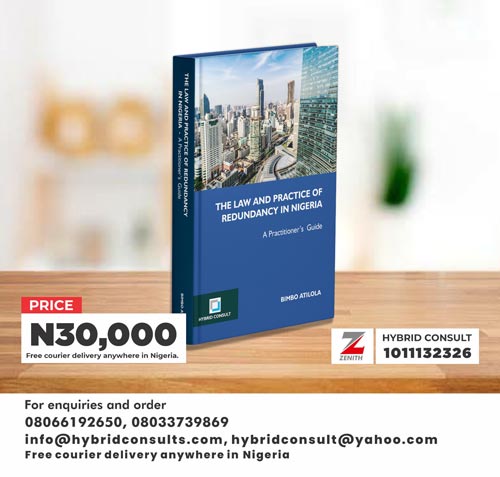 _______________________________________________________________________
[A MUST HAVE] Evidence Act Demystified With Recent And Contemporary Cases And Materials

Available now for NGN 40,000 at ASC Publications, 10, Boyle Street, Onikan, Lagos. Beside High Court, TBS. Email publications@ayindesanni.com or WhatsApp +2347056667384. Purchase Link: https://paystack.com/buy/evidence-act-complete-annotation
______________________________________________________________________ ARTIFICIAL INTELLIGENCE FOR LAWYERS: A COMPREHENSIVE GUIDE
Reimagine your practice with the power of AI “...this is the only Nigerian book I know of on the topic.” — Ohio Books Ltd
Authored by Ben Ijeoma Adigwe, Esq., ACIArb (UK), LL.M, Dip. in Artificial Intelligence, Director, Delta State Ministry of Justice, Asaba, Nigeria.
Bonus:
Get a FREE eBook titled “How to Use the AI in Legalpedia and Law Pavilion” with every purchase.
ARTIFICIAL INTELLIGENCE FOR LAWYERS: A COMPREHENSIVE GUIDE
Reimagine your practice with the power of AI “...this is the only Nigerian book I know of on the topic.” — Ohio Books Ltd
Authored by Ben Ijeoma Adigwe, Esq., ACIArb (UK), LL.M, Dip. in Artificial Intelligence, Director, Delta State Ministry of Justice, Asaba, Nigeria.
Bonus:
Get a FREE eBook titled “How to Use the AI in Legalpedia and Law Pavilion” with every purchase.
How to Order: 📞 Call, Text, or WhatsApp: 08034917063 | 07055285878 📧 Email: benadigwe1@gmail.com 🌐 Website: www.benadigwe.com
Ebook Version: Access directly online at: https://selar.com/prv626