The Executive Chairman of the Nigeria Revenue Service (NRS), Dr. Zacchaeus Adedeji, has urged Nigerians to study the new tax laws carefully and assess how the changes affect them individually, rather than relying on speculation or social media narratives.

Adedeji made the call on Sunday during an interview on Arise Television, where he said rumours and calls for mass action were being driven by misrepresentation of the tax reforms rather than a proper understanding of their provisions.
According to him, public discourse should be guided by facts and data, not emotions or mob pressure.
“The message to Nigerians is simple: don’t listen to rumours. Analyse the data as it affects you and wait to see the results, not mass or mob action,” he said.
The NRS boss dismissed calls for the suspension of the tax laws, describing such demands as unconstitutional. He noted that legislation duly passed by the National Assembly cannot be halted by individuals, groups, or public pressure, except under clearly defined emergency conditions.
“When people say they want to suspend the law, so does that mean the whole law has been repealed? When you suspend this one, we should not collect revenue for three years. What will happen to Nigeria? And when they say suspend, people forget that we subscribe ourselves to democracy where there are rules of law. So no individual, except you are under emergency, can suspend the law,” he stated.
He explained that the tax reform bills underwent extensive consultations before becoming law, including public hearings at the National Assembly that lasted over six months. Adedeji said concerns about the laws could only be addressed through amendments, not suspension.
Ruling out any pause in implementation, he disclosed that the reforms have already taken effect and early results are beginning to emerge, even as agitation for protests grows.
“I am using this opportunity to call on all security agencies to be on alert,” he said.
Adedeji argued that the protests were unlikely to be driven by the poor, whom the reforms are designed to protect, but by individuals opposed to the policy’s intended benefits.
“You will definitely know that can never be the poor that the reform is protecting. These are patriotic Nigerians that they just want to frustrate the benefits of this reform,” he added.
Responding to allegations of discrepancies in the tax laws, Adedeji dismissed such claims as rumours, insisting that the proper lawmaking process was followed.
“When you talk about controversy and everything, it happened with all change in the world because you have certain people that prefer the status quo, you have some people that just don’t want you to succeed. So all those things are expected and there should not be anything that should distract us from the re-focus of the reform,” he said.
“So if you ask me, we don’t have any controversy whatsoever because the Nigerian constitution stipulated what each arm of government should do and in this instance, I think that has been properly done. As of today, we have the gazetted law as passed by National Assembly which is the duty of us as revenue administrator to implement.”
The NRS chairman emphasised that the essence of the tax reform is about taxing rights, not taxing more.
“We just want to tax right, fairness, transparency, and then consolidate the whole system in order to simplify and unify the process of revenue administration,” he explained.
Quoting President Bola Tinubu, Adedeji said: “I’m not going to tax poverty, I want to tax prosperity. I want to tax the fruit, so I’m not going to just go and face investments. I only want to tax return.”
On the benefits of the reform, Adedeji noted that ninety-five percent of poor Nigerians have been exempted from tax obligations under the new laws.
“When you have a reform that exempted almost everything that has to do with ninety-five percent of poor people and someone is still talking that this is not the right policy, you begin to wonder whether they’ve not read it,” he said.
Addressing concerns about the transition from the Federal Inland Revenue Service to the Nigeria Revenue Service, Adedeji assured Nigerians that the agency is prepared for seamless implementation.
“We are prepared, we are ready. Most of those manual activities that encourage human intervention have been removed totally. A dedicated department is now for technology because we know the future actually belongs to data-driven organizations,” he said.
He assured that there would be no glitches in the system, noting that contingency plans have been put in place.
“Even if there will be glitches, there are alternatives. We have contingency plans because we are administrators,” he added.
The tax laws took effect on January 1, alongside the unveiling of the new corporate identity of the Nigeria Revenue Service, formerly the Federal Inland Revenue Service, amid mixed reactions nationwide.
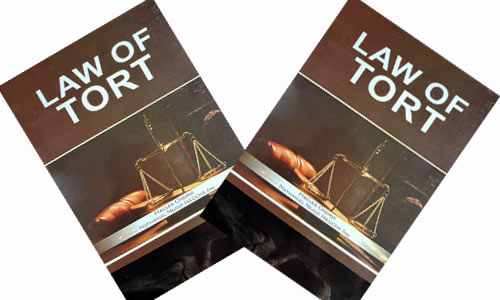 The book, titled The Law of Torts in Nigeria: A Functional Approach, authored by Professor Hagler Sunny Okorie Ph.D and Ikeocha, Nathaniel Ngozi Esq, offers law students, practitioners, and academics a comprehensive guide to understanding and applying tort law in Nigerian courts. Interested buyers can place orders via the following contact numbers: 08028636615, 08037667945, 08032253813, or +234 902 196 2209.
______________________________________________________________________
[A MUST HAVE] Evidence Act Demystified With Recent And Contemporary Cases And Materials
The book, titled The Law of Torts in Nigeria: A Functional Approach, authored by Professor Hagler Sunny Okorie Ph.D and Ikeocha, Nathaniel Ngozi Esq, offers law students, practitioners, and academics a comprehensive guide to understanding and applying tort law in Nigerian courts. Interested buyers can place orders via the following contact numbers: 08028636615, 08037667945, 08032253813, or +234 902 196 2209.
______________________________________________________________________
[A MUST HAVE] Evidence Act Demystified With Recent And Contemporary Cases And Materials

 ARTIFICIAL INTELLIGENCE FOR LAWYERS: A COMPREHENSIVE GUIDE
Reimagine your practice with the power of AI “...this is the only Nigerian book I know of on the topic.” — Ohio Books Ltd
Authored by Ben Ijeoma Adigwe, Esq., ACIArb (UK), LL.M, Dip. in Artificial Intelligence, Director, Delta State Ministry of Justice, Asaba, Nigeria.
Bonus:
Get a FREE eBook titled “How to Use the AI in Legalpedia and Law Pavilion” with every purchase.
ARTIFICIAL INTELLIGENCE FOR LAWYERS: A COMPREHENSIVE GUIDE
Reimagine your practice with the power of AI “...this is the only Nigerian book I know of on the topic.” — Ohio Books Ltd
Authored by Ben Ijeoma Adigwe, Esq., ACIArb (UK), LL.M, Dip. in Artificial Intelligence, Director, Delta State Ministry of Justice, Asaba, Nigeria.
Bonus:
Get a FREE eBook titled “How to Use the AI in Legalpedia and Law Pavilion” with every purchase.
How to Order: 📞 Call, Text, or WhatsApp: 08034917063 | 07055285878 📧 Email: benadigwe1@gmail.com 🌐 Website: www.benadigwe.com
Ebook Version: Access directly online at: https://selar.com/prv626
________________________________________________________________________ The Law And Practice Of Redundancy In Nigeria: A Practitioner’s Guide, Authored By A Labour & Employment Law Expert Bimbo Atilola _______________________________________________________________________