An original precedent creates or lays down a new rule of law for the first time. A declaratory precedent on the other hand declares the position of an already existing law and does not create a new law, while a derivative precedent extends an existing rule of law to new facts or issues. An indispensable corollary to judicial precedent is the doctrine of ‘stare decisis,’ which means courts must follow what has been decided previously in a case. Accordingly, it has been stated by the Supreme Court of Nigeria that stare decisis is a basic principle of the administration of justice which stipulates that like cases should be decided alike. In the recent case of Oladeji (Nig) Ltd. v. N.B. C. Plc., the Supreme Court stated that in reality there can hardly be any two cases where the facts are exactly the same, but that the doctrine of stare decisis does not stipulate that the facts must exactly be same. It agreed that there may be differences, but that these may be minute and so will not necessarily prevent the application of the doctrine, and that a major criterion in resolving the matter before the court is that the facts of the previous case are major, substantial and material to the facts of the present case begging for the application of the previously decided case. In the practical application of the doctrine of judicial precedent, the Court of Appeal is absolutely bound by the judgments of the Supreme Court which is the final court in Nigeria. The Court of Appeal is also bound by its own (previous) decisions. The Federal and State High Courts (including those of the Federal Capital Territory, Abuja), the Sharia and Customary Courts of Appeal (including those of the Federal Capital Territory, Abuja), the National Industrial Court and the Investment and Securities Tribunal, are courts of co-ordinate jurisdiction and are absolutely bound by the judgments of the Supreme Court and the Court of Appeal. They are also bound by their own previous decisions. The Magistrate Courts in the Northern and Southern parts of Nigeria, and the District Courts in the North, as well as the Area Courts in the North, and the Customary Courts in the South are absolutely bound by the decision of all the superior Courts of record enumerated in the preceding paragraph. They are however not bound to follow their previous decisions. The Supreme Court of Nigeria is bound by its previous judgments, but not absolutely. This means that it has the power to overrule its previous decision if: (i). it was given per incuriam (in ignorance of some statutory provision or other authority hinging on it; (ii) in the opinion of the Court the previous case was wrongly decided; and (iii) it is satisfied that the continued existence of the previous decision would perpetuate uncertainty in the law or cause hardship and injustice to parties. The Supreme Court has held in the case of Oladeji (Nig.) Ltd. v. N.B. Plc that decision of English courts or any other foreign courts are not binding on Nigerian courts, but that where Nigerian courts have followed a particular principle or rule of law adopted from a foreign decision over the years, such as the one in Hadley v. Baxendale or Salomon v. Salomon, then it will be erroneous to say that such principle still remains a foreign decision. The concluding part of a paper presented by George Oguntade, retired Justice of the Supreme Court (JSC) and currently Nigeria’s High Commissioner to the UK, at the maiden Hon. Justice Adolphus Karibi-Whyte Convocation Lecture of the Nigerian Institute of Advanced Legal Studies.]]>


Get your copy today and take the first step toward financial growth:👉 https://selar.co/4f16676016
_______________________________________________________________________ The Law And Practice Of Redundancy In Nigeria: A Practitioner’s Guide, Authored By A Labour & Employment Law Expert Bimbo Atilola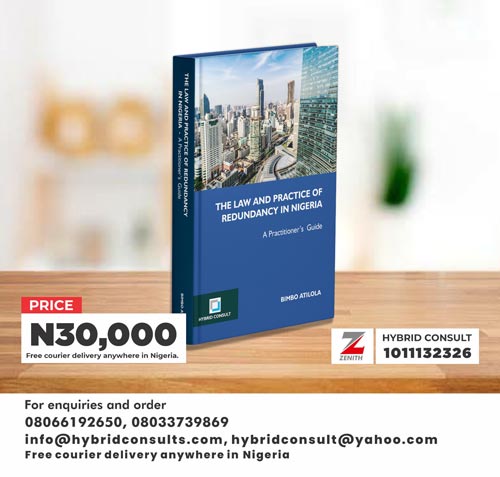 _______________________________________________________________________
[A MUST HAVE] Evidence Act Demystified With Recent And Contemporary Cases And Materials

Available now for NGN 40,000 at ASC Publications, 10, Boyle Street, Onikan, Lagos. Beside High Court, TBS. Email publications@ayindesanni.com or WhatsApp +2347056667384. Purchase Link: https://paystack.com/buy/evidence-act-complete-annotation
______________________________________________________________________ ARTIFICIAL INTELLIGENCE FOR LAWYERS: A COMPREHENSIVE GUIDE
Reimagine your practice with the power of AI “...this is the only Nigerian book I know of on the topic.” — Ohio Books Ltd
Authored by Ben Ijeoma Adigwe, Esq., ACIArb (UK), LL.M, Dip. in Artificial Intelligence, Director, Delta State Ministry of Justice, Asaba, Nigeria.
Bonus:
Get a FREE eBook titled “How to Use the AI in Legalpedia and Law Pavilion” with every purchase.
ARTIFICIAL INTELLIGENCE FOR LAWYERS: A COMPREHENSIVE GUIDE
Reimagine your practice with the power of AI “...this is the only Nigerian book I know of on the topic.” — Ohio Books Ltd
Authored by Ben Ijeoma Adigwe, Esq., ACIArb (UK), LL.M, Dip. in Artificial Intelligence, Director, Delta State Ministry of Justice, Asaba, Nigeria.
Bonus:
Get a FREE eBook titled “How to Use the AI in Legalpedia and Law Pavilion” with every purchase.
How to Order: 📞 Call, Text, or WhatsApp: 08034917063 | 07055285878 📧 Email: benadigwe1@gmail.com 🌐 Website: www.benadigwe.com
Ebook Version: Access directly online at: https://selar.com/prv626