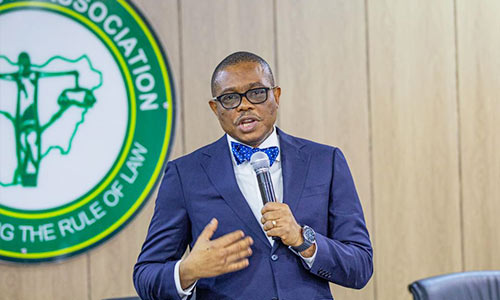
As the tenure of the current President of the Nigerian Bar Association, Mazi Afam Josiah Osigwe, SAN, winds down in August 2026, attention is returning to the manifesto on which he campaigned for office two years ago, with lawyers now expected to assess whether his administration met the expectations he set for the Bar.

Osigwe, who was sworn in as the 32nd President of the NBA on August 29, 2024, had campaigned on the theme of “A Proactive Bar,” built around identifying problems, anticipating challenges and delivering solutions for lawyers and the justice sector.
In his manifesto for the 2024–2026 NBA presidency, Osigwe promised to run a unified and inclusive Bar that would improve the standing of the Association, strengthen and unify the Bar, address lawyers’ welfare and deliver benefits to all members.
The manifesto stated that the NBA under his leadership would not “turn a blind eye” to fundamental problems affecting the legal profession and the judiciary, but would be vibrant, speak, act and constructively engage stakeholders while keeping members informed on issues affecting legal practice and their welfare.
The document grouped his agenda into three broad areas: enhancing member welfare and development, reinvigorating public confidence in the NBA, and strengthening institutional structures and efficiency.
On welfare, Osigwe promised initiatives such as an endowment fund for legal education, sponsorship of training and conferences, provision of a free online library or resource for lawyers from part of the Annual Practising Fees, annual funding for welfare and continuing professional development, protection of the legal industry from non-lawyers and foreign law firms, and the creation of a Human Rights Attorney Support Network to respond where lawyers’ rights are threatened or violated.
He also promised to deepen the benefits lawyers enjoy for paying Annual Practising Fees, including negotiating discounted rates for lawyers in hotels, airlines, restaurants and major businesses. The manifesto further promised that lawyers in both public and private practice would benefit from welfare packages such as NBA-NHIS GIFSHIP and the NBA life assurance scheme, while the administration would push for compliance with the Legal Practitioners Remuneration Order, 2023 to improve lawyers’ pay.
For young lawyers, the manifesto promised advocacy for fair compensation and benefits, work-life balance, improved practical legal training, mental health support, counselling services, stress management workshops, pilot co-working spaces in Lagos and Abuja, employment opportunities as research assistants to judicial officers, and programmes that would prepare young lawyers for the future through legal missions, exchange programmes and rule of law projects.
The manifesto also pledged human capital development through mentorship, pupillage, continuing legal education and the creation of a Pro Bono Trust Fund from which lawyers handling NBA prison decongestion matters would be paid fair and reasonable sums for court appearances. It also proposed a law firm pro bono scheme under which participating firms would commit part of their billable time to pro bono work.
On continuing professional development, Osigwe promised to make rules regulating mandatory CPD, license service providers, introduce online training modules with computer-based tests, institutionalise and reform the NBA Journal, organise specialised trainings with bodies such as WIPO, ICMC and CIArb, promote IT skills among lawyers, judges, litigants and court officers, and support branches to organise quarterly continuing legal education programmes.
On legal education, the manifesto promised to formulate the NBA’s position on legal education reform, push for review of curricula in law faculties and the Nigerian Law School, propose criteria for employment and retraining of law lecturers, improve infrastructure in Nigerian Law School campuses, involve practising lawyers in teaching at the Law School and faculties of law, and sponsor trainings and mentorship programmes for law students.
On public confidence, Osigwe promised to strengthen and reform the NBA Human Rights Institute, direct branches to undertake quarterly visits to police stations, correctional centres, SSS facilities and Joint Task Force locations, offer pro bono legal services for human rights enforcement, set up a standing litigation committee for human rights violations and public interest matters, and reposition the NBA-Security Agencies Relations Committee.
The manifesto also promised stronger anti-corruption advocacy through collaboration with the Office of the Attorney-General of the Federation, EFCC, ICPC, Police, SSS and the Army, as well as a more active role for the NBA in nation-building, public advocacy, discipline of lawyers and judicial reform.
On judicial reform, Osigwe pledged to advocate financial autonomy for the judiciary, modernise court infrastructure, support training for judges and court staff, push for justice sector reform bills, promote case management and scheduling, notification of adjournments, use of NBA email addresses in filings, customised email addresses for court registries and a judicial decision review committee to assess court decisions quarterly.
On institutional efficiency, the manifesto promised digitalisation of the Bar, effective use of Legal Mail, electronic filing and payment platforms in superior and appellate courts, amendment of laws and court rules to accommodate electronic processes and hearings, and the introduction of case management systems across courts of record in Nigeria.
The manifesto further promised licensing and an annual practice list tied not only to payment of Bar Practising Fees but also to CPD compliance, reform of the NBA Secretariat, online help centres, transparent procurement and financial systems, effective operation of secretariat directorates and continuous training of secretariat staff.
On governance, Osigwe promised that NEC meetings would be detailed and business-like, branch reports and written proposals would receive priority, NBA representatives on statutory bodies would submit periodic reports, NEC members would vote where there is no consensus, and NEC decisions would be published on the NBA website within 48 hours and sent to all members.
The manifesto also promised inclusive appointments into NBA committees and statutory bodies, with membership spread fairly among branches to avoid cronyism and parochialism, while ensuring stronger participation by female lawyers, young lawyers, in-house counsel, lawyers in public service and lawyers with disabilities.
On transparency, Osigwe promised that members would be regularly furnished electronically with the financial position and accounts of the Association, preferably monthly. He also promised policies on equal opportunities, sexual harassment and conflict of interest, professionalisation of the NBA Secretariat and insulation of secretariat staff from electoral and political processes.
For branches, the manifesto promised the reinstatement of an additional 10 per cent of Annual Practising Fees paid by lawyers in each branch into a dedicated Branch Welfare Fund, strict respect for branch democracy, non-interference in branch management and legacy projects such as an NBA Exhibition Hall, NBA Library and NBA Conference and Event Centre.
In office, supporters of the Osigwe administration may point to some initiatives as evidence of implementation. In March 2025, the NBA introduced digital Annual Practice Licences for lawyers who had paid their Bar Practising Fees, describing the initiative as part of efforts to improve professional verification and records.
At the 2025 Annual General Meeting in Enugu, the NBA reported what it called milestone achievements, including the launch of the Digital Annual Practice Licence, digitisation of the Letter of Good Standing, resolution of delays in stamp and seal production, repositioning of the Institute of Continuing Legal Education, creation of the NBA NEC Portal, the Joseph Ottey Pro Bono Scheme, the National Litigation Committee and expanded welfare support for members.
The administration also moved on continuing professional development. At the February 2025 NEC meeting, Osigwe presented draft Mandatory Continuing Professional Development Rules, 2025, aimed at linking practice eligibility to payment of Bar Practising Fees and fulfilment of CPD requirements.
Following concerns over the cost of CPD programmes, the NBA announced measures in June 2025 to make continuing legal education more accessible, including free seminars by accredited institutions and complimentary trainings organised by NBA-ICLE and local branches.
In January 2026, the NBA unveiled the Chief Kanu Agabi, SAN, NBA Co-Working Space for Young Lawyers, describing it as a welfare initiative aimed at structured learning, professional collaboration, mentorship, skills development and support for young practitioners.
In February 2026, the NBA relaunched its Digital Stamp and Seal, saying the improved process was designed to strengthen legal practice and protect the integrity of legal documents, with young lawyers between one and seven years post-call entitled to the digital stamp and seal at no cost after paying their 2026 Bar Practising Fee.
The Association also held the 2026 NBA Legal Education Summit in Abuja under the theme, “Accelerating Legal Education Reform in Nigeria: Progress, Problems and Prospects,” with Osigwe calling for legal education to become more practical, technology-driven and responsive to contemporary realities.
On branch administration, the NBA President issued directives in May 2026 on membership participation, technology utilisation and branch elections, directing branches to recognise physical, virtual and hybrid participation, avoid disenfranchising members solely on the ground of virtual attendance, maintain electronic attendance records, adopt digital membership databases and review electoral guidelines for fairness and inclusiveness.
Osigwe’s administration also took positions on issues touching the independence of the Bar. In July 2026, he rejected an alleged directive relating to the postponement of the NBA national officers’ election, insisting that only the National Executive Council of the NBA could direct the postponement of the election and that no external body had authority to dictate how the Association should conduct its internal affairs.
However, as the administration approaches its handover, many lawyers may now ask whether these reforms fully answered the promises contained in the 2024 manifesto or whether they represent only partial implementation of a wider agenda.
Questions likely to arise include whether the promised free online legal library was fully delivered; whether the welfare and legal education funds were established and transparently managed; whether discounted rates for lawyers in hotels, airlines, restaurants and major businesses became practical benefits; whether NBA-NHIS GIFSHIP and life assurance reached lawyers across all sectors; and whether the Remuneration Order has translated into better pay for young lawyers.
Lawyers may also ask whether the pilot co-working spaces promised for Lagos and Abuja were established beyond isolated initiatives; whether employment opportunities for young lawyers as research assistants to judicial officers became operational; whether the Pro Bono Trust Fund was created; whether lawyers handling prison decongestion matters were paid fair sums; and whether mental health, counselling and stress-management structures were put in place for young lawyers.
On public interest and rule of law advocacy, lawyers may examine whether the NBA Human Rights Institute was truly strengthened; whether branches actually undertook quarterly visits to police stations, correctional centres, SSS facilities and JTF locations; whether the standing litigation committee intervened effectively in human rights violations; and whether the Bar remained sufficiently vocal on national issues affecting justice, democracy and constitutional governance.
On transparency, members may ask whether the Association’s financial position and accounts were sent electronically to lawyers monthly as promised; whether NEC decisions were consistently published within 48 hours; whether NBA representatives on statutory bodies regularly reported to NEC; and whether appointments into committees reflected the promised inclusion of young lawyers, female lawyers, in-house counsel, public-sector lawyers and lawyers with disabilities.
The 2026 NBA national officers’ election controversy may also form part of the scorecard. While supporters may argue that Osigwe defended the independence of the Bar against external interference, critics may still ask whether the outgoing administration did enough to protect transparency, confidence and credibility in the Association’s own electoral process, especially amid complaints that trailed the election.
The coming 66th NBA Annual General Conference, scheduled to hold in Port Harcourt from August 21 to 28, 2026, under the theme “Beyond Limits,” is expected to provide a natural moment for lawyers to reflect on the outgoing administration’s promises, achievements, shortcomings and unfinished business.
For many lawyers, the central issue is no longer what was promised in 2024, but what can be independently verified in 2026.
The question now is whether the Osigwe administration delivered the “Proactive Bar” it promised, or whether the next NBA leadership will inherit unresolved questions around welfare, transparency, digitalisation, branch support, young lawyers’ development, electoral reform, judicial reform and institutional accountability.
As the Osigwe administration winds down, TheNigeriaLawyer invites lawyers across the country to assess the outgoing NBA leadership against the promises contained in its manifesto and share their views on whether the administration met the expectations of members of the Bar.
Download a copy of The Manifesto of Mazi Afam Josiah Osigwe,SAN.
Lawyers are encouraged to send their comments, assessments and scorecards to: thenigerialawyers@gmail.com and editor@thenigerialawyer.com.
[A MUST HAVE] Evidence Act Demystified With Recent And Contemporary Cases And Materials

Available now for NGN 40,000 at ASC Publications, 10, Boyle Street, Onikan, Lagos. Beside High Court, TBS. Email publications@ayindesanni.com or WhatsApp +2347056667384. Purchase Link: https://paystack.com/buy/evidence-act-complete-annotation
______________________________________________________________________ “Enhance Legal Practice With Authoritative Reports” — Alexander Payne Offers Comprehensive Law Reports, Spanning Over A Century Of Nigerian Jurisprudence Interested buyers are encouraged to place their orders and enquiries via:
0704 444 4777, 0704 444 4999, 0818 199 9888
Website: www.alexandernigeria.com
Interested buyers are encouraged to place their orders and enquiries via:
0704 444 4777, 0704 444 4999, 0818 199 9888
Website: www.alexandernigeria.com