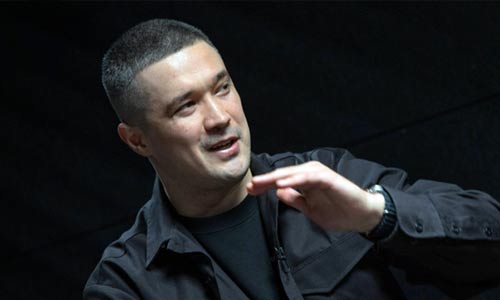
Ukraine’s recently dismissed former Defence Minister, Mykhailo Fedorov, has called for a presidential election to be held despite the continuing war with Russia, in what is being seen as the most significant political challenge to President Volodymyr Zelenskyy since Moscow launched its full-scale invasion in 2022.

Fedorov, 35, made the call in a nine-minute video address released late on Tuesday, arguing that Ukraine must find a “legal, safe and realistic mechanism” to restore a full democratic process even while the war continues.
“Democracy cannot be held hostage by Russia. We are fighting precisely because we want to remain a free European state,” Fedorov said.
Although he did not mention Zelenskyy by name, the former minister strongly criticised the functioning of the Ukrainian state, warning about corruption, a lack of transparency in decision-making and what he described as the growing perception that loyalty, rather than competence, was influencing government appointments.
“People cannot endlessly live in a state where they do not understand why certain decisions are made. Why some reforms move forward while others are blocked,” he said.
Fedorov warned that it was “particularly dangerous when society develops the feeling that the main criterion for an appointment is not professionalism, results or the ability to transform the country, but personal loyalty to the system.”
He argued that Ukraine was facing what he described as a “systemic crisis of governance” and was becoming afraid of change, while maintaining that corruption continued to weaken the country’s war effort.
His intervention comes at a politically sensitive moment following his abrupt removal from the Defence Ministry in July, a decision that sparked protests in Kyiv and other parts of the country.
Fedorov had served as Ukraine’s Minister of Digital Transformation from 2019 before being appointed Defence Minister earlier in 2026. He developed a strong public profile through Ukraine’s wartime adoption of drones and other military technologies.
His dismissal, only about six months after taking over the Defence Ministry, was reportedly linked to tensions with then military commander-in-chief, General Oleksandr Syrskyi.
The decision triggered public demonstrations calling for Fedorov’s reinstatement. Syrskyi was also subsequently removed amid mounting political pressure, but there was no indication that Fedorov would return as Defence Minister.
Fedorov was reportedly offered alternative positions in government, including Deputy Prime Minister responsible for military innovation, but made clear that he would only return to his previous position as Defence Minister.
The protests continued, with a rally on Sunday attracting about 2,000 people chanting Fedorov’s name.
About 100 demonstrators also gathered outside the Ukrainian parliament on Wednesday morning chanting, “Bring back Fedorov as Minister of Defence” and “We are fed up, we want dialogue.”
Hours before Fedorov released his video, Zelenskyy formally asked parliament to confirm acting Defence Minister Yevhenii Khmara as the substantive minister, with lawmakers expected to vote on the nomination on Wednesday.
Fedorov did not explicitly declare an intention to contest against Zelenskyy, but his intervention represents a significant shift from his earlier insistence that he would only return to government as Defence Minister.
He instead called for wider political and institutional reforms, saying Ukraine needed “a state where institutions are stronger than names.”
The former minister’s call has reignited debate over whether Ukraine can safely and credibly conduct an election while the country remains under martial law and continues to face Russian attacks.
Ukraine has not held a presidential election since the start of Russia’s full-scale invasion because elections are suspended while martial law remains in force.
Zelenskyy’s five-year presidential term formally expired in May 2024, but Ukrainian law does not permit elections to be conducted while martial law remains in effect.
There has also been limited public appetite for holding national elections during the war because of security, logistical and constitutional concerns.
Millions of Ukrainians have either fled the country or been internally displaced since 2022, while more than one million people are serving in the armed forces, many of them on the frontline.
About one-fifth of Ukraine’s territory is under Russian occupation, further complicating questions over voter registration, access to polling stations and the ability of citizens in occupied areas to participate.
Political analyst Artem Bronzhukov questioned whether conducting an election under continuous Russian bombardment would be practical.
According to him, there is presently no clear understanding of how voters could be kept safe during a nationwide election in the middle of a full-scale war.
He said there remained a deeply rooted belief within Ukrainian society that elections were necessary, but that they should be conducted after the most intense phase of the war had ended.
Some Ukrainians who supported protests demanding Fedorov’s reinstatement have also rejected his call for an immediate election.
A 24-year-old protester identified as Ivan, who participated in demonstrations outside parliament, said an election “at this time of war wouldn’t be the best thing.”
Oleksandr Merezhko, a member of parliament loyal to Zelenskyy, said he had previously supported Fedorov’s return to the Defence Ministry but described the proposal for elections during wartime as “very dangerous and unrealistic.”
“It will weaken the country and our unity, our resilience. That’s why I think that the idea to hold elections unfortunately plays into the hands of Putin,” Merezhko said.
Opposition lawmaker Volodymyr Aryev, however, took a different position, accusing Zelenskyy of becoming detached from reality and arguing that Ukraine had reached a point where it “must choose between elections and chaos.”
The debate is also taking place against the background of repeated pressure from United States President Donald Trump, who has previously urged Ukraine to conduct elections.
Trump had earlier suggested that Kyiv was using the war as justification for avoiding a presidential contest.
Zelenskyy responded at the time that Ukraine was prepared to hold an election within 60 to 90 days if its international partners could guarantee the security conditions necessary to conduct the vote.
Many Ukrainians, however, viewed Trump’s criticism as echoing Russian President Vladimir Putin’s argument that Zelenskyy lacked legitimacy because his original presidential term had expired.
Fedorov’s political profile has also been strengthened by recent opinion polling.
A poll conducted by the Socis Centre for Social Research at the beginning of August reportedly placed Zelenskyy first in a hypothetical first-round presidential contest with 22.3 per cent.
Former Ukrainian armed forces commander and current ambassador to the United Kingdom, Valerii Zaluzhnyi, followed closely with 21.4 per cent, while Fedorov placed third with 13.1 per cent.
However, the same polling suggested that Zelenskyy could lose a second-round runoff to either Fedorov or Zaluzhnyi under Ukraine’s two-round presidential voting system.
Fedorov rose to prominence as Ukraine’s Digital Transformation Minister and became one of the country’s most visible advocates of technology-driven warfare following Russia’s invasion.
During the early stages of the war, he helped establish the volunteer “IT Army of Ukraine,” which organised cyber operations against Russian targets.
He later oversaw the “Army of Drones” fundraising campaign and helped introduce a system that awarded Ukrainian military units credits for successfully striking Russian targets.
As Defence Minister, he continued to emphasise drones, high-technology warfare and procurement reform.
He also appealed to SpaceX founder Elon Musk to prevent Russia from using Starlink satellite technology to support drone attacks, a move credited with disrupting some Russian frontline operations.
Following his dismissal, Fedorov said he intended to continue helping Ukraine defeat Russia through “asymmetry, speed of innovation, and organisational strength.”
His call for elections comes as fighting between Ukraine and Russia remains intense.
Ukraine has increased long-range drone attacks against Russian targets in recent weeks, including oil refineries and warehouses.
Russian officials said hundreds of Ukrainian drones were launched during one recent attack, while Russian strikes on Ukraine have also continued.
In one of the latest attacks, four people were reportedly killed when a Russian drone struck a minibus in the southern Ukrainian city of Kherson.
Another recent round of Russian attacks reportedly killed 17 people.
Against that backdrop, Fedorov’s call has divided political opinion, with supporters portraying it as a demand for stronger democratic accountability while critics argue that an election during an active war could weaken national unity and create serious security problems.
Zelenskyy had not publicly responded to Fedorov’s video at the time of the reports.
While Fedorov has stopped short of announcing a presidential candidacy, his call for the restoration of elections, criticism of political loyalty in government appointments and demand for stronger institutions have placed him at the centre of a growing debate over Ukraine’s political future as the war with Russia continues.
[A MUST HAVE] Evidence Act Demystified With Recent And Contemporary Cases And Materials

Available now for NGN 40,000 at ASC Publications, 10, Boyle Street, Onikan, Lagos. Beside High Court, TBS. Email publications@ayindesanni.com or WhatsApp +2347056667384. Purchase Link: https://paystack.com/buy/evidence-act-complete-annotation
______________________________________________________________________ “Enhance Legal Practice With Authoritative Reports” — Alexander Payne Offers Comprehensive Law Reports, Spanning Over A Century Of Nigerian Jurisprudence Interested buyers are encouraged to place their orders and enquiries via:
0704 444 4777, 0704 444 4999, 0818 199 9888
Website: www.alexandernigeria.com
Interested buyers are encouraged to place their orders and enquiries via:
0704 444 4777, 0704 444 4999, 0818 199 9888
Website: www.alexandernigeria.com