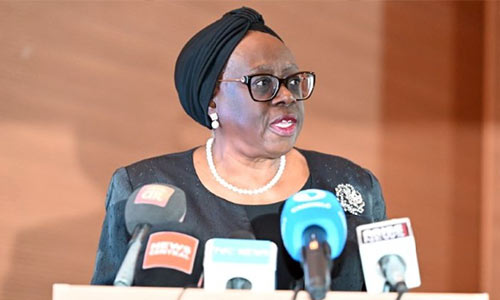
The Chief Justice of Nigeria (CJN), Justice Kudirat Kekere-Ekun, the Attorney General of the Federation (AGF), Lateef Fagbemi, and the Administrator of the National Judicial Institute (NJI), Justice Babatunde Adejumo, have advocated the enhanced deployment of non-custodial sentencing measures to address prison congestion.

They noted that current reality dictates that judges and magistrates can no longer view custodial sentencing as the only option when determining criminal cases.
The CJN, AGF, and Justice Adejumo spoke in Abuja on Friday at a “Roundtable on enhanced collaboration on alternatives to custody: Practical strategies for reducing prison congestion – an interactive collaboration between the United Kingdom’s Ministry of Justice and the justice sector in Nigeria,” hosted by the NJI.
Justice Kekere-Ekun noted that while the power to deprive a person of his liberty remains one of the most profound responsibilities entrusted to judges, incarceration must not be viewed as the default response in all circumstances.
She stated that the evolving realities of modern justice administration require adopting more balanced, proportionate, and forward-looking approaches to sentencing.
The CJN noted that the challenge of prison congestion in the country has been longstanding, driven mainly by delays in criminal justice administration, the high number of persons awaiting trial, and limited utilisation of non-custodial measures.
She added, “Addressing this challenge demands a shift in judicial mindset; one that recognises and embraces credible alternatives to custody. It is encouraging to note that we have made notable progress in recent years.
“The enactment of the Nigerian Correctional Service Act, 2019, provides a robust legal framework for non-custodial measures, including probation, community service, and restorative justice mechanisms.”
“However, the effectiveness of these provisions depends significantly on judicial confidence in their application and the availability of the necessary institutional support structures,” she said.
Justice Kekere-Ekun argued that using alternatives to custody should not be seen as a sign of leniency or an attempt to undermine the deterrent function of the law.
She said that when properly applied, alternatives to custody could enhance the justice system’s credibility by ensuring that punishment is not only just, but also constructive and proportionate.
The CJN said, “They enable us to address the root causes of offending behaviour, reduce recidivism, and promote the reintegration of offenders into society as law-abiding citizens.”
Justice Adejumo explained that the event was intended as a platform to explore practical strategies necessary for reducing congestion in the country’s correctional facilities.
He noted that the concept of decarceration is not new in the country because for decades, efforts have been made to shift focus toward restorative interventions, community-based disposals, and the essential decongestion of carceral institutions.
The Administrator of NJI noted that beyond the effects on human beings, prison congestion increases public spending required to maintain these facilities.
Justice Adejumo stated there was an urgent need to bridge the existing gap between policymakers, the Judiciary, correctional officers, and other stakeholders to ensure enhanced deployment of alternatives to custodial sentences.
Fagbemi said prison congestion poses serious implications for justice administration and human lives, requiring a balanced approach in promoting public safety, fairness, and system efficiency.
He said the country has undertaken reforms to strengthen non-custodial measures as alternatives to incarceration, including the enactment of the Administration of Criminal Justice Act (ACJA) 2015, which introduced innovations to reduce detention, promote speedy trial, and encourage alternatives to imprisonment.
Fagbemi added that through the ACJA and the Nigerian Correctional Service Act (NCSA) 2019, mechanisms like community service and restorative justice are recognised as effective tools for addressing minor offences, promoting rehabilitation, and reducing pressure on Correctional facilities.
He said the Federal Ministry of Justice supports initiatives to strengthen existing non-custodial measures, including capacity building, coordination, and partnership.
The AGF, who stressed the need for continuous training for judges and magistrates, said non-custodial measures remain a major component of a modern criminal justice system that prioritizes rehabilitation, reintegration, and restorative justice.
The event was attended by heads of courts in the country, officials from the UK’s Ministry of Justice, and other law experts.

 ARTIFICIAL INTELLIGENCE FOR LAWYERS: A COMPREHENSIVE GUIDE
Reimagine your practice with the power of AI “...this is the only Nigerian book I know of on the topic.” — Ohio Books Ltd
Authored by Ben Ijeoma Adigwe, Esq., ACIArb (UK), LL.M, Dip. in Artificial Intelligence, Director, Delta State Ministry of Justice, Asaba, Nigeria.
Bonus:
Get a FREE eBook titled “How to Use the AI in Legalpedia and Law Pavilion” with every purchase.
ARTIFICIAL INTELLIGENCE FOR LAWYERS: A COMPREHENSIVE GUIDE
Reimagine your practice with the power of AI “...this is the only Nigerian book I know of on the topic.” — Ohio Books Ltd
Authored by Ben Ijeoma Adigwe, Esq., ACIArb (UK), LL.M, Dip. in Artificial Intelligence, Director, Delta State Ministry of Justice, Asaba, Nigeria.
Bonus:
Get a FREE eBook titled “How to Use the AI in Legalpedia and Law Pavilion” with every purchase.
How to Order: 📞 Call, Text, or WhatsApp: 08034917063 | 07055285878 📧 Email: benadigwe1@gmail.com 🌐 Website: www.benadigwe.com
Ebook Version: Access directly online at: https://selar.com/prv626
________________________________________________________________________ The Law And Practice Of Redundancy In Nigeria: A Practitioner’s Guide, Authored By A Labour & Employment Law Expert Bimbo Atilola _______________________________________________________________________