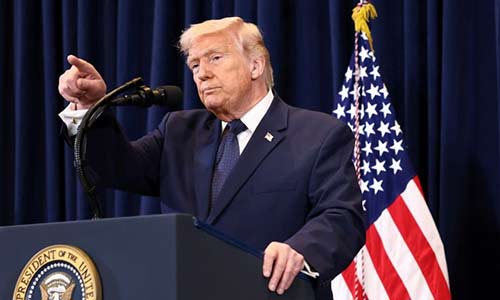
CNN, Politico and MS NOW have filed a federal lawsuit against President Donald Trump and senior administration officials challenging the White House’s decision to bar their journalists from its grounds, as America’s five major television networks declined to provide pooled television coverage of the President on Monday in response to CNN’s exclusion.
The dispute escalated after Trump announced on Friday, September 18, that CNN, Politico and MS NOW would no longer be allowed access to the White House, accusing them of repeatedly publishing what he described as “fake news.” The ban was enforced the following day when reporters from the three organisations were turned away and, in some cases, had their White House press credentials confiscated or deactivated.
CNN White House correspondent Betsy Klein, Politico reporter Cheyenne Haslett and MS NOW correspondent Akayla Gardner were among the journalists denied access on Saturday. Gardner said an MS NOW photographer was also denied entry, although one producer from the network was allowed onto the grounds, an inconsistency for which no immediate explanation was given.
Klein and Haslett subsequently had their White House credentials confiscated after attempting to enter the premises, while workspaces ordinarily used by CNN and MS NOW were left vacant.
The three organisations responded on Monday by filing suit in the United States District Court for the District of Columbia, arguing that the administration violated their First Amendment rights to freedom of speech and the press as well as their due-process protections.
The lawsuit names Trump; White House Communications Director Steven Cheung; Secret Service Director Sean Curran; and White House Chief of Staff Susie Wiles as defendants.
The individual journalists affected by the ban Gardner, Haslett and Klein are also plaintiffs alongside their employers.
The media organisations are asking U.S. District Judge Timothy Kelly to issue a temporary restraining order preventing enforcement of the ban and directing the administration to restore the journalists’ White House hard passes.
They argue that the government cannot remove journalists from the White House press corps because officials object to the content or tone of their reporting.
In their joint statement, the organisations said they brought the action to defend their First Amendment rights and the principle that government should not determine what independent news organisations are permitted to publish.
They further alleged that the credentials were revoked without notice or a meaningful process and warned that allowing such an action to stand could affect both press freedom and the public’s access to independent reporting.
Reuters similarly reported that CNN, MS NOW and Politico are alleging violations of constitutional free-speech and free-press protections and seeking immediate judicial intervention to restore their White House access.
Judge Kelly has scheduled a hearing for Wednesday on the organisations’ request for temporary relief and directed the Trump administration to respond to their claims by Tuesday.
The judge previously handled a similar White House press-access dispute in 2018 involving CNN correspondent Jim Acosta.
In that case, the Trump administration had revoked Acosta’s White House hard pass following a contentious press conference. Kelly ordered the administration to temporarily restore the credential, after which the White House ultimately reinstated the pass permanently.
Trump has defended the latest ban, arguing that news organisations granted access to the White House have an obligation to report fairly.
Speaking on Monday after meeting New York City Mayor Zohran Mamdani, Trump maintained that outlets he regards as publishing false information should not necessarily receive access to what he described as a special institution.
Mamdani, for his part, said he told Trump that journalists should be permitted access regardless of whether their reporting is favourable or critical.
The White House Correspondents’ Association has sided with the affected organisations, saying the revocation of access violates First Amendment protections and warning that a standard used to exclude one organisation because of its reporting could later be used against others.
WHCA President Jacqui Heinrich called on the administration to immediately restore the journalists’ access, arguing that once the government creates press access it cannot arbitrarily deny that access on the basis of editorial content.
The legal fight was accompanied Monday by a significant disruption to the system through which television networks have traditionally covered American presidents.
CNN had been scheduled to serve as the television pool network for Trump’s activities on Monday, including his trip to New York for events surrounding the United Nations General Assembly.
Under the longstanding pool arrangement, ABC, CBS, CNN, NBC and Fox News rotate responsibility for providing cameras, crews and live television footage of presidential activities when space or logistical restrictions prevent every outlet from having its own crew present.
The designated pool network then distributes its video and audio to the other networks and to a much wider group of media organisations in the United States and abroad.
However, after CNN reporter Klein was denied entry to the White House, the administration issued updated press guidance late Sunday night that removed CNN from Monday’s pool assignment.
The other four networks declined to replace CNN.
As a result, ABC, CBS, Fox News, CNN and NBC did not provide a network television pool for Trump’s presidential activities on Monday.
The networks said jointly that the public has an interest in receiving accurate and independent information about government and that an administration should not restrict a news organisation merely because it objects to that organisation’s reporting.
The decision did not amount to a complete suspension of television reporting about the Trump administration.
Individual networks remained free to cover events independently where access was available, while the print and radio pools continued operating. Television pool coverage for officials other than the President was also unaffected; CNN, for example, remained scheduled to provide pool coverage involving Secretary of State Marco Rubio.
The immediate effect of the absence of the television pool became visible during a ribbon-cutting ceremony for a new helipad on the White House lawn on Monday.
Without the usual pool cameras and microphones in position, viewers of some broadcasts could not clearly hear Trump’s remarks.
A Newsmax correspondent covering the event noted on air that the absence of the pool camera also meant the usual microphone was unavailable.
The television pool dispute also had implications for Trump’s trip to New York for the UN General Assembly.
CNN had been assigned to travel with the President and supply pooled footage of activities such as his departures and arrivals, movements aboard presidential transport and meetings where access would otherwise be restricted.
CNN reported that its journalists who had already been scheduled for the trip were subsequently unable to join the presidential travel pool following the ban.
The White House press-pool system has operated for decades because presidential events frequently take place in locations too small to accommodate every journalist seeking access.
Pool journalists serve as representatives of the wider press corps, sharing photographs, video, audio and written reports with organisations that cannot be physically present.
The White House Correspondents’ Association has operated independently of the White House since 1914 and represents journalists on questions of presidential access, logistics and press coverage.
Trump’s latest confrontation with CNN, Politico and MS NOW follows earlier disputes between his administration and other news organisations.
The administration previously restricted Associated Press access to certain presidential events after the organisation continued referring to the Gulf of Mexico by that name rather than adopting Trump’s preferred designation, “Gulf of America.”
The Associated Press sued, and litigation over that dispute has continued.
The latest lawsuit argues that the President’s own explanation for excluding the three organisations demonstrates that their access was revoked because of disagreement with their reporting.
The plaintiffs describe the action as viewpoint discrimination, while the administration disputes that its decisions amount to an unconstitutional suppression of the press.
Trump has repeatedly defended his action publicly, accusing the affected organisations of unfair and inaccurate reporting.
When NBC News sought the White House’s response to Monday’s lawsuit, the press office directed the network to a social-media post in which Trump again defended the restrictions and portrayed the targeted organisations as a national-security concern.
Some senior administration officials and Republican lawmakers have also defended the move.
Vice President JD Vance said the administration was not, in his description, “banning media outlets,” but rather declining to provide special White House access to organisations it considered to be engaging in propaganda. Trump’s original announcement, however, expressly described his action as a ban.
Treasury Secretary Scott Bessent separately criticised what he described as bias within legacy media, while Republican Senator John Barrasso said in an NBC interview that he did not believe Trump’s action violated the Constitution.
First Amendment specialists and press-freedom organisations have disputed that position and argue that the government faces significant constitutional restrictions once it establishes a system of press access.
The White House Correspondents’ Association maintains that access cannot be withdrawn merely because government officials dislike a journalist’s reporting.
The federal court will now be asked to determine whether the administration’s removal of the journalists’ credentials violated constitutional protections and whether their access should be immediately restored while the broader case proceeds.
[A MUST HAVE] Evidence Act Demystified With Recent And Contemporary Cases And Materials

Available now for NGN 40,000 at ASC Publications, 10, Boyle Street, Onikan, Lagos. Beside High Court, TBS. Email publications@ayindesanni.com or WhatsApp +2347056667384. Purchase Link: https://paystack.com/buy/evidence-act-complete-annotation
______________________________________________________________________ “Enhance Legal Practice With Authoritative Reports” — Alexander Payne Offers Comprehensive Law Reports, Spanning Over A Century Of Nigerian Jurisprudence Interested buyers are encouraged to place their orders and enquiries via:
0704 444 4777, 0704 444 4999, 0818 199 9888
Website: www.alexandernigeria.com
Interested buyers are encouraged to place their orders and enquiries via:
0704 444 4777, 0704 444 4999, 0818 199 9888
Website: www.alexandernigeria.com