*As Volkswagen Moves To End Production At Four German Plants

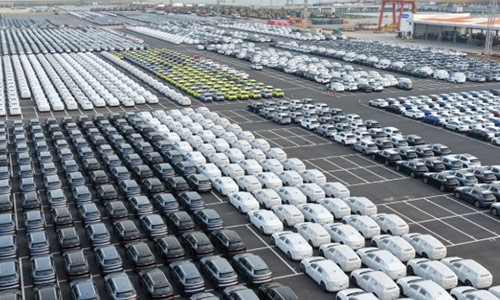
Germany has called on the European Union to take tougher trade measures against Chinese carmakers, including extending tariffs to plug-in hybrid vehicles, as Berlin seeks to protect its automotive industry from what officials describe as unfair competition and a rapidly growing wave of lower-priced Chinese imports.
German Vice Chancellor and Finance Minister Lars Klingbeil made the call during a visit to Volkswagen’s headquarters, saying Europe needed a more robust response to trading practices that could threaten its industrial base. He also urged Brussels to consider local-content requirements that would oblige manufacturers selling vehicles in Europe to source a greater proportion of components from European suppliers.
“We cannot, when all is said and done, be naive in our dealings with China,” Klingbeil said, arguing that Germany needed “a different, more robust approach toward countries that threaten our industry.” His remarks came as Volkswagen and other German manufacturers continue restructuring operations amid weak demand, high costs and intensifying competition from Chinese brands.
The immediate focus is a gap in the EU’s current trade measures. Since October 2024, battery-electric vehicles manufactured in China have been subject to additional countervailing duties ranging from 7.8 per cent to 35.3 per cent, on top of the EU’s normal import tariff, after the European Commission concluded that China’s BEV industry benefited from subsidies that threatened economic injury to European producers. Plug-in hybrids, however, are not covered by those additional anti-subsidy duties and generally face the standard 10 per cent tariff.
Chinese manufacturers have increasingly expanded their hybrid offerings in Europe since the BEV duties came into force. EU imports of Chinese hybrid vehicles rose from about 3,800 units in October 2024 to roughly 50,000 in July 2026, while Chinese brands’ share of European plug-in hybrid sales rose sharply over the period.
Chinese-brand vehicles more broadly have also increased their presence in Europe. Their market share rose from about 3 per cent in 2023 to 6.1 per cent in 2025 and 9.2 per cent in the first half of 2026, with sales on course to exceed one million vehicles in Europe this year for the first time.
Klingbeil’s intervention comes as pressure grows within Germany to protect industrial employment. Volkswagen is undergoing one of the largest restructuring programmes in its history, while Mercedes-Benz and BMW have also announced workforce reductions and cost-cutting measures. German industrial union IG Metall has meanwhile organised protests and workplace actions over job losses across the automotive sector.
Volkswagen labour representative Daniela Cavallo backed the call for measures covering Chinese hybrids, describing competition with China as “enormously tough, difficult and unfair.”
Germany’s tougher position also comes as the wider EU considers how to manage growing Chinese hybrid exports without escalating the trade dispute.
According to reports, Brussels has asked Beijing to consider voluntarily limiting hybrid vehicle exports to the European market, with EU officials considering stronger trade measures if no agreement is reached. The talks form part of broader efforts to reduce the bloc’s trade imbalance with China and address concerns about industrial overcapacity.
European Commission President Ursula von der Leyen has warned about the scale of the EU’s trade deficit with China, while European officials have said they want “concrete results” from ongoing negotiations. China, for its part, has rejected accusations that its industrial policies amount to unfair overcapacity and has criticised European restrictions as protectionist.
Concern over subsidies is also supported by recent research from the Organisation for Economic Co-operation and Development. The OECD said Chinese industrial firms received considerably more government support than competitors in other jurisdictions between 2005 and 2024. Its analysis estimated that subsidies could explain almost 60 per cent of global market-share gains achieved by expanding Chinese firms over the period studied.
In the automotive sector specifically, the OECD said China-based carmakers received roughly twice as much support in absolute terms and about four times as much relative support as carmakers based in OECD economies over the period covered by its study.
The European Commission’s original 2024 investigation dealt specifically with battery-electric vehicles. It imposed five-year countervailing duties of 17 per cent on BYD, 18.8 per cent on Geely and 35.3 per cent on SAIC, while other cooperating companies face a 20.7 per cent rate and Tesla’s China operation was assigned 7.8 per cent.
Germany is now pressing Brussels to examine whether similar measures should apply to hybrids, alongside rules intended to increase European content in vehicles sold within the bloc.
The debate marks a shift in Germany’s approach to China. Berlin has traditionally placed considerable importance on commercial ties with Beijing because China is an important market for German manufacturers, but the rapid growth of Chinese automotive exports and growing pressure on domestic employment have intensified calls for a more defensive European industrial policy.
Any extension of tariffs would ultimately require action at EU level, and no additional duty on Chinese hybrids has yet been formally adopted.
[A MUST HAVE] Evidence Act Demystified With Recent And Contemporary Cases And Materials

Available now for NGN 40,000 at ASC Publications, 10, Boyle Street, Onikan, Lagos. Beside High Court, TBS. Email publications@ayindesanni.com or WhatsApp +2347056667384. Purchase Link: https://paystack.com/buy/evidence-act-complete-annotation
______________________________________________________________________ “Enhance Legal Practice With Authoritative Reports” — Alexander Payne Offers Comprehensive Law Reports, Spanning Over A Century Of Nigerian Jurisprudence Interested buyers are encouraged to place their orders and enquiries via:
0704 444 4777, 0704 444 4999, 0818 199 9888
Website: www.alexandernigeria.com
Interested buyers are encouraged to place their orders and enquiries via:
0704 444 4777, 0704 444 4999, 0818 199 9888
Website: www.alexandernigeria.com