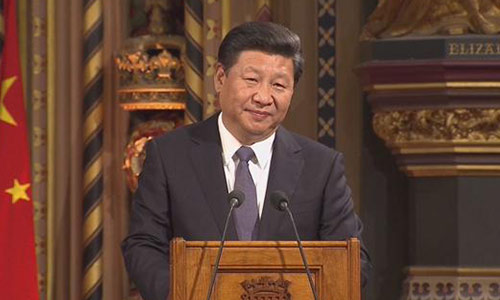
China has launched an ambitious plan to internationalize the yuan and expand its digital currency infrastructure, signaling a major shift in global financial dynamics.

The initiative, detailed by the South China Morning Post, was jointly announced by the Shanghai municipal government, the People’s Bank of China (PBoC), and national financial regulators. It aims to leverage Shanghai’s global financial hub status to reduce reliance on the US dollar and expand the yuan’s use—especially in trade with Global South nations.
A key component of the plan is the enhancement of China’s Cross-Border Interbank Payment System (CIPS), an alternative to the US-dominated SWIFT network. CIPS, coupled with the digital RMB, promises faster, cheaper, and more transparent transactions. For instance, a recent pilot between Hong Kong and Abu Dhabi settled a payment in seven seconds with a 98% reduction in fees. In a similar test between China and Indonesia, payment processing was cut to just eight seconds.
The PBoC also confirmed that its digital RMB will be fully connected to ten ASEAN countries and six in the Middle East—potentially enabling 38% of global trade to bypass the US dollar system. These developments are part of a broader strategy that includes integrating the digital RMB into Belt and Road projects like the China-Laos Railway and the Jakarta-Bandung High-Speed Rail, forming what experts call a “Digital Silk Road.”
The strategy is already seeing results. In 2024 alone, ASEAN’s RMB-denominated trade reached 5.8 trillion yuan, and several countries, including Malaysia and Singapore, have begun adding the yuan to their foreign reserves. Thailand recently completed its first digital RMB oil transaction, and 23 central banks are currently testing the system.
Analysts view China’s digital finance push as a transformative moment in global economics. By embedding blockchain-based compliance and settlement tools into infrastructure and trade, China is building a credible and scalable alternative to traditional Western banking systems. The digital RMB’s integration into cross-border trade has not only enhanced transaction efficiency by up to 400% in some cases but has also challenged the geopolitical dominance long held by the dollar and SWIFT.
As the US increasingly uses sanctions and tariffs as foreign policy tools—even against allies—China’s rapid deployment of its digital currency infrastructure is quietly reshaping global finance. The West, and particularly developing regions like Africa, are being urged to act swiftly or risk being sidelined in the emerging digital economic order.

 ARTIFICIAL INTELLIGENCE FOR LAWYERS: A COMPREHENSIVE GUIDE
Reimagine your practice with the power of AI “...this is the only Nigerian book I know of on the topic.” — Ohio Books Ltd
Authored by Ben Ijeoma Adigwe, Esq., ACIArb (UK), LL.M, Dip. in Artificial Intelligence, Director, Delta State Ministry of Justice, Asaba, Nigeria.
Bonus:
Get a FREE eBook titled “How to Use the AI in Legalpedia and Law Pavilion” with every purchase.
ARTIFICIAL INTELLIGENCE FOR LAWYERS: A COMPREHENSIVE GUIDE
Reimagine your practice with the power of AI “...this is the only Nigerian book I know of on the topic.” — Ohio Books Ltd
Authored by Ben Ijeoma Adigwe, Esq., ACIArb (UK), LL.M, Dip. in Artificial Intelligence, Director, Delta State Ministry of Justice, Asaba, Nigeria.
Bonus:
Get a FREE eBook titled “How to Use the AI in Legalpedia and Law Pavilion” with every purchase.
How to Order: 📞 Call, Text, or WhatsApp: 08034917063 | 07055285878 📧 Email: benadigwe1@gmail.com 🌐 Website: www.benadigwe.com
Ebook Version: Access directly online at: https://selar.com/prv626
________________________________________________________________________ The Law And Practice Of Redundancy In Nigeria: A Practitioner’s Guide, Authored By A Labour & Employment Law Expert Bimbo Atilola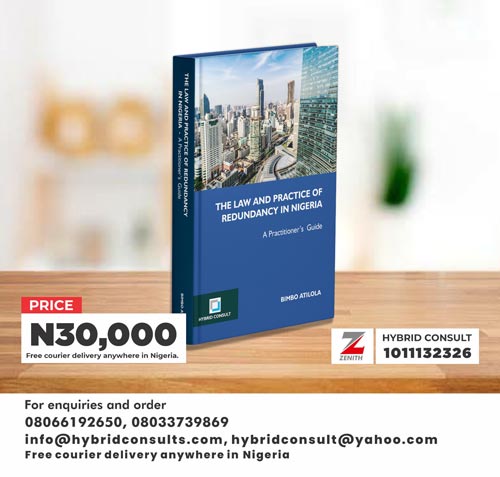 _______________________________________________________________________
"You Don't Need To Be Rich, You Just Need To Start" — Victoria Ezeigwe, Esq Launches Investment Handbook For Nigerians Starting With ₦5,000
_______________________________________________________________________
"You Don't Need To Be Rich, You Just Need To Start" — Victoria Ezeigwe, Esq Launches Investment Handbook For Nigerians Starting With ₦5,000

Get your copy today and take the first step toward financial growth:👉 https://selar.co/4f16676016
_______________________________________________________________________