By Afe Babalola SAN

Chapter Four of Chief Obafemi Awolowo’s press release of 18th August, 1975
I believe we all know and’ agree, for instance, that the Ibo, Hausa, Yoruba, Edo or Kanuri is a uni-lingual group with many dialects. If this is so, then each of these linguistic groups should be constituted into one State; unless, of course, it can be objectively established that, over the years, the Yoruba or Ibo or any of them has developed IMPORTANT CULTURAL DIVERGENCES AS WELL AS AUTONOMOUS POLITICAL AND GEOGRAPHICAL SEPARATENESS. In other words, if these divergences and separateness do in fact exist among any linguistic group, then a good case will have been made out for the breaking up of such linguistic group along THE ASCERTAINED LINES OF CULTURAL DIVERGENCES AND AUTONOMOUS POLITICAL AND GEOGRAPHICAL SEPARATENESS.
I have never claimed and do not now claim anything more than scientific validity for the linguistic principle applied to the creation of States. The principle has tremendous merits: it enjoys empirical vindication and approval (Vide the USSR, Switzerland, India, Yugoslavia, and Czechoslovakia where the principle has been applied; and Spain, the United Kingdom, and Belgium where failure to apply the principle has led to much violence and turmoil); it is certain in its application and predictable in its results; it alone is capable of eliminating agitation for the creation of a new State on purely subjective and rationalised personal grounds; and above all, it makes for permanency in the number as well as in the boundaries of States in any given country.
It has been suggested of late that if this principle were accepted, Nigeria would be landed with 200 States. I do not know how this figure is arrived at. If it is supposed to represent the number of tribal or dialect groups in Nigeria, then it is grossly understated. If, in the other hand, it is meant to give the number of linguistic groups In the country, then it is grossly exaggerated.
In this connection, I would like to invite attention to the 1952 Census Report which gives the number and identity of FIFTY-ONE linguistic groups in the country as follows:
MAJOR LINGUISTIC GROUPS:
1) Hausa/Fulani
2) Yoruba
3) Ibo
4) Efik/lbibiol Annang
5) Kanuri
6) Tiv
7) Ijaw
8) Edo
9) Urhobo
10) Nupe
OTHER LINGUISTIC GROUPS: PROVINCE:
11) Boki Ogoja
12) Ekri- Yakurr “
13) Nbembe “
14) Obanliks “
15) Ukelle “
16) Yala “
17) Abuah
Rivers
18) Ngenni “
19) Ogoni “
20) Bassa
Benue
21) Egedde “
22) Gwari “
23) Idoma “
24) Kutev “
25) Babur
Bornu
26) Beddawa “
27) Bura “
28) Shuwa Arab “
29) Borgawa
Ilorin
30) Bussawa “
31) Bassa-Komo
Kabba
32) Gwari “
33) Igala “
34) Igbirra “
35) Karnberi “
36) Owe “
37) Magazawa
Kano
38) Dak-Akerri
Niger
39) Dukawa “
40) Gwari “
41) Kamberi “
42) Kamuka “
43) Angas
Plateau
44) Birom “
45) Eggon “
46) Sura “
47) Yergum “
48) Adarawa
Sokoto
49) Arawa “
50) Zabirma “
51) Gwari “
52) Jaba “
53) Kadara
Zaria
54) Kaje “
55) Kataba “
(NOTE:) The Gwaris are minorities in four States, and the Kamberis in two; the Ijaws are a minority only in the Midwest State).
This is the list of the 51 linguistic groups about which I have written in some of my books and statements, NOT of tribal or dialect groups. I am sure it will interest many people including myself to have a list of the 200 ethnic or linguistic groups about which we have, again and again, been told, and the parts of the country in which they live.
It is clear, therefore, that under the linguistic principle, the number of States in the country cannot in the long run exceed 51. Having regard to the size and wealth of the country, this should not, by any manner of means be a worrying prospect. In the meantime, however, I have advocated eighteen States, simply because, from my knowledge of the minorities, I had thought that most of them would not be viable. And viability, in my considered view, is a matter of administrative relativity. Consequently, I have grouped together minorities which are geographically contiguous, and which, I believe, being together, would be administratively viable, and free from the fear of majority ethnic domination.
Those who advocate the creation of States only on the ‘principles’ of GEOGRAPHICAL CONTIGUITY, ECONOMIC VIABILITY and the like, are risking uncontrollable proliferation of States in the country. In the long-run we might find ourselves having to cope with well over 200 States. Perhaps this large number wouldn’t matter now since States are, in any case, fast becoming Provincial Units or inflated Local Councils.
When all these have been said, however, the STARK REALITY remains that on this issue of new States, many Nigerians just cannot be bothered about scientific principles. ‘Politics’ they contend, and quite rightly, ‘is the art of the possible’. So that whilst political ideals must remain the goal of action for those who believe in them, the reality of every situation and epoch must, in practical terms, be given due recognition when absolutely necessary.
The naked truth about the position in Nigeria now is that, because of a number of factors mainly subjective and emotional, partly environmental and historical, and to not a little extent personal, many leaders in Nigeria are implacably bent on having the territories of their birth carved out as separate States.
From purely pragmatic and realistic points of view, therefore, and because I believe that disillusionment awaits the protagonists in the not distant future, I THINK THAT EVERY GROUP WHICH ASKS FOR A STATE SHOULD BE GIVEN. SO FAR AS CAN BE JUDGED FROM THE MEMORANDA WHICH HAVE REACHED MY HANDS, MANY OF WHICH HAVE BEEN PUBLISHED, NO ONE HAS UNREASONABLY ASKED.
To give to some, and deny to others, on grounds which are not
dictated by objective and generally accepted principles; to approve the creation of Kanuri State and deny that of Kwararafa; to approve Yoruba Eastern, and deny Wawa; to approve Bauchi State and deny Calabar-Ogoja-Ikom State; to do any of these and, withal, to refuse to merge the Ijaws of the Midwest with those of the Rivers as well as leave the Gwaris and Kamberis scattered in four States and two States respectively, would be to give gratuitous and unmerited joy to some, and cause avoidable grief to others who are equally deserving. In any case, it must be borne in mind that the creation of new States now, will only serve as an invitation and encouragement to others to demand their own separate States in the very near future.
In closing my observations on this topic, I would like to make two brief points.
Firstly, I would like to invite the close attention of the Irikefe Committee and the Supreme Military Council to the memorandum of the Itsekiri Community, published in the Daily Times, asking for Itsekiriland to be made an Autonomous Province within the Midwest State. Short of a full-fledged State for every minority group, and short of grouping such minorities together into separate States of their own, the Itsekiri formula is, in my view, the answer to the fears of linguistic minorities throughout the country. All those concerned should carefully study this formula as well as the Constitutions of the USSR and Yugoslavia with special reference to the provisions for minorities.
Secondly, the present Federal Military Government should not allow itself to be bogged down by any controversy or problems arising from the immediate creation of States, to the extent that such controversy or problems would be used as a pretext for delaying the return to civilian rule. To do this would not be in the national interest, and would surely and totally destroy the raison d’etre of the last coup as our people see it.
THE NEW FEDERAL CAPITAL IN ABUJAAND
THE OLD CITY OF LAGOS
From Chief Obafemi Awolowo s press release of 18th August, 1975
The deficiencies of Lagos as Federal Capital have been stated and commented upon in the newspapers almost ad nauseam, and I do not want to repeat or contradict them. But there are some salient points to which I wish to direct my observations, partly as a contribution to the general debate on the subject; and partly for the consideration of the Aguda Committee and the Supreme Military Council.
Firstly, it must be borne in mind that the type of modern Capital we have been talking about takes a long time to plan and construct. There must be detailed survey of the area chosen; layout, designs and models must be prepared for exhaustive discussions at technical and political levels. After all the spade work has been done, tender documents must be prepared for the various segments of the Capital, and invitation to tender must be extended to contractors all over the world. I reckon that the planning of the new Capital up to the awards of contracts would take between FIVE to SEVEN years, unless of course we want to make a hash of what is conceived as a lofty project. The actual construction would take another FIVE to SEVEN years.
In any case, whatever we do about this question of new Capital, we must not encourage the Military to embark on any aspect of its planning. We should seek to limit their participation in this matter to a quick decision on the Aguda Committee’s Report. The actual implementation of that Report should be left to a future civilian Administration.
Secondly, whilst the planning as well as the construction of a new Capital is in progress, it will be our duty to make Lagos more habitable and presentable. In ten or more years from now, and taking into account the rate at which Lagos roads are being improved and at which modern buildings and industries are springing up all over the place, we might find ourselves completely frustrated at the end of the journey. We would have the new Capital of our dreams: ultramodern, superlatively prestigious, and all the rest of it; but the old Capital would have been transformed and would be pulsating with more liveliness, gaiety and business-as-usual than the new.
Someone has referred to the prevalence of immorality in Lagos as one of the factors which disqualify it from continuing as the country’s Capital. He did not elaborate. But I have no doubt that what he had in mind was the existence of Night Clubs, Gaming and Pools Houses, Brothels, and the comparative super-abundance of prostitutes and women of easy virtue in Lagos.
If one may be brutally frank without being offensive, the truth is that, from the beginning of time, it is these things which, abhorrent as they have always been to the Saints, make life worth living for the vast majority of human beings. They constitute e socio-gravitational pull even to those who live outside the borders of where they abound. Hence the annual pilgrimage, by many who an afford it, to London, Paris, Tokyo, Madrid, Monte Carlo and Las Palmas, to mention a few cities where these things exist in bounteous plentitude.
For almost a century, Lagos has developed this pull. And in the future, because of its position as a major port, and of the concentration of industries, commerce, and comparatively affluent population in and around it, its socio-gravitational pull will increase rather than diminish.
There are only two ways of reducing this pull: to canalise the Atlantic Ocean to the new Capital wherever it is situated, and to move the industries, Night Clubs, the entire population of prostitutes, etc., to the new site; or as an alternative to the latter, to create new brands of these factors in the new Capital. The one is impossible; the other would be almost insuperably obstructed by all the known factors of immobility of human beings and of industries and commerce. In any event, it will take many years to develop new brands, especially in the face of the constant pull of Lagos.
The result, therefore, will be that, when we move our Capital to the new site, the majority of our Ministers, Civil Servants in the senior and intermediate categories, and top employees of businesses and services established in the new Capital, will see to it that they spend their weekends and holidays in Lagos. Those in the junior categories will be unhappy because they cannot afford the expense of imitating their more prosperous fellow-workers.
There is a further complication. Ecologically, it will take some years for all those, other than the natives of the area, who are moved to the new site, to settle down and adjust themselves to their new environment.
The net result of all these is that, during the first few years in the new Capital, general efficiency would decline.
Thirdly, moving the entire government personnel from the old to the new Capital would involve logistics problems of tremendous and complex magnitude which would take months to surmount. The longer the distance of the new Capital from the old, the greater the magnitude. Conversely, the shorter the distance, the less. In addition, the transfer to the new site is sure to involve extensive disclocation of governmental activities.
Chief Kola Balogun has suggested nearness to a port as one of the factors to be considered in locating a new site. I agree with him; and merely want to add that, having regard to all the factors which I have discussed above, and, in particular, in order to minimise dislocation of governmental business, the new Capital should be as near to the Lagos port as possible.
Fourthly, the conclusion to which my reasoning leads me is that Lagos should be allowed to continue to be the Federal Capital. I Conjecture, and insist on being proved wrong, that the cost of removing the alleged deficiencies of Lagos – clearing the slums and widening the roads – will be far less than the cost of building a new Capital and overcoming the concomitant problems. In this connection, it is suggested that the Lagos State Government should move its Capital out of Lagos to Ikorodu and seek to establish a greater Lagos there.
Alternatively, the new Capital should be located as near to Lagos as possible. A maximum distance of 25 miles will be ideal. And in order to facilitate response to the socio-gravitational pull of Lagos, and minimise the logistics problem of moving to the new site, the new Capital should be linked with Lagos by a first-class express highway of not less than SIX LANES.
The site I have in mind is between Agege and Ifo. Those who advocate Kafanchan or Kaduna should remember that there are many areas between Lagos and Kafanchan or Kaduna which are equally suitable, and which, because they are nearer to Lagos present less intractable problems.
SEPARATION OF POWERS AMONG THE
THREE ARMS OF GOVERNMENT
From the address delivered by Chief Obafemi Awolowo, leader of
the Unity Party of Nigeria to the Second Annual Conference of the
Oyo State Branch of the UPN on Saturday, 8th November, 1980
Since 1st October, 1979, an unsavoury situation has emerged.
The relationship between the Legislature and the Executive, at the Federal level and in most States has, at the worst, been embittered, and, at the very least, not as cordial as it should be.
Under our Constitution the three organs of Government are separate and distinct both in respect of the functions which they perform, and of the functionaries who are entrusted with the performance of those functions. In other words, under our Constitution, no government functionary belongs to more than one organ, and none performs the functions of more than one organ. This is one of the three well-known forms of separation of powers, and, functionally, the neatest of them all.
The other two may be mentioned in passing. Though a set of public functionaries are members both of the Legislature and the Executive, yet there is separation of powers, as long as neither the Legislature nor the Executive performs the functions of the other. This is the form of separation of powers under the so-called parliamentary system of Government. There is also separation of powers in the solitary British instance of one functionary (the Lord Chancellor) belonging to all the three organs of Government, and at the same time remaining independent and separate in the exercise of each of his triunal functions. Ironically enough, Montesquieu, the first political philosopher to propound the principle of separation of powers, and to classify governmental powers into Legislative, executive, an judicial, drew inspiration for his famous theory from Britain’s unique parliamentary system.
Our own form of separation of powers is fashioned after the American system. The ideal of this system is the provision of effective checks and balances in the governmental structure itself. By the adoption of this form, absolutism or oligarchy of any kind is outlawed; true democracy is entrenched and manifestly seen to be entrenched in the Constitution. In other words, each of the three organs is obligated to keep within and guard its bounds of authority. In this kind of arrangement or its agence. In its role as outlined, the Judiciary is not abused, or excessive or arbitrary use of power by anyone organ.
But does this all mean that each must operate in a water-right compartment regardless of consideration for each of the other two? This is the big question. And the exhibition which we have witnessed since October 1979 clearly suggests that the answer which most legislators appear to give to the question is in the affirmative. At this threshold of our second year of the new democratic experiment, it is essential for the survival of the new system and of democracy that we should examine carefully, and pronounce wisely on, what should be the proper relationship between the Legislature and the Executive. Otherwise, if the present trend persisted, the Legislature and the Executive would sooner than later grind to a miserable disarray in their disparate and antithetic activities, with disastrous consequences to the trusting masses whom we vow to serve.
We must get it quite clear in our minds that, of the three organs, the Judiciary is sui generis. In a democratic society, the Judiciary is the fountain from which the preservation of law and order flows: for wherever there is no justice, anarchy and self-redress tend to prevail. The Judiciary is the adjudicator in all matters that may be brought before it, be they between individuals, between individual and Government at any level, or between Government and Government. It has a bounded duty, if so called upon, to declare, in no uncertain or ambiguous terms, against any legislative or executive abuse, misuse, or excessive use of power, and also against any violation of the law by any individual or Government or organ of Government or its agency. In its role as outlined, the Judiciary is not expected, under the Constitution, to collaborate with any of the other two organs. Indeed, it is expected to be detached, independent, impartial, honest, and absolutely fearless in the discharge of its duties which are universally held to be grave and sacred. Whether the Judiciary in Nigeria, with particular reference to the Supreme Court as at present composed, can be said to be or capable of being independent, honest, impartial and fearless in the discharge of its sacred and hollowed duties is another matter on which I propose to speak at some length next December. IN THE MEANTIME, HOWEVER, I MUST SAY THAT, SO FAR, ITWOULD APPEAR THAT THE VAST MAJORITY OF THE MEMBERS OF THE BENCH BELOW THE SUPREME COURT ARE UPHOLDING THE BEST JUDICIAL TRADITIONS, WITH CREDIT TO THEIR SECTION OF THE BENCH, AND CONSEQUENTIAL CONTRIBUTION TO PEACE AND ORDER IN OUR SOCIETY.
Whilst the Judiciary must be detached and independent from the other two organs, and be manifestly seen to be so, the Legislature and the Executive must work in close and harmonious collaboration with each other, if the welfare of the people is to be truly and effectively served.
It is the sole responsibility of the Executive to govern and administer the territory under its charge for the benefit of the people therein. To this end, it must initiate policies and programmes, and mobilise all the means at its disposal for their implementation and execution. In discharging its responsibilities, the Executive acts in its unfettered discretion, but within the bounds circumscribed by the Constitution. If it exceeds those bounds or infringes the law, and there is complaint to that effect, the Judiciary must so pronounce with a view to curbing the excess or infraction complained of.
On the other hand, it is the responsibility of the Legislature to give legally-binding effect and authority to the policies and programmes of the Executive, whenever called upon to do so by the latter. In the exercise of this function, the Legislature has to satisfy itself, in its own independent judgement, that any given policy or programme is in the best interests of the people, and intra vires its constitutional powers. Once in a while, on the motion of one or more of its Members, the Legislature may make laws which will have the effect of laying down policies and programmes which the Executive would be bound to implement and execute. In the discharge of its duties, if the Legislature exceeds its bounds, the judiciary may be called upon to adjudicate.
It is quite clear that the objective of the legislature and the Executive are one and the same – to promote and serve the best interests of the people. If they work at cross-purposes, or refuse to co-operate and collaborate with each other, the interests of the people would be seriously endangered. This point is reinforced or; the ground of plain common sense. When two persons or agencies are charged with joint responsibility to achieve a common objective, the two of them must co-operate harmoniously with each other. In the pursuit of their common objective, the two of them must constantly seek a consensus; or, in the event of disagreement, one of the two must be allowed to have the last say. If each of the two, in the absence of consensus, claims the right of last say, then, the common objective will either be unattainable, or be very slow of attainment.
ON THE SUPREMACY OF THE PARTY OVER
ITS MEMBERS
From the address delivered by Chief Obafemi Awolowo to the-
Oyo State Conference of the Unity Party of Nigeria on Saturday,
8th November, 1980
The questions now are: On what forum do the Legislature and the Executive conduct their debate with a view to arriving at a consensus? And, in the event of an unresolvable disagreement between the two, which must have the final say? We must appeal to the Constitution for answers to these questions.
The first point to note is that, under our Constitution, the Legislature has the final say in the making of laws, By its enactments, it can, as the dictum goes, make A WOMAN, MAN, and vice-versa. Indeed, in the language of the Statutes MASCULINE GENDER always includes the FEMININE, unless the contrary is expressly stated. It can be seen that subject to judicial intervention, the Legislature is absolute” within its domain.
The second point to note is that, under the Constitution, the Executive has the final say in the implementation and execution of policies and programmes. To these ends, it has absolute charge over all the Government’s administrative and executive personnel. It controls all the law-enforcement agencies as well as all the actual and potential instruments for demanding obeisance and for compelling compliance with any law. The Legislature has none of these things. It follows that, unless there is a meeting of minds at some stage between both the Legislature and the Executive, the former may make laws which are veritable dead letters from the moment of enactment, whilst the latter may find it almost impossible to give legal effect to its policies and programmes.
The third point to note is that our Constitution lays down ‘Fundamental Objectives and Directive Principles of State Policy’ which both the Legislature and the Executive are called upon strictly to observe in the exercise of their respective functions. It follows that, though each of the Legislature and the Executive has the final say in its allotted separate domain of powers, yet both are enjoined to pursue common goals in the best interest of the people they serve. As to social goals, therefore, there can be no disparate legislative or executive viewpoints. The touchstones for social objectives are already indisputably and inexorably laid down in Chapter 11 of our Constitution. But as to methods of attaining the common goals, there is plenty of room to manoeuvre, and hence for operational conflict and antithesis.
The fourth and final point to note is that, as regards the Legislature and the Executive, our Constitution recognises only a Registered Political Party, and not the individual members of the Party. Members of the Legislature and the Chief Executive of any Government are, in the first place, candidates of the Registered Political Parties; and, in the second place, in the case of those elected into the Legislature, enjoined by the Constitution, under pain of severe sanction, to remain loyal to the registered Party which sponsored their election. It is the Registered Political Party alone which has authority to canvass for them to be elected. And any member of the Legislature who changes his party allegiance, ipso facto, loses his seat in the Legislature.
At this juncture, it is apposite to observe that the new FEDECO whose activities, from its incipient ill-digested utterances, must be closely watched and quickly curbed where necessary, has called our attention to Section 3 7(b) of the Constitution. This Section recognises, by clear implication, an independent candidate. But the Section is otiose; because, in my considered view, it is cancelled out by Section 20 I, 202, and 209 of the Constitution.
Furthermore, one fundamental condition for the registration of a Political Party is that its:
‘programme as well as aims and objects … shall conform
with the provisions of Chapter II of the Constitution .. .’
that is, the ‘Fundamental Objectives and Directive Principles of State Policy’. In other words, all Political Parties undertake to pursue aims identical to those in Chapter II of our Constitution, if elected into office. Whether or not all the five Registered Political Parties are doing so now or not, is another matter. Because Chapter II is not enforceable in a Court of Law; the NPN, as chief defaulters, appear to be getting away with their blatant breach of faith with the electorate. It is comforting, however, that their fraudulent manipulations can only last till the next elections.
Be that as it may. The important point to stress here is that our Constitution clearly makes a Registered Political Party the cornerstone of the activities of all the members of that Party, including those of them in the Legislature and the Executive, as well as those of them operating outside these two organs of Government. Indeed, the Registered Political Party is the sole source from which candidates for election, and elected members of the Legislature and Executive, derive their life-blood for acceptability, public status, and legitimacy. Any elected member or group of elected members of a Political Party who refuse to toe the Party line – that is, choose to break their link with the Party Source – must, of a necessity, either quickly affiliate with another Political Party for a link with another party source, or be doomed to political dehydration or anaemia. In other words, by express provisions as well as necessary implications in the Constitution, the Registered Political Party is supreme and absolutely decisive in the conduct of our public affairs.
If the Party is supreme, then it is simple logic that in all matters of dispute, conflict, or antithesis between the Legislature and the Executive, the Party in Power should have the last say whenever a consensus cannot be reached between them.
In those circumstances, the Party in Power must provide forums and avenues for regular consultations designed to forestall or nib in the bud acrimonious disputes between the Legislature and the Executive, to promote a consensus between the two organs, to correct deviation from the Party line on the part of Members of the Legislature or of the Chief Executive, and to take a firm and final decision one way or the other, whenever necessary. This should be the case wherever the Party controls both the Legislature and the Executive. Accordingly, this should be the case in the five States controlled by the UPN. More so as our Party Constitution makes sufficient provisions for forums of consultation between those elected into public offices on the one hand, and Party leaders on the other, at every level of governmental activities – from Local Government right up to Federal Government.
Two problems of peculiar dimensions, however, arise; firstly, when the Party in control of the Legislature is different from the Party in control of the Executive; and secondly, when a party is a minority in a Legislature controlled by another Party which also controls the Executive and is, therefore, the Party in Power.
In the first case, since the Members in the Legislature and those in the Executive must regard their respective parties as supreme, then there has to be constant occasions for operational conflict or even irreconcilability. The same thing goes for the second case. Nevertheless, I do once again affirm, most emphatically, that the Party is supreme, and that the Party is the political cornerstone in all conduct and direction of public life. At the same time, the Constitution has stipulated for all Political Parties, regardless of their methodological diverseness, common social objectives which they are all enjoined to pursue at all times. The Constitution has also provided identical touchstones by means of which genuine conformity with the ‘Fundamental Objectives and Directive Principles of State Policy’, can be assayed.
As a result, there need be no permanent operational irreconcilability or antithesis between the Legislature and the Executive,’ such as obtains in Kaduna State. It is clear that the PRP Government under Balarabe Musa is conscientiously and diligently making efforts to promote the welfare of the people of the State, as enjoined by Chapter II of our Constitution. It, therefore, deserves the support of the Legislature. But it is also clear from all accounts that he is being insensately hindered, at every turn, by an extremely narrow-minded and anti-social NPN majority in the Kaduna Legislature. In this connection, I invite the NPN to reflect upon and learn from the UPN approach to every issue in the National Assembly, and transmit the lessons derived to their fellow-party men in the Kaduna State Assembly.
For instance, of the multitude of Ministers appointed by Alhaji Shehu Shagari, only two were strenuously and implacably opposed by the UPN Members of Senate. Of these two, one has resigned his appointment under disgraceful circumstances. The other one is still holding shamelessly and precariously to office, even though a Committee, of which the Minister is not a member, has recently been set up by Alhaji Shehu Shagari to advise him on matters within the portfolio of the said Minister.
But in Kaduna, lists of Commissioners have been wholly rejected on two occasions. Among those in the lists are men of fine qualities and high qualifications, who are, in many respects, superior to many of those in Alhaji Shehu Shagari’s list supported by the UPN and PRP Members of Senate. What we are witnessing in Kaduna, therefore, IS NAKED TYRANNY OF THE LEGISLATURE AT ITS VERY UGLIEST.
THE BLESSINGS OF COURAGE
Full text of Chief Obafemi Awolowo s speech to Oyo State Houseof Assembly in Ibadan on Wednesday,’ 16th January, 1980. This is the speech in which Chief Awolowo listed his main achievements as Premier of Western Region of Nigeria from January, 1952, o
December, 1959.
The last time I was here in this august Chamber was 25th May, 1962, when I sat in the official box as a very important guest. That same day, two meetings of the Western Region House of Assembly were held: one in the morning, and the other in the afternoon.
Each meeting ended in fiasco – a fiasco deliberately engineered by the powers-that-beat the federal level as an initial process in a well-calculated plan to annihilate the Action Group of Nigeria, and to destroy its leader politically and (as we have now been reliably informed) physically as well. It had been thought by the arch planners that, on the accomplishment of these diabolical ends, they would thenceforth remain in power for ever, and that all those who believed in the ideals of the Action Group either would totally surrender their ideological identity, or would never, NEVER, taste of power again.
The last time I spoke in this Chamber was on the 3rd November, 1959, when I delivered my valedictory address to the House of Assembly. I did not imagine then that I would one day, like this, be accorded the honour and privilege of ever again addressing Hon. Members of the House of Assembly in this same Chamber.
It is, therefore, most gratifying for me to be here again in this Chamber and to have this unique honour of addressing you on this occasion of the twenty-fifth anniversary of the introduction of Free Universal Primary Education in the old Western Region out of which five virile States – Lagos, Ogun, Oyo, Ondo and Bendel – have been carved.
I have pleasant and proud memories of my association with the Western Region, and of the role which I had had the honour to play as the leader of its government for eight full years from January 1952 to December 1959.
During this period, the Western Region earned the nick-name of pace-setter in all that is good and worthy of report. Some of the pace-setting achievements can be recalled:
1) Voting by symbol was introduced into Nigeria by the Action Group and was first practised at the Local Government Elections in Ijebu-Remo in 1953.
2) Steel ballot boxes and security-printed ballot papers were first used in the Western Region in 1956, at the instance and insistence of the Action Group Government.
3) The first motion ever for the creation of a new Region – in this case for the creation of a Midwestern Region now known as Bendel State – was moved in the Western Region House of Assembly by an Action Group Member of the House.
4) It was only in the Western Region that the Leader of Opposition was elected Deputy Speaker of the House of Assembly.
5) It was also in the Western Region that Ministers of Finance and of Works were withdrawn from the Tenders Board, and the membership of the Board was restricted to Officials headed by the Permanent Secretary, Ministry of Finance, together with known members of the Action Group and of the NCNC chosen, from time to time in equal numbers, by the said Permanent Secretary, Ministry of Finance.
6) Agricultural Settlements and Institutes were first established in the Western Region.
7) It was in the Western Region that a minimum living wage was first introduced in Nigeria, and paid to workers in the Region.
8) The first-ever industrial estate and housing estate in Nigeria were established in the Western Region.
9) The first television service in Nigeria, indeed in the whole of Africa, was established in the Western Region.
10) The very famous Liberty Stadium was the first and the best of its kind in Nigeria when it was built in 1959. In terms of elegance and comfort, it still remains the best in the country.
11) Before 1952, the Nigerian Government had never awarded as many as twenty university scholarships a year to Nigerian students. In that year (1952), the Western Region Government became the first ever to award 200 university scholarships in one year to students of Western Region origin.
12) It was in the Western Region, twenty-five years ago, that Free Universal Primary Education, and Free health Services for children up to the age of 18, were first introduced in any part of Nigeria. It was also in the Western Region that a six-year primary course, instead of the then existing eight-year primary course, was first introduced.
Some people have disrespectfully and insultingly described the Western Region as ‘the wild wild West’. No people with predominant wild inclinations such as are implicit in the description can record in a short period of EIGHT YEARS the supremely impressive, epoch-making, and pace-setting innovations and achievements which have been itemised above. The truth about the people of the Western Region is that they are sufficiently enlightened and bold to refuse to be led by the nose by any person or group however sophisticated such person or group may appear. They are slow to anger; robust in contentions; alert to their rights, and will fearlessly resist and combat evil whenever and wherever they discern it, with all their might and resources. To the people of the Western Region A LEADER IS MADE, NOT BORN. He is expected to justify his leadership by his personal attributes, and by his works for the good of the people. Whereas in some other parts of the country A LEADER IS BORN; and it is the followership that are expected to justify their worthiness to follow by the extremity of their obedience and subservience.
When the decision was taken in 1952 to introduce free universal education and free health services for children up to the age of 18, in the Western Region, it became necessary, in order to finance the schemes, immediately to impose an Education and Health Levy of TEN SHILLINGS per male adult taxpayers in Ijebu Province only. The collection of the levy commenced two years before the introduction of the schemes. This time-lag led to a lot of misrepresentations, which were heightened by the novelty of the schemes and the incredulity of the people towards them.
There was widespread resistance to the schemes, partly spontaneous and mainly instigated by the Opposition. But the Action Group Government had no iota of doubt in its mind that the schemes would fructify and mature in due time to the delight and gratitude of the vast majority of our people.
In concluding my speech on the motion for Education and Health Levy in the Western House of Assembly on 2Jrd January, 1953, I said something which now appears prophetic but which in actual fact exemplifies the clear vision and profound faith of the Action Group Government about the eventual and abiding success of the two epoch-making schemes. This is what I said:
‘Finally, Mr. President, we of the Action Group will press forward and I make this solemn promise with a due sense of responsibility and resolution, we of the Action Group will press forward in the execution of the laudable projects which this House has unanimously approved and accepted, believing as we do, being Christians and good Mohammedans on this side, believing as we do that God Almighty, who sees our hearts and knows we are doing all these things to better the lot of our people, is on our side, and confident also that our beloved and trusting masses, when they begin to enjoy the delectable fruits of the education and health levy which they are now being called upon to pay, will now and in future years remember us with gratitude and adoration as their faithful and devoted servants, and as their only true friends and benefactors.’
But incredulity and hostility towards the free education scheme were not confined to the Opposition and a good number of our people. All the senior Opposition and a good number of our people. All the senior Government Officials – both Black and White – and all the Nigerian intellectuals outside the fold of the Action Group were solidly opposed to the scheme. The then Director of Education in the Western Region declared that he did not believe that the Region was ripe for extension of primary education, let alone for free universal primary education. He thought it was a futile venture to embark on the latter. The Financial Secretary, for his part, thought that the whole business amounted to no more than an academic exercise; as, according to him, we needed to impose at least £5 not 10/- per capita to implement the free education scheme alone.
Because of official attitude to the scheme, Chief S.O. Awokoya, now Professor of Education at the University of Ife, had to prepare his White paper on the scheme, based on the Action Group Policy Paper previously prepared by Chief M.A. Ajasin, now Governor of On do State, and adopted at the inaugural Conference of the Party at Owo. Later, I had to prepare the Exco Memoranda on the implementation of the scheme as it related to education and Health Levy, and the construction of low-cost classrooms.
Now, the offsprings of the old Western Region – Lagos, Ogun, Oyo, Ondo and Bendel States – are at it again. But this time on a much grander scale than we dared to essay in 1955. For, today in these five dynamic States, education is free not only at primary level, but also at secondary and tertiary levels as well. As we all know, by free education at these levels is meant non-payment of fees by whatever name called, together with free supply of textbooks t pupils and students.
Those who protested vehemently some six months ago that the introduction of this laudable scheme from 1st October, 1979, could not be accomplished because of non-existent difficulties which they imagined in their heads can now see how very wrong they were, and how muddled their thought-processes had been. For the scheme is now more than three months old; and, in about five months from now, it would have completed one full academic session.
Here then in the five UPN-controlled States, a new historic pace has been set; a new revolutionary impulse has been generated; and, by God’s Grace, this new dialectical progression will not only endure as its predecessor, but will also pervade the entire Federation of Nigeria.
It is not given to many a thinker or theoretician to see his ideas or theories practicalised in his lifetime; nor to more than a few pioneers to witness the fructification’ and ripening of their endeavours, and take part in the glorious harvest. Today, it was exactly twenty- five years ago when I had the honour to launch the Free Universal Primary Education Scheme for the Western Region of Nigeria here in Ibadan on 17th January, 1955. Tomorrow will be the beginning of another natal cycle for the Scheme. The youngest of the founding pupils of the Scheme are now 31 years of age. It stands to reason, therefore, to say that many of them now occupy important positions in all the spheres of useful activities throughout the Federal Republic of Nigeria. Indeed a good number of our legislators in, the five. UPN-controlled States are products of that Scheme which was launched twenty-five years ago. As a matter of fact, the planners of these silver jubilee celebrations are products of the Scheme, and are mostly self-employed professionals and businessmen.
Today, my joy knows no bounds, as one of the planners and executants of the old Scheme, and as one of the planners of the new Scheme which is now unfolding before us with unparalled speed. I seize this opportunity to congratulate, with all my heart, three classes of people: first, those products of the old Scheme who are alive today to witness these silver jubilee celebrations; second, our five Governors – Chief M.A. Ajasin, Chief Bola Ige, Chief Bisi Onabanjo, Professor Ambrose Ali, and Alhaji L.K. Jakande – for the excellent manner and adorable despatch with which they have set about the execution of the UPN’s four cardinal programmes, with special reference to free education at all levels; and, third, the lucky children of the five UPN-controlled States who are now benefiting and who, from generation to generation in the years to come, will benefit from the new education programme. After launching the free primary education programme in the morning twenty-five years ago, I also did a radio broadcast to the people of the Western Region, on the night of the same day. I concluded the broadcast in the following words:
‘ … The opportunity which the Government of this Region’ offers to all of us in the way of education of our children is far-reaching. I appeal to all of you to seize this opportunity in real earnest. I do not at all minimise the problems that are bound to confront us as we proceed with the execution of all our educational schemes.
‘But if all of you will co-operate, in a spirit of willingness and loyalty, with the Government, the task of tackling and solving any problems that may arise will, God being our helper, be considerably lightened.’
This appeal which was made twenty-five years ago inures today for each of our five States, and for any State in the Federation which may wish to embark on the Scheme of free education at all levels.
As the Scheme unfolds and progresses, difficulties of various kinds will be encountered. There will be administrative, executive, and financial difficulties, among others. But the knottiest of them al is the financial difficulty. Even this, like the other two can and ought to be tackled vigorously and solved.
The country has enough manpower and financial resources to cope with its social and economic problems including in particular the introduction of free education at all levels. But of course it all depends on what we regard as national priorities, and on how our resources are husbanded and deployed for the greatest good of all our people without any discrimination whatsoever.
In this connection, it is imperative that all the relevant arguments should be mustered and directed, with unrelenting and unabating persistence, at the ‘densely-compacted intellect’ of the Federal Government to the end that it may awaken to the very urgent need for promoting the immediate introduction of free education at all levels, free health care, integrated rural development, and full employment of our human resources throughout the country.
There is one and only one primary and overriding objective which all the twenty Governments in our Federation, and all the leaders in the country must recognise: it is the full development and full employment of every Nigerian citizen. This objective, to the exclusion of any other, deserves to be given FIRST PRIORITY in all our national endeavours. Any policy or programme which relegates this objective to the second place is sure to come to grief, and to fail woefully in its bid to advance our economic development, and to promote social justice and political stability.
No one in his senses has ever denied and can ever deny that man is the Alpha and Omega of all activities. And in all these economy and at any stage of human advancement. He is the producer of all raw materials and secondary goods; he is the distributor, exchanger and final consumer of everything that is ever produced by man. In the Church, in the Mosque, in politics, in the State, in the family, and in society generally, man is the Alpha and Omega of all activities. An in all these activities, he alone has the capacity to make or mar: nothing else on earth has. Man is ordained to have dominion and be monarch over the earth. The vagaries of nature and the acts of God which now and again affect him adversely, do so because of his ignorance of their causes, and of his lack of sufficient knowledge to eliminate such causes when he ascertains them or to cope successfully with their effects.’
The point in controversy as far as some people are concerned is whether man’s development should have or should not have priority over the development of natural resources into raw materials and then into secondary goods for man’s final consumption.
In this regard, there is a feudalist-capitalist veil which has, for centuries, and until recently, obscured the prime-importance of the developed man in the economic development process, or in any kind of development process, for that matter. The Japanese are the first to peep seriously behind the veil; and the USSR is the first to tear the veil asunder; the prime dynamic of all development or advancement – be it economic, social or political – is the developed man. Accordingly, they have both given the prime of place to the development – that is the education and health – of everyone of their respective citizens.
Look in whichever direction you like, and you will see for yourselves that in the long saga of man’s multifarious adventures, nothing worthwhile has been initiated and achieved without the motivating impulse and sustaining direction of the man of education, science, and technology.
From the earliest days of man, and centuries before the establishment of institutions for formal education or health care, we see the slave-owner and feudalist, in all parts of the world, taking great pains to develop his offsprings, whilst he sedulously forbids similar facility for his slaves and serfs. The early capitalists also took after the feudalists whom they had displaced. They made sure that their own children were sufficiently developed to take over from them, and that the working classes and their descendants remained as mentally underdeveloped as was compatible with the functions and operations they were called upon to perform.
Some of us do speak glibly, indeed thoughlessly, of the Industrial Revolution in Britain as being the precursor of Britain’s rapid economic development in the eighteenth and nineteenth centuries. But such people carelessly overlook the fact that, without the men of education, science and technology, like Richard Arkwright, James Hargreaves, Revd. Edmund Cartwright, James Watt, and a multitude of others, the Industrial Revolution could not have taken -place. Some of the main charactreristics of the Revolution, can be mentioned as proof of this assertion. These are:
1) the discovery and utilisation of new energy sources;
2) the invention and fabrication of new machines and other mechanical devices; and
3) the invention and development of faster forms of transportation and communication.
The very rapid development of Britain in late eighteenth and nineteenth centuries, of the USA in the nineteenth century, of Japan in late nineteenth and early twentieth centuries, and of the USSR in this twentieth century, has been brought about primarily by the men of education, science and technology in these countries. And the examples of these highly developed countries, among others not mentioned here, are enough for us to reiterate categorically that at every stage of human development or advancement, the moving spirits are invariably the men of education, science and technology. The more of them a country has, the brighter are its prospects for rapid economic progress, for social justice, and for political stability.
It is generally agreed, and in any case the fact stares us in the face, that in spite of her enormous economic potentialities, Nigeria is one of the poorest and most underdeveloped countries of the world. She has been in this shameful position for very many years. We must not allow her to remain this way for much longer. All those who share the view that RAPID DEVELOPMENT OF NIGERIA BY NIGERIANS FOR NIGERIANS is a matter of urgent necessity must agree to do first thing first, no matter to which political party they may belong. And that FIRST THING is the full development and full employment of every Nigerian citizen.
Already, most parts of the country have lost twenty-five years in the matter of the development of our people. The reason is that many of our leaders and so-called intellectuals, instead of girding their loins and doing likewise for our people in their respective areas of influence, have elected to spend a-quarter-of-a-century in deriding and jeering at a great scheme which was introduced here in 1955, and which has in the course of years produced many of the most brilliant and ablest Nigerian youths who abound today in the professions, in industry and commerce, in parastatal organisations, and in Government.
I seize this auspicious occasion to appeal to those Nigerian leaders who may still be inclined that way, to desist NOW from playing a stupid and dangerous game which experience of twenty-five years has shown to be fit only for nation-wreckers, and for ‘the envious and asses that bray’.
We must always bear in mind that our Constitution enjoins us, as and when practicable, to provide free education at all levels for our children and adolescents. I declare for the umpteenth time that all the good things of life provided for in our Constitution are practicable now.
Those who foolishly and recklessly maintain that, compared with the other parts of the country, the primary education given in the five UPN-controlled States is lacking in quality will do themselves a lot of good by looking to pages 25 and 27 of THE ANNUAL REPORT OF THE WEST AFRICAN EXAMINATION COUNCIL FOR THE YEAR ENDED 31st MARCH, 1977. At page 25 the results for GCE (Advanced Level) Examination held in November – December, 1976, showed that the Western States have 6,492 passes which are 48.8 per cent of those who sat for the examination from those States; the Eastern States have 2,500 passes which are 37.9 per cent of those who sat; whilst the northern States have 1,251 passes, that is 41 per cent of those who sat. At page 27 the results of GCE (Ordinary Level) Examinations held in May – June, 1975, may be tabulated as follows:
Division 1,’ Distinction Passes Percentage of
those who sat
Western States 72 0.2
Eastern States 51 0.1
Northern States 37 0.25
Division I
Western States 1,151 2.6
Eastern States 1,087 3.1
Northern States 462 2.8
Division II
Western States 3,545 8.0
Eastern States 3,381 10.5
Northern States 969 5.7
Division III
Western States 13,494 28.6
Eastern States 9,060 27.6
Northern States 3,834 22.4
It is crystal clear from these figures that the products of the Free Universal Primary Education, who have been disposal, should no longer drag his feet on the question of free robbers’, are indisputably in the lead in all the GCE (Ordinary Level) and GCE (Advanced Level) Examinations held in 1975 and 1976 respectively.
Alhaji Shagari, in the face of these and other facts at his disposal, should no longer drag his feet on the question of free education at all levels on the pretext that he wants something better than what obtains in the UPN-controlled States. From the percentages of passes, there is no doubt that there’ is considerable room for improvement in ALL THE STATES. But more so in the Northern States where the total number of candidates who passed these examinations are comparatively very very low indeed.
The educational gap between the Western States and the Northern States is too wide for comfort. And it would be criminal for anyone who has the power and the means to close it, to allow it to widen further. It cannot be closed by trying to halt the forward march of the Western or Eastern States as someone had suggested some three or so years ago. For one thing, this is an impossible proposition. For another, such an attempt would be certain to provoke an emotional reaction of frightful proportions among those affected. The gap can only, therefore, be closed by embarking now, throughout the country, on Free and Compulsory Primary Education, Free and Compulsory Secondary Education, and Free Education at Post-Secondary levels. If we do this now, the existing educational gap will be permanently closed in FIFTEEN to TWENTY YEARS’ time.
In closing, I wholeheartedly congratulate our five Governors – Ajasin, Onabanjo, Jakande, Ige, and Alii, and with them I associate the names of Abubakar Rimi, Governor of Kano State, and Abdulkadir Balarabe, Governor ofKaduna State – for blazing these new beneficial educational trails offree education at all levels. Obstacles there must be in the path of every pilgrim or pioneer in search and pursuit of noble and humane objectives. I have no doubt that when they do appear, as they are bound to, we shall, with Almighty God on our side, overcome them, even more gloriously than the pioneers of twenty years ago had done in their time.
OBAFEMI AWOLOWO
INDEX
AACB, 127, 129, 131
ADB,127
Additional Revenue, 16
African Group, 62
Aims of the AACB, 128
Aims and Objectives, 92
Ajasin, Chief M.A. 184, 185
Ali, Professor Ambrose, 185
Angell, Sir Norman, 62
Arikpo, Dr. Okoi, 150
Association of African Central Bank, 125
Association of Chambers of Commerce, Industry and Mines of Nigeria, 115
Avebury, Lord, 150
Awokoya, Chief S.O., 183, 184
Awolowo, Chief Obafemi, 1,3,6,9,19,24,28,33,40,48,69, 72,74,82,98, 115, 124, 131,
147, 150, 152, 154, 156, 163, 169,172,175,180
Balarabe, Abdulhadir, 190
Balogun, Chief Kola, 171
Biafran War, 9
Census Report, 1952, 165
Charges of Treasonable Felony, 1
Commonwealth Group, 62
Conference of Finance Commissioners of the Federation in Kano, 40
Conservation of Foreign Exchange, 18
Constitution, 84
Courses of Action, 10, 11
Creation of More States, 163
‘Crisis of Plenty’, 59
Definitions, 84
Development Plans, 153
Direct Tax, 16
Eastern States, 189
ECA, 31,127
Economic Growth Rate, 13
Economic Survey of Nigeria 1959, 74
Emerson, Ralph Waldo, 27
Faruk, H.E. Usman, 80
FEDECO,197
Fernando Po, 28
Form of Governments, 95
Free Education, 42, 43
Free Health Services, 42, 43
Full Employment, 40, 41
Fundamental Factors, 88
GCE, 189, 190
GDP, 43, 44, 111, 113, 114
Gezira Scheme, 53
Gowon, Major General Yakubu, 8, 19, 79
Group of Ten, 62
IDEP, 127
Ige, Chief Bola, 185
Import and Excise Duties, 16
Import Quota Allocation Committee, 106
industrialisation of Each State, 45
Iron and Steel Complex, 112
Items of Programme, 149
Jakande, Alhaji L.K., 185
Jebba,35
Johnson, Professor Glenn, 44
Kano, Alhaji Aminu, 156, 158
Kano State, 39, 78
King, Edmund 1., 70
Laws and Principles, 5
Letiche, Dr. John D., 111
Lewis, Professor Arthur, 160
Linguistic Groups, 165, 167
Maladjustment, 57
‘Man does not live by bread alone’, 35
Marketing Board, 108, 113
Minimum Conditions, 39, 40
Modernisation of Agriculture, ‘Mohammed, Brigadier Murtala Ramat, 148
National Reconstruction Surcharges, 16
NCNC, 181
NIDB, 122
Nigerian Trade Union Congress, 33
Nine-Point Programme, 149, 151
NPN, 177, 179
OAU, 20, 22, 23
Okaba, 119
Ojukwu, 9, 10, 99, 106
Oluwasanmi, Professor H.A., 43
Onabanjo, Chief Bisi, 185
One Nigeria Bonds, 17
Onitsha,35
Opium War, 56
Organisation of African Unity, 19
Oyo State Branch of the UPN, Oyo State Conference of the Unity Party of Nigeria, 175
Oyo State House of Assembly, 180
Pace-setting Achievements, 181, 182
People’s Republic, The, 68, 143
Pigou, A.C., 134
Post-war Ruler, 36
Press Statements, 147, 150, 152, 154, 156, 163, 169
Provinces, 166, 167
PRP,179
Rapid Development of Our Systems of Transportation, 45, 46
Rapid Industrialisation of Each State, 45
Regional Assemblies, 41
Release from Prison, 3
Rimi, Abubakar, 190
Robbins, Lord, 13
Second National Development Plan, 27
Smith, Ian, 29
Southern States, 11
Strategy and Tactics of the People’s Republic of Nigeria, The, 143
Strict Austerity Measures, 14, 15
Sufficient Funds, 46, 47, 48
Systems of Transportation, 45
Tenno, Meiji, 115
‘The Role of the Working Class in Post-War Nigeria’, 33
Third Revolutionary Convention of the Nigerian Trade
Union Congress, 33
Thoughts on Nigerian Constitution, 4, 89, 91, 143
Treasury Bills, 106
Treasury Certificates, 104
Type of Constitution, 89
UDI,23
UNESCO, 75, 77
United Nation’s Population Division, 76
University of Ibadan, 98
University of Ife, 6, 69, 72, 74, 131
University of Lagos, 82
University of Lagos Annual Lecture Series, 48
UPN, 172, 178, 179, 183, 184, 185
USA,21,30, 86, 169, 188
USSR,30, 86, 169, 188
Walpole, Hugh, 2
Ways and Means Advances, 104
Wells, H.G., 57
Western States, 189
World Perspective in Education, 70
Yusup, Alhaji, 148
Zielinski, J.G, 139

 ARTIFICIAL INTELLIGENCE FOR LAWYERS: A COMPREHENSIVE GUIDE
Reimagine your practice with the power of AI “...this is the only Nigerian book I know of on the topic.” — Ohio Books Ltd
Authored by Ben Ijeoma Adigwe, Esq., ACIArb (UK), LL.M, Dip. in Artificial Intelligence, Director, Delta State Ministry of Justice, Asaba, Nigeria.
Bonus:
Get a FREE eBook titled “How to Use the AI in Legalpedia and Law Pavilion” with every purchase.
ARTIFICIAL INTELLIGENCE FOR LAWYERS: A COMPREHENSIVE GUIDE
Reimagine your practice with the power of AI “...this is the only Nigerian book I know of on the topic.” — Ohio Books Ltd
Authored by Ben Ijeoma Adigwe, Esq., ACIArb (UK), LL.M, Dip. in Artificial Intelligence, Director, Delta State Ministry of Justice, Asaba, Nigeria.
Bonus:
Get a FREE eBook titled “How to Use the AI in Legalpedia and Law Pavilion” with every purchase.
How to Order: 📞 Call, Text, or WhatsApp: 08034917063 | 07055285878 📧 Email: benadigwe1@gmail.com 🌐 Website: www.benadigwe.com
Ebook Version: Access directly online at: https://selar.com/prv626
________________________________________________________________________ The Law And Practice Of Redundancy In Nigeria: A Practitioner’s Guide, Authored By A Labour & Employment Law Expert Bimbo Atilola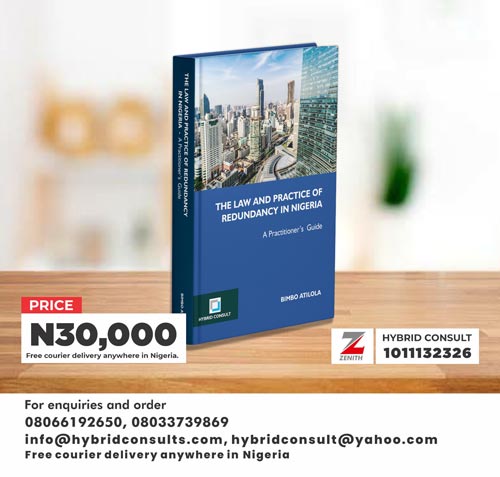 _______________________________________________________________________