By David Bassey Antia

In the recent decision of the Supreme Court in the case of Olakehinde v. EFCC (2025) 17 NWLR (Pt. 2014) 275, Saulawa, JSC, after resolving the substantive issues canvassed in the appeal, undertook a meticulous and surgical examination of the attitudinal disposition of learned counsel for the appellant, arising from the particular diction employed in criticising the judgment of the Court of Appeal.
His Lordship’s intervention was provoked by the appellant’s counsel’s use of the word “prevaricated” in describing the refusal of the Court of Appeal to consider one of the issues distilled for determination. The Supreme Court cautioned, with unmistakable clarity, that counsel must be circumspect in the use of language, lest advocacy degenerates into contempt of court.
The offending passage in the appellant’s brief read as follows:
“My Noble Lords, we submit that the lower court abdicated its duties when it prevaricated from considering issues one (1) and three as formulated in the appellant’s brief of argument duly distilled from the grounds of appeal.”
In a careful semantic and contextual analysis, His Lordship observed that the sentence, to the average reader, erodes the reputational sanctity of the judicial officer concerned. The Court proceeded to explicate the import of the word “prevarication”, holding thus:
“The term ‘prevarication’ denotes an act of avoiding the truth, especially by not answering (or addressing) questions or issues directly. It equally connotes deviation from honest expression; equivocation. Thus, a ‘prevaricator’ may aptly be described as a liar, an equivocator, or one who betrays another’s trust, such as an advocate who aids the opposing party by betraying his client.”
His Lordship relied on Black’s Law Dictionary, 11th Edition (2019) at pages 1438–1439.
In the final analysis, the Supreme Court held that the phrase suggesting that the lower court abdicated its duties” by “prevaricating” in the discharge of its adjudicatory function amounted to scandalising the Court of Appeal in the course of its constitutional duty to dispense justice “without fear or favour, affection or ill-will,” in accordance with the judicial oath contained in the Seventh Schedule to the Constitution of the Federal Republic of Nigeria, 1999 (as amended). His Lordship further emphasized on the settled position of the law that where judges are criticised in a manner that is defamatory or scandalous, the court is not bereft of the power to punish the offender for contempt.
This pronouncement is not a jurisprudential novelty unsupported by precedent. Indeed, the earliest reported English authority on the subject of scandalising the court is R v. Almon(1765). Commentators have remarked of that decision that “free comment about judges became too free for the taste of the Bench.”
The language employed by lawyers and legal writers in criticising judicial decisions may either reflect measured respect in disagreement, or, if intemperate, may crystallise into contemptuous insinuations amounting to the scandalisation of the court. This, however, does not suggest that a lawyer’s fearlessness, independence, or constitutionally protected freedom of expression should be reduced to near insignificance by an exaggerated anxiety to placate an irritable or hypersensitive judge.
This delicate balance was eloquently articulated by a Bench of the Kolkata High Court, when Arun Mishra, J. (as he then was), observed that courts ought not to take offence at every triviality—“at every irritant or pinprick.” Nonetheless, the decorum and respect owed by counsel to the court is not hortatory; it is mandatory, forming part of the ethical foundation of legal practice.
Lord Denning, MR – arguably one of the most illustrious jurists of all time – revisited R v. Almon with characteristic eloquence. Recalling the incident involving Lord Mansfield in 1765, he narrated how Mr. Almon published a pamphlet accusing the Chief Justice of acting “officiously, arbitrarily and illegally.” Though such criticisms may appear commonplace today, they were deemed intolerable at the time, prompting contempt proceedings. Mr. Justice Wilmot prepared a lengthy judgment condemning the publication as a grave assault on judicial authority, although it was never delivered due to subsequent events.
In that judgment, later published, Wilmot, J. Warned with enduring relevance:
“If their authority (that is, of the Judges) is to be trampled upon by pamphleteers and news writers, and the people are to be told that the power given to the judges for their protection is prostituted to their destruction, the court may retain its power for some little time, but it will instantly lose all its authority… Is it possible to stab that authority more fatally than by charging the court, and more particularly the Chief Justice, with having introduced a rule to subvert the constitutional liberty of the people? A greater scandal could not be published.”
The lesson i have taken from the recent decision of the Supreme Court cited at the entrance of this article is that timeless robust advocacy must never cross the fine but firm line separating principled criticism from scandalous abuse of judicial authority
David Bassey Antia
Writes from Topfaith University, Mkpatak, Akwa Ibom State
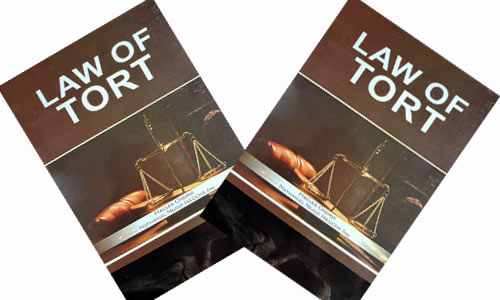 The book, titled The Law of Torts in Nigeria: A Functional Approach, authored by Professor Hagler Sunny Okorie Ph.D and Ikeocha, Nathaniel Ngozi Esq, offers law students, practitioners, and academics a comprehensive guide to understanding and applying tort law in Nigerian courts. Interested buyers can place orders via the following contact numbers: 08028636615, 08037667945, 08032253813, or +234 902 196 2209.
_______________________________________________________________________
The book, titled The Law of Torts in Nigeria: A Functional Approach, authored by Professor Hagler Sunny Okorie Ph.D and Ikeocha, Nathaniel Ngozi Esq, offers law students, practitioners, and academics a comprehensive guide to understanding and applying tort law in Nigerian courts. Interested buyers can place orders via the following contact numbers: 08028636615, 08037667945, 08032253813, or +234 902 196 2209.
_______________________________________________________________________
 ARTIFICIAL INTELLIGENCE FOR LAWYERS: A COMPREHENSIVE GUIDE
Reimagine your practice with the power of AI “...this is the only Nigerian book I know of on the topic.” — Ohio Books Ltd
Authored by Ben Ijeoma Adigwe, Esq., ACIArb (UK), LL.M, Dip. in Artificial Intelligence, Director, Delta State Ministry of Justice, Asaba, Nigeria.
Bonus:
Get a FREE eBook titled “How to Use the AI in Legalpedia and Law Pavilion” with every purchase.
ARTIFICIAL INTELLIGENCE FOR LAWYERS: A COMPREHENSIVE GUIDE
Reimagine your practice with the power of AI “...this is the only Nigerian book I know of on the topic.” — Ohio Books Ltd
Authored by Ben Ijeoma Adigwe, Esq., ACIArb (UK), LL.M, Dip. in Artificial Intelligence, Director, Delta State Ministry of Justice, Asaba, Nigeria.
Bonus:
Get a FREE eBook titled “How to Use the AI in Legalpedia and Law Pavilion” with every purchase.
How to Order: 📞 Call, Text, or WhatsApp: 08034917063 | 07055285878 📧 Email: benadigwe1@gmail.com 🌐 Website: www.benadigwe.com
Ebook Version: Access directly online at: https://selar.com/prv626
________________________________________________________________________ The Law And Practice Of Redundancy In Nigeria: A Practitioner’s Guide, Authored By A Labour & Employment Law Expert Bimbo Atilola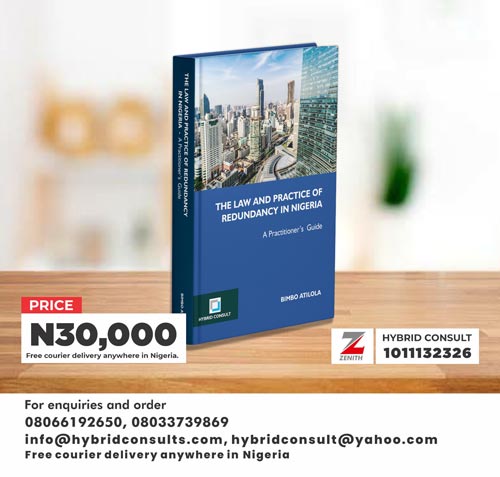 _______________________________________________________________________
[A MUST HAVE] Evidence Act Demystified With Recent And Contemporary Cases And Materials
_______________________________________________________________________
[A MUST HAVE] Evidence Act Demystified With Recent And Contemporary Cases And Materials