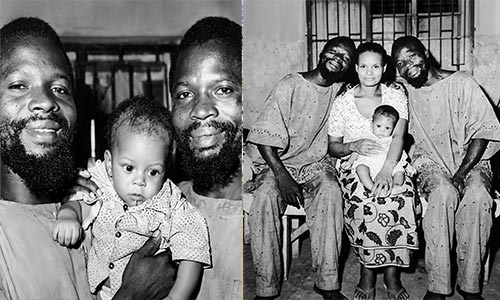
Nearly five decades after the unusual story of Nigerian twins, Taiwo and Kehinde Ogundipe, who reportedly regarded themselves as married to the same woman, Patricia Adewuyi, the account continues to attract curiosity but under Nigerian law, the arrangement raises fundamental questions about the legal meaning and validity of marriage.

The story, reported as having appeared in Drum magazine in 1978, described the identical twins as inseparable and determined to share virtually everything, including a wife. Later accounts of the publication say the brothers believed their closeness as twins justified the arrangement, while Patricia was said to have accepted it.
Legally, however, describing three people as “married” does not by itself establish that Nigerian law would recognise all three as spouses.
The arrangement is generally described as polyandry a marital system in which one woman has two or more husbands at the same time. It is the reverse of polygyny, under which a man may have more than one wife, a form recognised under some Nigerian customary and Islamic marriage systems.
Nigerian matrimonial law does not recognise a statutory marriage involving one woman simultaneously married to two men. Section 3(1)(a) of the Matrimonial Causes Act provides that a marriage is void where, at the time it is contracted, either party is already lawfully married to another person.
The Marriage Act similarly prevents parties from using different systems of marriage to circumvent an existing marital relationship. Section 33 provides, among other things, that a statutory marriage is not valid where one of the parties is already married under customary law to someone else, while Section 35 prevents a person already married under the Act from contracting a valid customary marriage during the continuance of that marriage.
This means that if Patricia had first contracted a legally valid statutory marriage with one of the twins and, while that marriage remained in force, purported to contract another marriage with the second twin, the subsequent marriage would face a fundamental validity problem.
It could also raise the question of bigamy.
Section 370 of the Criminal Code provides that a person who has a living husband or wife and contracts another marriage which is void because the first spouse is still living commits a felony and is liable to imprisonment for seven years, subject to statutory exceptions.
But the existence of the 1978 newspaper story alone would not be enough to establish that anyone committed bigamy. Criminal liability would depend on proof that there was an earlier legally recognised marriage, that another marriage was subsequently contracted while it remained valid, and that the statutory requirements for the offence were satisfied.
If, on the other hand, the Ogundipe arrangement was based on customary marriage, another difficulty arises.
Although customary marriage in Nigeria can be potentially polygynous, Nigerian legal materials distinguish that from polyandry. A paper hosted by the Edo State Judiciary states that under customary law, “a woman who is lawfully married cannot marry another man,” adding that polyandry is not permitted under Nigerian custom. A current country-law profile published by the UK government similarly states that polyandry is not permitted under Nigerian native law and customs.
There is, however, no single uniform customary marriage law governing every Nigerian community. Customary law generally depends on the applicable community’s established custom, subject to statutory and judicial limitations. That makes it important to distinguish an unusual social or domestic arrangement from a marriage legally recognised under customary law.
The Supreme Court’s 1976 decision in Meribe v. Egwu is sometimes mentioned in discussions about unconventional customary marriages. The case itself was not about one woman simultaneously marrying two men. It arose from a land dispute involving what had been described as a “woman-to-woman marriage.” The Supreme Court examined the true nature of the arrangement and held on the facts that the woman had actually procured another woman for her husband rather than married the woman herself.
The case is therefore not direct judicial authority on the Ogundipe twins’ alleged polyandrous arrangement, but it demonstrates that Nigerian courts will examine the substance of an alleged customary marriage rather than simply accept the label attached to it.
Patricia’s reported willingness to participate would also not, by itself, resolve the legal question. Consent is essential to marriage, but consent cannot transform an arrangement that fails the legal requirements of the applicable marriage system into a valid marriage.
There is also an important distinction between marriage and cohabitation.
If three consenting adults merely lived together and described themselves socially as husband, wife and husband without contracting legally recognised marriages, that fact alone would not automatically amount to bigamy. The crucial question would be whether legally cognisable marriage ceremonies or contracts actually occurred. Such an informal arrangement would, however, not necessarily confer on both men the legal status and incidents of husbandhood, including matrimonial, succession and other spousal rights.
Accordingly, the famous 1978 account is legally safer to describe as the story of twins who reportedly “shared” a wife or lived in a polyandrous-style domestic arrangement unless there is evidence showing precisely what marriage rites were performed and under which system of Nigerian law.
What may have appeared in 1978 as an extraordinary expression of the twins’ belief in their inseparability therefore presents a much more complicated legal picture: Nigerian law may recognise a man having multiple wives under certain customary or Islamic marriages, but it does not correspondingly recognise one woman as simultaneously having two legal husbands.
[A MUST HAVE] Evidence Act Demystified With Recent And Contemporary Cases And Materials

Available now for NGN 40,000 at ASC Publications, 10, Boyle Street, Onikan, Lagos. Beside High Court, TBS. Email publications@ayindesanni.com or WhatsApp +2347056667384. Purchase Link: https://paystack.com/buy/evidence-act-complete-annotation
______________________________________________________________________ “Enhance Legal Practice With Authoritative Reports” — Alexander Payne Offers Comprehensive Law Reports, Spanning Over A Century Of Nigerian Jurisprudence Interested buyers are encouraged to place their orders and enquiries via:
0704 444 4777, 0704 444 4999, 0818 199 9888
Website: www.alexandernigeria.com
Interested buyers are encouraged to place their orders and enquiries via:
0704 444 4777, 0704 444 4999, 0818 199 9888
Website: www.alexandernigeria.com