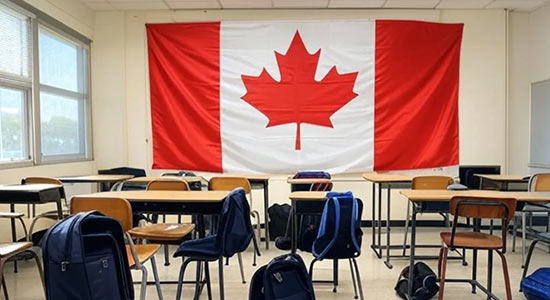
Canada has tightened the financial assessment process for international students applying for study permits, directing immigration officers to examine not only whether applicants have sufficient money but also whether their funds come from legitimate, reliable and sustainable sources.

The revised internal guidance issued by Immigration, Refugees and Citizenship Canada expands the scrutiny applied to proof-of-funds documents as part of efforts to strengthen the integrity of the international student programme.
Under the updated instructions, officers are expected to assess the source of an applicant’s funds in every case rather than limiting enhanced verification mainly to applications considered high-risk.
This means that applicants may be required to explain how money appearing in their accounts was earned or obtained and provide additional records where the available documents do not clearly establish that the funds are genuine and accessible.
Officers may request personal, family, employment, business and financial documents to confirm that an applicant or sponsor can provide continuing support throughout the proposed period of study.
The updated guidance reportedly recommends six months of bank statements, including the month in which the application was submitted or the month immediately preceding it. Earlier guidance referred to four months of bank statements. (CIC News)
The longer review period is expected to help immigration officers identify sudden deposits, unexplained transfers and funds temporarily placed in accounts solely to satisfy visa requirements.
Applicants relying on financial support from parents, relatives or other sponsors may consequently need to provide employment letters, payslips, business records, tax documents and evidence explaining the relationship between the applicant and the sponsor.
The revised framework also identifies pension income and earnings from rental properties as examples of evidence that may be used to demonstrate financial capacity.
However, bank drafts convertible into Canadian dollars were reportedly removed from the illustrative list contained in the updated internal instructions.
IRCC’s public-facing proof-of-financial-support page had not fully reflected those changes at the time of this check. The page still listed four months of bank statements and convertible bank drafts among common proof-of-funds documents, indicating that applicants should also review the instructions applicable to their country and application route.
International students seeking extensions of their existing study permits will also face closer financial scrutiny.
Under the revised guidance, immigration officers are expected to assess whether an extension applicant possesses sufficient resources for the first year following the requested extension, rather than merely checking funding for the next semester or immediate period.
Despite the enhanced verification process, Canada has not increased the minimum living-expense requirement under this particular update.
A single applicant intending to study outside Quebec must continue to demonstrate access to at least CAD$22,895 for one year of living expenses, excluding tuition fees and transportation costs.
Applicants must also show that they can pay their tuition, meet transportation expenses and support any accompanying family members without depending on employment in Canada.
For programmes lasting longer than one year, students are required to demonstrate sufficient resources for the first year and explain how they intend to finance the remainder of their studies.
Acceptable supporting documents may include proof of tuition and accommodation payments, Canadian or foreign bank statements, guaranteed investment certificates, education loans, scholarship documents and letters from individuals or institutions providing financial support.
IRCC has also retained the authority to demand additional documentation whenever an officer considers the information initially submitted insufficient to establish an applicant’s financial ability.
The tougher assessment is likely to have a significant impact on prospective Nigerian students, particularly applicants whose funding is provided by relatives, businesses or several different sources.
Applicants will need to ensure that their bank records show a consistent financial history and that large or recent deposits are supported by credible documentation explaining their origin.
The changes do not mean that every applicant must submit all possible financial documents. However, the evidence presented must clearly establish that the required funds are available, lawfully obtained and capable of supporting the student throughout the relevant period of study.
Canada’s official requirements continue to state that international students must prove they can pay their tuition, living expenses and transportation costs before a study permit can be approved.
[A MUST HAVE] Evidence Act Demystified With Recent And Contemporary Cases And Materials

Available now for NGN 40,000 at ASC Publications, 10, Boyle Street, Onikan, Lagos. Beside High Court, TBS. Email publications@ayindesanni.com or WhatsApp +2347056667384. Purchase Link: https://paystack.com/buy/evidence-act-complete-annotation
______________________________________________________________________ “Enhance Legal Practice With Authoritative Reports” — Alexander Payne Offers Comprehensive Law Reports, Spanning Over A Century Of Nigerian Jurisprudence Interested buyers are encouraged to place their orders and enquiries via:
0704 444 4777, 0704 444 4999, 0818 199 9888
Website: www.alexandernigeria.com
Interested buyers are encouraged to place their orders and enquiries via:
0704 444 4777, 0704 444 4999, 0818 199 9888
Website: www.alexandernigeria.com