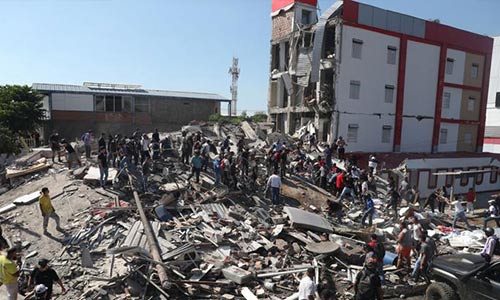
At least 169 people have been killed and about 700 others injured after a powerful 7.4-magnitude earthquake struck western Colombia, collapsing hospitals, schools and residential buildings and leaving scores of people trapped beneath rubble.

The earthquake, which struck on Monday, caused widespread destruction across several cities, including Pereira, Cali, Quibdó, Manizales and Armenia, all of which were placed under the country’s highest disaster alert.
Colombia’s newly inaugurated President, Abelardo De La Espriella, declared a national disaster and ordered the mobilisation and coordination of emergency resources as rescue teams continued searching damaged buildings for survivors.
The President said an estimated 5,000 homes had been damaged or destroyed, while 188 people remained missing.
Three hospitals reportedly collapsed completely, while 18 others were affected by the earthquake. At least 39 schools also sustained damage.
Seven airports suspended operations as authorities assessed structural damage and disruptions to electricity and other essential services.
Hospitals, roads, transportation systems, aqueducts, electricity infrastructure and telecommunications were also disrupted in some of the worst-hit areas.
The epicentre of the earthquake was reported near San José del Palmar municipality in the Chocó department.
Colombia’s Geological Service described the tremor as the strongest earthquake to strike the country this century.
In Valle del Cauca, Governor Dilian Francisca Toro described the situation as serious and reported at least 27 deaths, including three children.
The University Hospital of the Valley suffered structural damage, forcing medical workers to move some patients, including infants, outdoors while evacuation and rescue operations were carried out.
In Chocó, Governor Nubia Carolina Córdoba-Curi reported at least 13 deaths and dozens of injuries while authorities continued assessing damage to buildings and critical infrastructure.
Pereira, one of the cities in Colombia’s coffee-growing region, was also badly affected.
Mayor Mauricio Salazar reported at least 18 deaths in the city, while several buildings collapsed and rescue teams searched for people believed to be trapped.
In nearby Manizales, Mayor Jorge Eduardo Rojas reported at least two deaths.
Cali also suffered extensive damage, with Mayor Alejandro Eder reporting that at least 20 buildings had collapsed, some with people trapped inside.
Emergency teams and volunteers established temporary operational centres and began clearing rubble in an effort to reach survivors.
The disaster struck as Cali was hosting a week-long festival celebrating the region’s Afro-Pacific culture, an event that normally attracts hundreds of thousands of visitors.
Residents described scenes of panic as buildings shook violently and structures collapsed around them.
Cali resident Luis Angel Sarria said the earthquake was extremely severe and that many buildings had been damaged or destroyed.
“There are many damaged buildings, collapsed buildings, people trapped and fatalities; the quake felt here was very severe,” he said.
In Jamundí, south of Cali, resident Maria Alejandra Soto Zea said she was inside her seventh-floor apartment with her two-year-old son when the shaking began.
She said the tremor became so intense that she was unable to immediately reach the exit and instead held onto a kitchen counter while carrying her child.
When the shaking stopped, she carried the toddler down seven flights of stairs and evacuated the building amid fears of further tremors.
A magnitude 5.0 aftershock was recorded less than an hour after the initial earthquake, approximately 10 miles west of San José del Palmar.
Authorities warned residents to remain alert for further aftershocks.
Colombia’s civil aviation authority said airports in Cali, Pereira, Manizales, Quibdó, Armenia, Cartago and Buenaventura were affected by the earthquake, including through power outages and possible structural damage.
Flights were temporarily suspended at several airports pending safety assessments, although the Alfonso Bonilla Aragón International Airport serving Cali later resumed operations after electricity was restored.
At Pereira airport, videos showed parts of the ceiling collapsing as passengers and workers sought shelter.
One traveller, José Gallegos, said he hid under a table while dust filled the building and sections of the ceiling fell around him.
“Everything fell apart in a second,” he said, adding that he feared he was going to die.
Authorities also imposed security measures in some affected areas amid concerns about looting, with police and military personnel deployed to assist rescue operations and maintain order.
The United States announced $15.5 million in emergency assistance to Colombia for shelter, food, protection and other humanitarian needs.
The US State Department said it was prepared to support the Colombian government as authorities assessed the scale of the disaster.
The International Rescue Committee also expressed concern about the impact of the earthquake on Chocó, warning that communities in the region were already struggling with armed conflict and poverty before the disaster.
The organisation said damage to hospitals and clinics could further worsen access to healthcare and other essential services.
The earthquake revived painful memories of the January 1999 magnitude 6.1 earthquake that devastated Colombia’s coffee-growing region, killing nearly 1,200 people and leaving an estimated 250,000 homeless.
Rescue operations remained underway as emergency personnel searched collapsed structures, treated the injured and assessed damage across western Colombia.
Authorities have warned that the casualty figures could change as rescue teams gain access to affected communities and recover people trapped beneath collapsed buildings.
[A MUST HAVE] Evidence Act Demystified With Recent And Contemporary Cases And Materials

Available now for NGN 40,000 at ASC Publications, 10, Boyle Street, Onikan, Lagos. Beside High Court, TBS. Email publications@ayindesanni.com or WhatsApp +2347056667384. Purchase Link: https://paystack.com/buy/evidence-act-complete-annotation
______________________________________________________________________ “Enhance Legal Practice With Authoritative Reports” — Alexander Payne Offers Comprehensive Law Reports, Spanning Over A Century Of Nigerian Jurisprudence Interested buyers are encouraged to place their orders and enquiries via:
0704 444 4777, 0704 444 4999, 0818 199 9888
Website: www.alexandernigeria.com
Interested buyers are encouraged to place their orders and enquiries via:
0704 444 4777, 0704 444 4999, 0818 199 9888
Website: www.alexandernigeria.com