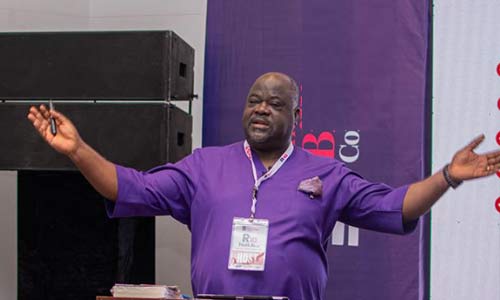
The Chief Executive Officer of Common Sense Group and cleric, Dr Olumide Emmanuel, has urged Nigerians to adopt solar energy, revealing that the entire Presidential Villa at Aso Rock is powered by solar and arguing that President Bola Tinubu’s decision to settle the seat of power with renewable energy is itself a message to the nation about the future of electricity in Nigeria.

Emmanuel, in an extensive interview with PUNCH, also rated the Tinubu administration six out of ten on economic management, defended the removal of the fuel subsidy and the floating of the naira as “right decisions,” praised the Dangote Petroleum Refinery as the country’s “saviour,” called for governors and local government chairmen to be held more accountable for their use of increased allocations, and offered practical advice on savings, investment, and generational wealth creation in an era of economic hardship.
Emmanuel’s most striking revelation was his assertion that the Presidential Villa operates entirely on solar power — a fact he used to argue that ordinary Nigerians and businesses should follow the same path rather than continuing to depend on diesel generators and an unreliable national grid.
“Do you know that the whole of Aso Rock is solar-powered? What are they telling you? ‘Go and do solar.’ If the president that is telling you he will give you light has settled himself and everybody in Aso Rock with solar, what is he telling you? So, why are we fooling ourselves?” Emmanuel stated.
He illustrated the economic logic using his own organisation’s experience. Common Sense Group was spending N7.5 million monthly on diesel as of February 2026, but by May that figure had doubled to N15 million — a projected annual diesel bill of nearly N200 million.
When the organisation explored solar alternatives, the cost of a comprehensive solar installation was quoted at N130 million. Emmanuel said the decision was straightforward: borrow the money at 30 per cent interest, eliminate the diesel expenditure entirely, and allow the solar system to pay for itself over five years.
“We considered solar. They said it will cost N130 million. So, if we do solar, we will put everything on solar. I said, ‘Let’s go and borrow the money.’ We’ll pay 30 per cent interest. At the end of the day, we’ll still spend the N200 million, but now we’ll no longer pay for the diesel, and the solar will now take us five years,” Emmanuel explained.
Emmanuel addressed the significant revenue boost that Nigeria has received from rising crude oil prices, driven by geopolitical developments including what he described as the US-Iran war and the closure of the Strait of Hormuz. With crude oil prices rising above $100 per barrel — well above the 2026 budget benchmark of $64.85 per barrel — Nigeria is experiencing a substantial windfall.
However, Emmanuel argued that the critical question is not how much money is available but how it is spent, shifting the accountability spotlight from the presidency to state governors and local government chairmen.
“A lot of the governors actually have more money available to them than they have ever had in the history of the states. Some governors are getting up to four times what they used to get and some three times. So, there has been a lot of money available since the removal of the subsidy,” Emmanuel observed.
He insisted that despite these unprecedented allocations, many governors are not delivering on their responsibilities. “We need to begin to hold the governors and the local government chairmen more accountable than just looking towards the president for everything. Because now, the governors really have serious money with them. And despite the money that they have, a lot of them are not doing what they’re supposed to do,” he stated.
Emmanuel rejected the commonly held view that Nigeria suffers from insufficient revenue, arguing instead that the country’s fundamental challenge is one of management and multiplication of resources.
“I don’t think our country has a revenue problem, even though people try to claim that. I think we have a management and multiplication problem. I’ve never believed that Nigeria is poor. Because if you look at the level of corruption that is going on, you realise that all the money that people have stolen, if that money was not stolen, then the money would be there. So, it’s not a revenue problem,” Emmanuel declared.
He broke down the wealth creation process into three stages making money, managing it, and multiplying it arguing that Nigeria’s failure occurs primarily at the management stage. “If you make the money and you don’t manage it well, improper management of what you make will make you look like someone that is not making any money, which is part of our major issue,” he explained.
On fuel prices, which have climbed above N1,300 per litre despite rising oil revenues, Emmanuel mounted a vigorous defence of the Dangote Petroleum Refinery and argued that Nigerians have short memories about the suffering that preceded the refinery’s operations.
“Truth be told, the Dangote Petroleum Refinery has become our saviour. The man had foresight and did what he did. If there were no Dangote refinery, all these people talking about price would be in the queue now for hours because we seem to always forget all those things. Now the fuel is available. If you cannot afford it, keep your car or decide where you want to go,” Emmanuel stated.
He explained the economic reality facing Dangote: the same oil price increase that benefits Nigeria as a crude exporter hurts the refinery as a crude buyer. “Dangote is not the government. The man is buying crude at above $100. That $100+ that is benefiting Nigeria, it is suffering for Dangote. And you expect him to sell it to you cheap. This is just economics. If you want cheap fuel, produce your own. All the refineries should work,” Emmanuel argued.
He drew comparisons with developed economies: “There are people that have cars in London; they can’t drive them to work every day because they cannot afford it. They have to use public transport or use the train to go to work.”
Emmanuel called for every state government to invest in independent power generation, noting that the constitutional barriers that previously prevented states from entering the power sector have been removed.
He recalled the confrontation between then-Governor Bola Tinubu and the Olusegun Obasanjo administration over Lagos State’s attempt to develop independent power, which was blocked on the grounds that electricity was on the exclusive legislative list. “But now all those things are gone. Every state can generate power now. Why are states not generating power? Why are the states not doing that now that they have the money and they have the freedom?” Emmanuel asked.
Emmanuel rated the Tinubu administration six out of ten on economic performance after three years in office. He acknowledged that the removal of the fuel subsidy and the floating of the naira were “right decisions” that had increased government revenues, but noted that making the right decision and implementing it effectively are two different things.
He identified several factors that are preventing the positive macro-economic indicators from translating into improved living standards for ordinary Nigerians: the country’s heavy debt burden, the fact that much of Nigeria’s crude oil production had been pledged against debts before the current administration took office, the continued dominance of recurrent expenditure over capital expenditure, persistent corruption, and the failure of the power sector — from generation to transmission to distribution and metering.
“We are making more money, but we have a lot of debt, and we have a lot of expenses that are leaving only a little for the capital expenditure that will affect the people,” Emmanuel explained.
On infrastructure, he pointed to the absence of rail transport for food distribution as a major driver of food inflation. “Why do we have a food problem? The roads are bad. Foods get spoilt on the road. In developed nations, they don’t carry food by trucks. They carry food by train. Where is the rail to bring the food from the north to the south?” he asked.
Emmanuel praised the new tax regime introduced at the start of 2026 as “one of the most fantastic things that this administration has done,” but criticised the government’s communication of its benefits.
He explained that the new law exempts low-income earners from tax entirely, provides tax-free status for small and medium-scale businesses with low turnover, and replaces flat-rate taxation with a graduated system. “If they are able to implement it and allow it to go the way it was agreed upon, it will help a lot of businesses, families, and the country,” Emmanuel stated.
Emmanuel offered direct financial advice to Nigerians navigating the current economic climate, drawing a clear distinction between saving and investing.
“Saving is not an investment. Savings is required for you to have money to invest. If you don’t save, you are not safe. No matter how poor and wretched you think you are, you have to save. Everybody must save a minimum of 10 per cent of every income that comes into their life,” he stated.
On investment, he highlighted the strong performance of the Nigerian stock market over the past three years, noting that treasury bills, bonds, mutual funds, and even dollar-denominated instruments are available to Nigerian investors.
He urged Nigerians to diversify their income sources, suggesting that those who work during the day should explore remote work opportunities on other continents for a few hours in the evening. “If you are working in Nigeria during the day, is there any other work I can do remotely for two or three hours on any other continent before you go to sleep?” he asked.
On the question of why family businesses in Nigeria rarely survive beyond their founders, Emmanuel offered a generational analysis.
“The first generation is usually the pioneering generation. They suffer, struggle, and build wealth. Their children, the second generation, enjoy better education, exposure, and comfort. They become the maintenance generation. Then the third generation grows up without going through any hardship or sacrifice, and eventually the wealth collapses,” Emmanuel explained.
His prescription was clear: “For businesses to survive generations, every generation must become a pioneering generation again. They must maintain what was built, but also innovate, rebrand, reposition, and create new products for changing times.”
He also advised against building businesses exclusively around family: “Do not start businesses just for the family. A family business will collapse if the children are not interested in running it. Family members can own the business without necessarily managing it. There is a difference between ownership and management.”
[A MUST HAVE] Evidence Act Demystified With Recent And Contemporary Cases And Materials

Available now for NGN 40,000 at ASC Publications, 10, Boyle Street, Onikan, Lagos. Beside High Court, TBS. Email publications@ayindesanni.com or WhatsApp +2347056667384. Purchase Link: https://paystack.com/buy/evidence-act-complete-annotation
______________________________________________________________________ “Enhance Legal Practice With Authoritative Reports” — Alexander Payne Offers Comprehensive Law Reports, Spanning Over A Century Of Nigerian Jurisprudence Interested buyers are encouraged to place their orders and enquiries via:
0704 444 4777, 0704 444 4999, 0818 199 9888
Website: www.alexandernigeria.com
Interested buyers are encouraged to place their orders and enquiries via:
0704 444 4777, 0704 444 4999, 0818 199 9888
Website: www.alexandernigeria.com