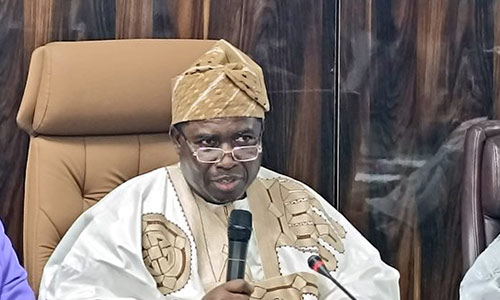
The Chairman of the Independent National Electoral Commission (INEC), Professor Joash Amupitan, SAN, has defended the use of artificial intelligence (AI) in election management, insisting that the technology can strengthen electoral administration while warning that its misuse could undermine public confidence in Nigeria’s 2027 general elections.

Amupitan said artificial intelligence could improve voter registration processes, detect duplicate records, enhance logistics planning, support data analysis and strengthen the management of large voter databases.
However, he warned that the increasing availability of generative AI tools had made it easier for malicious actors to create manipulated videos, cloned voices and false electoral announcements capable of misleading voters and disrupting the electoral process.
The INEC chairman spoke on Monday, November 2, 2026, in Abuja at the National Summit on Electoral Information Integrity, themed “Beyond the Ballot: AI, FIMI, and the Integrity of Nigeria’s 2027 Elections.”
The summit brought together electoral stakeholders, media professionals, technology experts and civil society organisations to examine the threats posed by artificial intelligence, disinformation and foreign information manipulation and interference ahead of the elections.
Addressing participants, Amupitan maintained that AI should not be regarded as inherently harmful to democracy, noting that electoral management bodies across the world were increasingly deploying technology to improve efficiency and strengthen their operations.
“Artificial Intelligence is not an enemy of democracy,” he declared.
He explained that machine learning could assist electoral institutions in identifying duplicate entries in voters’ registers, improving the deployment of election materials, analysing electoral data and reducing administrative difficulties.
According to him, the application of such technology could help election management bodies address operational challenges, particularly in countries with large populations and difficult geographical conditions.
Nevertheless, Amupitan warned that the benefits of AI must be balanced against the dangers associated with its deliberate misuse.
He expressed concern that technological capabilities previously available mainly to sophisticated intelligence organisations had become accessible to individuals and groups at relatively low cost.
The INEC chairman identified voice cloning, realistic AI-generated videos, automated disinformation networks and the impersonation of election officials as some of the emerging threats to electoral credibility.
He explained that malicious actors could now generate convincing audio recordings of political figures making statements they never made or create videos falsely depicting electoral officials announcing election results or changes to voting arrangements.
Such content, he warned, could spread rapidly through social media platforms and influence public perceptions before electoral authorities had an opportunity to correct the misinformation.
Amupitan said the threat was no longer limited to physical interference with elections, such as ballot snatching, attacks on polling units or the disruption of election logistics.
According to him, electoral processes could now be undermined through coordinated digital manipulation long before voting commenced.
He noted that fabricated election directives, fraudulent voter registration websites and misleading information concerning the voters’ register could be circulated to confuse eligible voters.
The chairman also warned that manipulated announcements concerning the postponement or cancellation of elections could discourage participation or create uncertainty about the official electoral timetable.
He explained that the circulation of false election results during collation could trigger tension, undermine public confidence and potentially threaten public order.
Amupitan particularly expressed concern about the possibility of manipulated audio or video recordings being released shortly before election day, when candidates and relevant institutions might have limited opportunities to respond.
He cited the 2023 parliamentary election in Slovakia, during which an AI-generated audio recording falsely portrayed a political figure discussing electoral manipulation shortly before voting.
According to him, the incident demonstrated how false information released during sensitive electoral periods could spread faster than verification and correction mechanisms.
The INEC chairman maintained that simply educating citizens about the existence of deepfakes would not be sufficient to protect Nigeria’s electoral system against sophisticated disinformation campaigns.
He therefore called for a coordinated response involving INEC, security agencies, independent fact-checkers, media organisations, telecommunications companies and social media platforms.
Amupitan said the commission was strengthening its technical and communication capabilities to identify manipulated content, verify suspicious information and issue timely clarifications.
He disclosed that INEC was developing arrangements for monitoring digital information and responding rapidly to coordinated attempts to interfere with election-related communications.
The commission, he explained, was also exploring ways of using appropriate technological safeguards to protect its digital infrastructure against manipulation and cyberattacks.
He stressed the need for electoral authorities to work directly with major technology companies to ensure that misleading content capable of disrupting electoral operations could be promptly reviewed.
According to him, INEC had already entered into a memorandum of understanding with TikTok as part of efforts to strengthen cooperation against election-related disinformation.
He also identified Facebook, Instagram, WhatsApp, YouTube, Telegram and X among the platforms whose cooperation would be important in addressing digital threats.
Amupitan called for stronger voter education programmes that would teach Nigerians not only how to vote but also how to verify election-related information.
He said such programmes should help citizens distinguish official INEC announcements from fabricated statements, manipulated videos and other misleading content.
The chairman emphasised the importance of communicating verified information in indigenous languages and Nigerian Pidgin, particularly through platforms widely used by communities with limited access to conventional information channels.
He also urged media organisations to strengthen fact-checking procedures and establish direct communication channels with electoral officials to verify suspicious announcements before publication.
Amupitan maintained that the commission could not independently address every threat arising from AI-generated misinformation and foreign interference.
He consequently advocated a coordinated national mechanism that would clearly identify the responsibilities of institutions involved in detecting, verifying and responding to incidents of electoral information manipulation.
The INEC chairman proposed the establishment of formal communication arrangements between the commission’s information officers, media monitoring organisations and independent fact-checking institutions.
He also called for practical simulations to test how electoral authorities and other stakeholders would respond to fabricated announcements, deepfake videos and coordinated digital attacks during the 2027 elections.
According to him, the commission had already participated in exercises designed to assess its capacity to respond to such scenarios.
However, Amupitan cautioned that efforts to address disinformation must not be used as justification for censorship, suppression of political dissent or restrictions on constitutionally protected freedoms.
He maintained that measures introduced to protect election information must remain transparent, proportionate and consistent with the rule of law.
The chairman stressed that legitimate political criticism, freedom of expression and independent journalism must continue to be protected even as authorities strengthen safeguards against digital manipulation.
He explained that the objective was to preserve the authenticity of election-related information rather than regulate political opinions or prevent citizens from expressing dissenting views.
The INEC chairman’s remarks come as the commission intensifies preparations for the 2027 general elections, with the presidential and National Assembly elections scheduled for January 16, 2027.
In October, Amupitan disclosed that INEC was developing an artificial intelligence governance framework to support election administration while ensuring that sensitive electoral decisions remained subject to human oversight.
He explained that AI-assisted systems could support logistics planning, voter education, cybersecurity, the detection of duplicate voter records and the identification of anomalies in electoral documentation.
However, he maintained that the commission would not surrender critical electoral decisions, including the determination of election results and candidate eligibility, to autonomous algorithms.
The chairman had also reiterated that the outcome of the 2027 elections would be determined by Nigerian voters rather than artificial intelligence.
His latest remarks therefore underscore INEC’s position that AI could serve as a useful administrative and security tool while also presenting risks that require safeguards.
As Nigeria approaches the general elections, Amupitan maintained that protecting electoral credibility would require more than securing polling units and election materials.
He said the commission and other stakeholders must also ensure that voters have access to reliable information and are protected against deliberate attempts to manipulate their electoral decisions through fabricated digital content.
The INEC chairman expressed optimism that cooperation among electoral institutions, media organisations, technology companies and civil society groups would strengthen the integrity of the electoral process.
He maintained that credible elections would depend not only on the physical security of voting arrangements but also on the reliability of the information available to citizens before, during and after the polls.
[A MUST HAVE] Evidence Act Demystified With Recent And Contemporary Cases And Materials

Available now for NGN 40,000 at ASC Publications, 10, Boyle Street, Onikan, Lagos. Beside High Court, TBS. Email publications@ayindesanni.com or WhatsApp +2347056667384. Purchase Link: https://paystack.com/buy/evidence-act-complete-annotation
______________________________________________________________________ “Enhance Legal Practice With Authoritative Reports” — Alexander Payne Offers Comprehensive Law Reports, Spanning Over A Century Of Nigerian Jurisprudence Interested buyers are encouraged to place their orders and enquiries via:
0704 444 4777, 0704 444 4999, 0818 199 9888
Website: www.alexandernigeria.com