

The Socio-Economic Rights and Accountability Project (SERAP) has given the Chairman of the Independent National Electoral Commission (INEC), Professor Joash Amupitan, seven days to take steps towards prosecuting persons arrested in connection with reported electoral and political violence across Nigeria ahead of the 2027 general elections.

SERAP urged Amupitan to obtain relevant case files and investigation materials from the Nigeria Police Force and ensure that suspects against whom sufficient evidence exists are prosecuted for offences under the Electoral Act 2026.
The organisation also called on INEC to work with the Police to identify, investigate and prosecute those allegedly responsible for organising, financing or sponsoring political violence, warning that failure to enforce electoral laws could encourage further attacks and undermine the credibility of the 2027 elections.
The demand followed reports of violent incidents involving political parties, candidates and supporters across the country, including the alleged attack on members and supporters of the Nigeria Democratic Congress (NDC) during a town hall meeting in Oregun, Lagos State, on November 12, 2026.
In a letter dated November 14, 2026, and signed by its Deputy Director, Kolawole Oluwadare, SERAP urged the INEC Chairman to direct the Commission’s legal officers or appointed legal practitioners to review police investigation files and commence prosecutions wherever the available evidence establishes electoral offences.
The organisation maintained that INEC has a statutory responsibility to prosecute electoral offences and ensure accountability, irrespective of the political affiliations or positions of those involved.
“The prosecution of electoral offences is essential not only to punish individual offenders but also to deter future violations and prevent the normalisation of electoral and political violence in the country,” SERAP stated.
It added: “INEC has a clear statutory responsibility to prosecute electoral offences and ensure that those responsible are held to account, regardless of their political affiliations or positions. Effective prosecutions would send a clear message that no individual, political party, candidate, or group is above the law.”
SERAP also asked the Commission to press the Police to intensify and conclude investigations into other reported incidents, identify and arrest additional suspected perpetrators and their sponsors, and transmit relevant evidence to INEC for prosecution.
The organisation further urged Amupitan to exercise INEC’s powers under Section 83 of the Electoral Act 2026 to demand explanations from political parties suspected of involvement in or encouragement of prohibited conduct.
It called on the Commission to impose the prescribed fine on any political party that fails to respond to or comply with a lawful directive.
SERAP warned that it would institute legal proceedings if the Commission failed to take the recommended measures within seven days.
“We would be grateful if the recommended measures are taken within seven days of the receipt and/or publication of this letter. If we have not heard from you by then, SERAP shall take all appropriate legal actions to compel you and INEC to discharge your statutory responsibilities in the public interest,” the organisation stated.
Explaining the reasons for its intervention, SERAP expressed concern over increasing reports of electoral violence, threats, intimidation and attacks on political meetings, candidates, supporters and campaign activities.
It said several incidents had been reported since campaigns for the 2027 general elections commenced on August 19, 2026, including attacks on political convoys and party secretariats, disruptions of rallies and meetings, and intimidation of political opponents.
According to the organisation, some of the reported incidents resulted in deaths, injuries, destruction of property and arrests.
“These developments raise serious concerns about the safety of political participants, the ability of parties and candidates to campaign freely, and the prospects for peaceful, free and credible general elections in 2027,” SERAP stated.
It warned that failure to prosecute suspected perpetrators could encourage further attacks, deepen impunity and create a climate of fear capable of preventing opposition parties from holding meetings or candidates from freely engaging voters.
SERAP also expressed concern that persistent political intimidation could silence journalists and discourage citizens from participating in political activities.
“Failure to prosecute suspected perpetrators could encourage further attacks and deepen impunity. Such a climate of fear may deter opposition parties from holding meetings, prevent candidates from reaching voters, silence journalists and undermine citizens’ political participation,” the letter stated.
Citing reported incidents, SERAP referred to the alleged obstruction of the convoy of the NDC presidential candidate, Peter Obi, in Benue State on September 8, 2026.
It also mentioned an attack on an NDC ward meeting and a separate Peoples Democratic Party (PDP) rally in Enugu State on September 12, 2026.
The organisation listed the reported attack on the convoy of African Democratic Congress (ADC) senatorial candidate Herberta Okonofua in Edo State on October 6, 2026.
It further referred to attacks on NDC supporters during the campaign activities of governorship candidate Chinyeaka Ohaa in Enugu State on October 10, 2026, in which one supporter reportedly died subsequently.
SERAP also cited an attack on supporters of Accord governorship candidate Oriyomi Hamzat during a procession in Ibadan on October 14, 2026, which reportedly resulted in one death.
The organisation referred to another incident involving the convoy of NDC candidate Rollins Offia-Nwali in Ebonyi State on October 22, 2026, in which one person was reportedly killed and three others injured.
It also listed the reported attack on African Action Congress (AAC) presidential candidate Omoyele Sowore and members of his team in Ado-Ekiti on October 30, 2026.
According to SERAP, subsequent incidents included an attack on Peter Obi’s convoy in Calabar on November 4, 2026, and violence during an NDC political procession in Asaba on November 7, 2026, which reportedly left one person dead and five others injured.
The organisation also referred to the alleged disruption of an NDC town hall meeting in Lagos by suspected armed men on November 12, 2026.
During the Lagos incident, journalist Samuel Adebanjo was reportedly assaulted and his equipment seized while covering the meeting.
SERAP maintained that the reported incidents demonstrated the need for stronger enforcement of electoral laws to protect political participants, journalists and members of the public.
It acknowledged reports of arrests and investigative measures taken by the Police but argued that arrests without prosecution would not guarantee accountability or deter future violence.
“While SERAP acknowledges the reported arrests and investigative steps taken by the Police, arrests alone are insufficient to secure accountability or deter further violations. Suspected perpetrators must be investigated and, where the evidence supports prosecution, brought before competent courts,” it stated.
The organisation insisted that responsibility should extend beyond individuals who physically carry out attacks to those who allegedly organise, direct, finance or sponsor them.
“Those who organise, finance, direct or sponsor political violence must not escape accountability,” SERAP declared.
It explained that prosecuting electoral offences would reassure Nigerians that they could express political opinions, support candidates, attend meetings and participate in campaigns without fear of violence or intimidation.
According to the organisation, the absence of a safe political environment could render citizens’ participation in the electoral process ineffective and undermine public confidence in election outcomes.
“Without such an environment, political participation risks becoming merely theoretical, while the credibility and legitimacy of the electoral process may be seriously undermined,” SERAP warned.
The organisation drew attention to provisions of the Electoral Act 2026 which it said prohibit electoral violence, intimidation and other forms of misconduct during political campaigns.
It cited Section 96(5), which prohibits political parties, aspirants and candidates from retaining, organising, training or equipping any person or group to use physical force or coercion to advance political objectives.
SERAP also referred to Section 96(6), which prohibits political parties, aspirants and candidates from keeping or using armed private security organisations, vanguards or other groups to provide security or assistance during campaigns, rallies, processions or elections.
It noted that Sections 96(7) and 96(8) prescribe penalties for violations of Section 96 and for aiding or abetting contraventions of subsection (5).
The organisation further cited Section 97 of the Act, which prohibits directly or indirectly threatening any person with force or violence during a political campaign to compel support for, or opposition to, a political party or candidate.
SERAP also referred to Section 120, which criminalises disorderly conduct intended to prevent the transaction of business at a political meeting, as well as possession of offensive weapons or missiles at such meetings.
It maintained that the penalties prescribed by these provisions reflected the seriousness of electoral violence but warned that the law would become ineffective if suspects were arrested without being prosecuted.
“The penalties prescribed by these provisions reflect the seriousness of political violence and intimidation. However, these statutory safeguards will be ineffective if suspects are arrested but not prosecuted,” it stated.
The organisation placed particular emphasis on Section 148(2) of the Electoral Act 2026, which it said provides that prosecutions under the Act shall be undertaken by INEC’s legal officers or legal practitioners appointed by the Commission.
It consequently urged INEC to work closely with the Police and other investigative authorities to obtain relevant evidence and institute prosecutions where sufficient grounds exist.
SERAP also cited Sections 150 and 151 of the Act, which empower the Commission to delegate its functions and issue regulations and guidelines for the effective implementation of the legislation.
According to the organisation, these provisions support the establishment of effective institutional arrangements for prosecuting electoral offences.
It acknowledged that the Police and other law-enforcement agencies bear primary responsibility for criminal investigations, arrests and evidence gathering.
However, SERAP maintained that the division of responsibilities between the Police and INEC should not create gaps that allow suspected electoral offenders to escape accountability.
“However, this division of responsibilities must not create a gap in accountability. INEC should proactively obtain relevant police reports and case files, assess the evidence and ensure that its legal officers or appointed practitioners promptly institute and conduct prosecutions where sufficient evidence exists,” the organisation stated.
SERAP further argued that the responsibility to prevent and address electoral violence was supported by Nigeria’s constitutional and international human rights obligations.
It referred to Section 14(2)(c) of the 1999 Constitution, as amended, which affirms that the participation of the people in their government shall be ensured.
The organisation also cited Sections 39 and 40 of the Constitution, which protect freedom of expression, assembly and association, and Section 42, which prohibits discrimination, including discrimination based on political opinion.
It maintained that these constitutional protections guarantee the rights of Nigerians to express political views, organise meetings, associate with political parties of their choice and participate freely in public affairs.
SERAP also referred to Article 25 of the International Covenant on Civil and Political Rights (ICCPR), which protects the right of citizens to participate in public affairs and elections.
It cited Articles 19, 21 and 22 of the Covenant, which protect freedom of expression, peaceful assembly and association, as well as Articles 2(1) and 2(3), which require respect for protected rights and the provision of effective remedies for violations.
Similarly, the organisation referred to Articles 9, 10, 11 and 13 of the African Charter on Human and Peoples’ Rights, which protect freedom of expression, association, assembly and participation in government.
SERAP noted that Article 1 of the Charter requires Nigeria to adopt measures to give effect to the rights guaranteed under the instrument.
The organisation insisted that INEC must demonstrate its commitment to credible elections by ensuring that electoral violence attracts legal consequences wherever sufficient evidence establishes an offence.
It maintained that prosecution of suspects, accountability for sponsors of violence and protection of citizens’ political rights were essential to creating a peaceful environment for the 2027 general elections.
SERAP consequently urged Amupitan to take the recommended steps within seven days of receipt or publication of its letter, warning that failure to act would leave the organisation with no option but to pursue appropriate legal remedies to compel compliance with INEC’s statutory responsibilities.
[A MUST HAVE] Evidence Act Demystified With Recent And Contemporary Cases And Materials
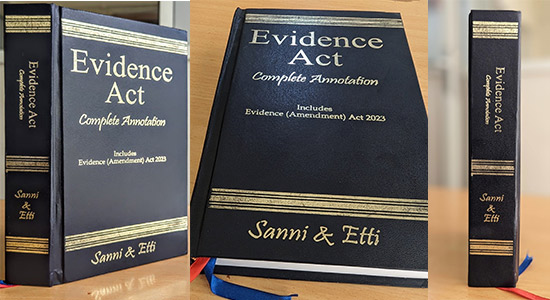
Available now for NGN 40,000 at ASC Publications, 10, Boyle Street, Onikan, Lagos. Beside High Court, TBS. Email publications@ayindesanni.com or WhatsApp +2347056667384. Purchase Link: https://paystack.com/buy/evidence-act-complete-annotation
______________________________________________________________________ “Enhance Legal Practice With Authoritative Reports” — Alexander Payne Offers Comprehensive Law Reports, Spanning Over A Century Of Nigerian Jurisprudence Interested buyers are encouraged to place their orders and enquiries via:
0704 444 4777, 0704 444 4999, 0818 199 9888
Website: www.alexandernigeria.com
“A Comprehensive Guide To Evidence Law” — Releases Second Edition In Three Volumes, Covering 4,051 Cases
For enquiries and orders, contact: 08035526491 Email: jerryamadisilk@gmail.com
 Prof. Jerry Amadi’s Evidence Law, Second Edition (2026), contains 3,314 pages in three volumes, covering the Evidence Act 2011, its 2023 amendment, and 4,051 Nigerian and English cases.