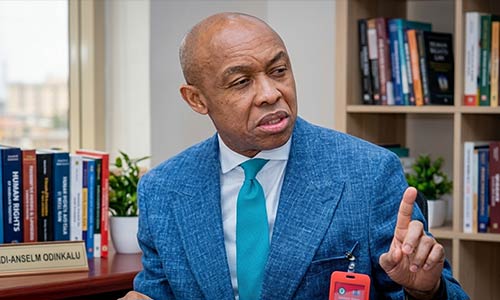
By Chidi Anselm Odinkalu

José Eduardo Van-Dúnem dos Santos was 37 when the ruling Popular Movement for the Liberation of Angola, (better known by its Portuguese acronym, MPLA) chose him to succeed its founding president, Augustinho Neto, in September 1979. By 2010, dos Santos had been in power for 31 years. But the shy and retreating dos Santos was neither an enthusiastic glad-hander nor a wildly popular figure.
For a long time, dos Santos laboured in search of a cure for both ailments. In 2010, he finally found one. Under Angola’s 1992 constitution, the president was the only leader with national standing. The citizens elected him directly on a national ticket. In December 2006, the country issued a three-year notice of presidential election to be conducted in 2009. When the time came, however, President dos Santos could not be bothered with one.
Instead, on 21 January 2010, the parliament controlled entirely by the MPLA approved a new constitution. On 5 February, dos Santos formally assented to the new constitution. It abolished the right of the people to elect their president and extended the unelected tenure of dos Santos as president until a new vote in 2012.
Under the terms of the new constitution, the president was to be elected no longer by the people. Instead, the leader of the majority party in the National Assembly would automatically assume power as the president. The parliament controlled by dos Santos and his MPLA had accomplished an extraordinary power-grab at the expense of the people and without even a pretense of giving them a say or look-in.
In neighbouring Democratic Republic of the Congo, President Joseph Kabila took notice. It took every tool in the DRC’s complex political economy to foil him. Elected to a second five-year term in 2011, “Kabila employed various strategies to prolong his stay in power” and “to manipulate the system to his advantage.” After running out of tenure tarmac in December 2016, Kabila contrived to grant himself an unelected two-year extension. In the end, the country forced him to yield up power in 2019 and bring an end to his 18-year rule.
In Togo, Faure Gnassingbe has presided over two republics over 21 years as successor to his father, General Gnassingbe Eyadema. As president, Faure has never faced a term limit that he could not lift. In May 2024, faced with a term limit that seemed insuperable, Faure, president of Togo since the death of his own father in 2005, abolished the executive presidency and the right of Togo’s citizens to elect their own president in order that he could continue in power.
Under a new constitution to usher in Togo’s 5th Republic in 2024, Parliament doubled the number of presidents in Togo from one to two. The office of the state president became largely ceremonial. Beside him, the constitution created the new and all-powerful office of President of the Council of Ministers in which it reposed all executive powers. In one swoop, Faure Gnassingbe ended all speculations about term limits and presidential elections.
Under the new constitution, the President of the Council of Ministers can hold office indefinitely as long as his party is in power. Indeed, Faure “could…. remain in power for life as president of the council as long as his party remained in the majority.” In a close reprise of the script by Angola’s MPLA, the amendment in Togo was authored entirely by the ruling party and with no opportunity for the people to participate. The political opposition in Togo called it a “constitutional coup”. Elsewhere in Africa, others have called it “a blueprint for dictators.”
One dictator who took close notice was Zimbabwe’s Emmerson Mnangagwa. When he overthrew the long-serving regime of President Robert Mugabe in November 2017, Mnangagwa – who goes by the nickname “the Crocodile” in homage to his political ruthlessness and cunning – was already 75. Many regarded him as no more than a stop-gap figure in what they hoped would be an assured transition to more open and democratic Zimbabwe. Instead, he began a methodical process of consolidating power in a scheme that appears clearly designed to guarantee him a life presidency (which he denied his predecessor).
When the tenure of the Chief Justice, Luke Malaba, fell due upon his turning 70 in May 2021, President Mnangagwa contrived to grant Malaba an unprecedented five-year extension and eventually got a compliant court system to fall in line. To manage suspected judicial un-ease ahead of presidential elections in August 2023, he awarded all judges a non-repayable housing loan of $400,000 US dollars.
In the period since Mnangagwa’s rise to power, over 25 leading military generals, including four of the six who propelled him to power, have died, most of them mysteriously.
Under Zimbabwe’s 2013 constitution, the president is elected to a five-year tenure, which can be renewed once. Elected to his first presidential term in 2018, Mnangagwa was liable to become term-limited in 2028. However, in October 2025, the ruling ZANU-PF Party decided to seek an extension of his tenure for the sake of continuity and national stability.
On 7 July, 2026, President Mnangagwa assented to a constitutional amendment “extending the presidential term from five to seven years and abolishing the popular election of the president in favour of selection by parliament, a change that will keep him in office two years beyond the limit previously set by the constitution.” Again, it was an entirely parliamentary affair.
So, in 2028 when he is due to turn 86 and become term-limited, President Mnangagwa will instead be presented to the people of Zimbabwe for the formality of continuing his rule until he is at least 93. If his tenure is renewed at the end of that, Mnangagwa will be eligible to rule until he is a centenarian, and the people of Zimbabwe will have no say in this.
Nearly three years ago, in November 2023, Nigeria’s former President, Olusegun Obasanjo, who himself tried – and failed – to grant himself an extended tour of duty in the presidency beyond the eight years permitted by the constitution under which he took office in May 1999, complained that Western-style democracy was forced on Africa and was not good for the continent. He was short of clarity on a model that could replace it.
Perhaps inspired by Obasanjo’s complaint, his disciples in power across different political traditions on the continent now offer experiments in how to attain his goal. The emerging elements are clear.
First, the people are inconvenient. Increasingly, the question of who sits at the top of the pecking order of power is to be decided by folks entirely beholden to the ruler and not by a perennially obstreperous citizenry.
Second, parliament and judges are dependable enablers of dictatorship. It is a lot cheaper to pay them off and much easier to eliminate or isolate hold-outs among them with no complaints.
Third, popular elections are an unaffordable luxury. It is more efficient to carve up the country into small, manageable constituencies in the service of pretend democracy.
Fourth, periodic renewal of mandate is an anachronism. It pays to keep things predictable and simple. A life presidency does it.
Around the continent, many wannabe life presidents are limbering up. Wherever you look, the future of government of the people, for the people, and by the people in Africa increasingly looks beleaguered, if not indeed bleak.
A lawyer and a teacher, Odinkalu can be reached at chidi.odinkalu@tufts.edu
[A MUST HAVE] Evidence Act Demystified With Recent And Contemporary Cases And Materials

Available now for NGN 40,000 at ASC Publications, 10, Boyle Street, Onikan, Lagos. Beside High Court, TBS. Email publications@ayindesanni.com or WhatsApp +2347056667384. Purchase Link: https://paystack.com/buy/evidence-act-complete-annotation
______________________________________________________________________ “Enhance Legal Practice With Authoritative Reports” — Alexander Payne Offers Comprehensive Law Reports, Spanning Over A Century Of Nigerian Jurisprudence Interested buyers are encouraged to place their orders and enquiries via:
0704 444 4777, 0704 444 4999, 0818 199 9888
Website: www.alexandernigeria.com
Interested buyers are encouraged to place their orders and enquiries via:
0704 444 4777, 0704 444 4999, 0818 199 9888
Website: www.alexandernigeria.com