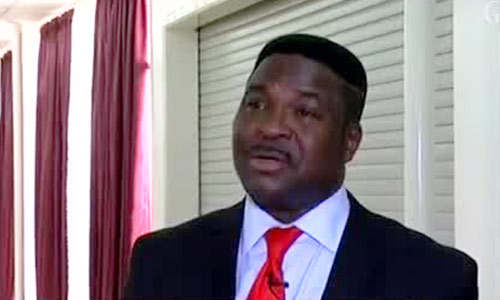
By Mike Ozekhome, SAN

INTRODUCTION
On 26th May, 2020, we analysed this topical constitutional issue in Part 1. Today, we shall conclude our discourse: except there is an amendment to section 36 of the 1999 Constitution, virtual court proceedings shall be declared null and void. Mark my words. I predicted in this manner in the Orji UzorKalu, Rivers, Bayelsa, Zamfara and Imo cases. They all came to pass. It is better to tarry awhile and amend the Constitution first.
CHALLENGES POSED BY VIRTUAL COURT HEARINGS
Let us state right away that our legal system has not been all analogue. After all, the Law Pavilion Electronic Law Report (LPELR), Nigerian Weekly Law Report (NWLR) electronic versions, have since been in use. However, aside the obvious constitutional obstacles posed by section 36 of the 1999 Constitution, a virtual court hearing poses multi-faceted challenges beyond our immediate contemplation. Even advanced countries of the world with upscale technological, socio-economic and infrastructural development still have open court sittings. I have watched the USA Supreme Court’s physical sittings on a couple of times. Virtual Court sittings would have been less problematic if they related only to mere harmless motions, non-adversarial applications, simple oral evidence and non-contentious threshold proceedings. The questions are legion: What happens when evidence is given, such that requires vigorous cross examination and physical identification and calculation of figures, pictures, signatures, etc? How do you take finger prints electronically and prove same through the same process? How do you deal with our epileptic power supply where some patients have been known to have died during operations due to sudden black out? What about witnesses (and they are in the majority) resident in rural areas, whoare involved in deadly chieftaincy, land and succession matters? How do you rail-road them into a zoom camera? What about the fact that unlike a normal court sitting where any member of the public can easily stroll in physically, zoom or skype proceedings are only accessible to those who have actually been invited, using a special password? Let us behold more virtual court challenges.
ONLINE DISPUTE REOLUTION PROCEEDINGS
Even some of the ‘Online Dispute Resolution’ (ODR) technological machines currently being used are only as efficient as their Internet Service Providers, leading to great risk of possible technical failures in the transmission of documents, or in the conduct of videoconferences. This impairs a party’s adequate response to allegations made by the opposing party (contrary to section 36(2)(a) of the Nigerian Constitution); a scenario not possible with traditional arbitration mechanisms.
Even at that, under Article 9 of theUNCITRAL Model Law on International Commercial Arbitration, parties have the discretion as to what procedure shall be followed by an arbitral tribunal. This merely includes (not forced), the use of smart technologies and blockchain arbitration. However, such a party’s right to a free and fair trial is absolute, and he cannot waive or dispense with such a right; because it is a fundamental right which goes to the root of justice [EYESAN V. SANUSI (1984) LPELR-SC/107/1982].
CYBERCRIME ON THE INCREASE
With cybercrime on the increase, sensitive documents of individuals, organisations and states are liable to being hacked when subjected to virtual hearing or blockchain arbitration or ODR. The insecurity of confidentiality engendered by digitization, raises serious legal and constitutional issues.
The present serial manipulations and photoshoppings inherent in technology are dangerous in virtual court sittings. Have we not been entertained on the social media with Queen Elizabeth II dancing “owambe” with President Buhari, or Kim Jong-un, the President and Supreme leader of North Korea, suddenly opening up a booby trap and letting President Trump crash inside after Kim had carefully passed? To me, the very best that may happen for now, remains virtual hearing in extremely non-contentious simple applications that merely complements(not displace outrightly)physical court hearings.
VISIT TO LOCUS IN QUO
What will virtual court protagonists say when a court decides to have a visit to “locus in quo” (scene of the event; where the cause of action arose)? I guess everyone would move there through the lenses of the camera and then also cross-examine through the same lenses, on matters concerning extent of a disputed piece of land.
As held by the Supreme Court, in NWANKPU & ANOR V. EWULU & ORS(1995) LPELR – 2107 (SC):
“… it is now an established principle of law that there are certain matters that must be resolved by a visit to the locus in quo, such that at the locus in quo, the trial Judge will not avail himself of the mere belief but of what he sees there.”Per OGUNDARE J.S.C. (P.36, paras. A-B).
See also KENON V. TEKAM (1989) 5 NWLR (Pt 121) 366; OLUBODE V. SALAMI (1985) 2 NWLR (Pt. 7) 282;OLUSANMI V. OSHASONA (1992) 6 NWLR (Pt 245);EJIDIKE V. OBIORA(1951) 13 WACA 270;ORUGBO V. UNA (2002) LPELR – 2778 (SC);SEISMOGRAPH SERVICE (NIGERIA) LTD V. AKPORUOVO (1974) 6 SC 111 at 128;ABDULLAHI & ORS V. ADETUTU (2019) LPELR – 47384 (SC).
I guess the corpse of a deceased(the circumstances of whose death are hotly disputed by the prosecution and defence, and which must therefore be exhumed for autopsy), could also be done through zoom?Haba!
In addition to the above decided case, the Administration Criminal Justice Act (ACJA) provides in section 263 for visit to locus in quo and for the defendant to be “present at the viewing of the place, person or thing concerned”. At this locus, the “court shall give directions as it may deem fit for the purpose of preventing communication between the witnesses and the defendant.”
While section 127(1)(b) of the Evidence Act provides for a court’s visit to locus in quo; and that the court “may, if it deems fit inspect any moveable or improvable property the inspection of which may be material to the proper determination of the question in dispute”, section 127 of the Evidence Act also permits a court to inspect “any moveable or immovable property, the inspection of which may be material to the proper determination of the question in dispute” outside a courtroom. The court may “adjourn to the place where the subject-matter of the said inspection may be and the proceeding shall continue at that place until the court further adjourns back to its original place of sitting, or to some other place of sitting”.
WITNESSES’ DEMEANOUR
What happens to the well-known evidential issue about a judex watching a witness’s physical demeanour to ascertain his credibility or otherwise? As held by the apex court in U.T.C. NIGERIA PLC V. LAWAL (2013) LPELR-23003 (SC),
“It is well settled that a trial judge who sees and hears the witnesses giving evidence before him has the exclusive right to assess their demeanour so as to determine whether they are telling the truth or not. He can in this way determine the credibility or otherwise of the testimony of every witness who testified before him. If this is done properly, it is not for the Appeal Court to interfere in any way possible.” Per MUNTAKA-COOMASSIE, J.S.C.
See also OGUN V. AKINYELU & ORS(2004) LPELR-2319 (SC); MBAKWE V. ESIONE (2016) LPELR-40954 (CA); NNADOZIE & ORS V. MBAGWU (2008) LPELR-2-55 (SC); ONUOHA V. STATE (1989) LPELR-2704 (SC).
CONTEMPT IN FACIE CURIAE
Contempt proceedings are used as a weapon to preserve the dignity and authority of the court by punishing disobedience or disrespectful conduct towards a court of law or its officers, so as to maintain justice. In OMOIJAHE V. UMORU & ORS. (1999) LPELR-2645 (SC), the Supreme Court held:
“A superior court of record has the inherent jurisdiction to deal with contempt in facie curiae and punish for the offence summarily.” Per KATSINA ALU J.S.C.
See also INEC & ANOR. V. OGUEBEGO & ORS (2017) LPELR-42609 (CA); SHERIFF & ANOR. V. PDP & ORS (2017) LPELR-41805 (CA); AG OF EDO STATE & ANOR. V. CHURCHGATE INDUSTRIES LTD & ANOR. (2016) LPELR-41439 (CA); OKAFOR V. ORANU & ORS (2017) LPELR-42778 (CA).
THE CONSTITUTION AND VIRTUAL COURT SITTINGS
Section 36 (1) provides:“In the determination of his civil rights and obligations, including any question or determination by or against any government or authority, a person shall be titled to a fair hearing within a reasonable time by a court or other tribunal established by law and constituted in such manner as to secure its independence and impartiality.
(3) The proceedings of a court or the proceedings of any tribunal relating to the matters mentioned in subsection (1) of this section (including the announcement of the decisions of the court or tribunal) shall be held in public.
(6) Every person who is charged with a criminal offence shall be entitled to-
- be informed promptly in the language that he understands and in detail ofthe nature of the offence;
- be given adequate time and facilities for the preparation of his defence;
- defend himself in person or by legal practitioners of his own choice;
- examine, in person or by his legal practitioners, the witnesses called by the prosecution before any court or tribunal and obtain the attendance and carry out the examination of witnesses to testify on his behalf before the court or tribunal on the same conditions as those applying to the witnesses called by the prosecution” (emphasis supplied).
The law is now well settled from a plethora of decided cases that a court must “sit in public”. In OSIGWELEM VS INEC & ORs (2008) LPELR – 4805 (CA), the intermediate court held that: “proceedings of courts or tribunals established under the law’ not conducted in public but in other places, including the judges’ chambers to which members of the public do not have free and unfettered access, are null and void and therefore no proceedings. Neither the court or Tribunal nor the agreement or consent of the parties can validate such proceedings.” – per Garba, JCA, at p.14. The thus court held that proceedings which were conducted by the lower tribunal in chambers with respect to the Appellant’s petition violated the provisions of section 36 (3) of the 1999 Constitution. See also ABARSHI V. COP (2005) 5 NWLR (917) 36 at 489;ACB PLC V. NTS NIG LTD (2007) 1 NWLR (Pt 1010) 596; EDIBO V. STATE (2007) 13 NWLR (Pt 1051) 306.
If proceedings in a Judge’s Chambers can be wholly voided because “members of the public do not have free and unfettered access”, how much more proceedings that are limited to invited viewers only through an advertised password, but also to which “members of the public do not have free and unfettered access”?
In CHUKWU V. STATE (2012) LPELR – 15360 (CA), the court made it clear that:
“the requirement of fair hearing in public, especially to a person charged with a criminal offence is a Constitutional requirement. It is meant to preclude hearing of causes or matters in private or in secret. Thus by Section 36(3) and (4) of the 1999 Constitution (supra), the proceedings of a court or Tribunal including the announcement of decisions shall be held in public. The hearing of the court in a particular cause starts from the filing of the action or writ as the case may be, the calling of evidence, the addresses of counsel and the pronouncement of judgment. In all these the proceedings must be in public.” Per TSAMMANI J.C.A. (P. 23-24, paras. C-G)
In KOSEBINU & ORS V. ALIMI (2005) LPELR – 11442 (CA), it was made clear that “by section 74(m) of the Evidence Act, Judicial notice should be taken of “the course of proceeding” in the lower court; and the course has been that proceeding including pronouncement of decision in the State or Federal High Courts, have always been conducted in the open court rather than the Chambers the lower court resorted to in the delivery of its judgment”. The Appellant in this case had argued what amounts to a “public place” within the meaning of section 36 (3) OF THE 1999 Constitution, is a question of fact. He had relied on the Supreme Court decision in N.A.B. LTD V. BARRI ENGINEERING (NIG) LTD (1995) 8 NWLR (p 413) 257. In rejecting this argument out rightly, Muhammad, JCA (as he then was) who delivered the lead judgment, put it most succinctly, thus:
“The Supreme Court’s decision in the Barri’s case is a profound restatement of this practice and recognition of same. The Supreme Court per Kutigi, JSC at p. 276 of the Law Report in considering S.33 (1) and (3) of the 1979 Constitution and Order 43 (1) of the Lagos State High Court rules firstly stated thus: “These enactments clearly show that the learned trial Judge should have sat in public and in open Court to deliver his judgment.” Then in a further amplification at page 291 of the report, Ogundare, JSC (as he then was) stated why delivery of judgment in Chambers contravenes the legislations under reference. He held thus: “A Judges’ Chambers is not one of the regular court rooms nor is it a place to which the public have right to ingress and egress as of right except on invitation by or with permission of the Judge.” It is my firm and considered view that a place qualifies under S.36 (3) of the 1999 Constitution to be called “public”, and which a regular Court room is, if it is outrightly accessible and not so accessible on the basis of the “permission” or “consent” of the Judge. In the case at hand, but for the “permission” or “consent” of the Judge to have the judgment delivered in his Chambers, neither the parties nor their counsel and indeed the public at large would have had access as of right to the Judge’s Chambers. It is of essence of justice that not only should it be done but that it should actually be seen to be done. Read the apex Court again to this end when in Barri’s case (Supra) at pages. 290-291 of the report it states: “Any act of secrecy, however desirable it might seem, detracts from the aura of impartiality, independence, publicity, and unqualified respect which enshrouds justice given without fear of favour. Its acceptance by the public at large, and the confidence it demands, depend on these aura being strictly adhered to.”
The Supreme Court was more profuse in SIMON EDIBO V. STATE (2007) LPELR – 1012 (SC) when, it held:
“By Section 33(3) of the 1979 Constitution, the proceeding of a court or tribunal shall be held in public. Public means, for the use of everyone without discrimination. Anything, gathering or audience which is not private is public.” “Learned counsel for the respondent urged the court to follow Oyeyipo and submitted that there was no miscarriage of justice by taking the plea of the appellant in chambers. With respect, learned counsel is not correct. If there is a breach of fundamental right, it does not lie in the mouth of the party in breach to canvass that there was no miscarriage of justice arising from the breach. The breach of the fundamental right being fundamental overrides and overtakes the common law principle of “no miscarriage of justice.”
Indeed, Section 259. ACJA (1) provides:
259(1). Subject to the provisions of sections 232 and 260 to 262 of this Act and of any other law specifically relating thereto, the room or place in which a trial is to take place under this Act shall be an open court to which the public generally may have access as far as it can conveniently contain them.
The following provisions of the FEDERAL HIGH COURT (CIVIL PROCEDURE RULES) 2019, are also apposite.
Order 18 (4) Where the Court intends to formulate issues for determination, it shall be done in open Court and on notice to the parties to attend the hearing for the formulation of issues for determination.
ORDER 20 (1) Subject to these rules and to any enactment relating to evidence, any fact required to be proved at the trial of any action shall be proved by written deposition and oral examination of witnesses in open court.
ORDER 23 JUDGEMENT, ENTRY OF JUDGEMENT
The Judge shall after trial, deliver judgement in open Court.
Order 23(9)(1) Where the defendant has no legal practitioner such order shall not be made unless the defendant gives consent in person in open Court.
It has been argued that section 36 (4) (a) and (b) permit courts of law to exclude certain persons from their proceeding; and this therefore mean sitting in secrecy, the equivalent they argue, to virtual court sitting. This is incorrect.
That a court must sit in public and in the open shows is actually emphasized by the exceptions provided in section 36 (4) (a) and (b).
Section 36 (4) (a) & (b) state:
“(4) Whenever any person is charged with a criminal offence, he shall, unless the charge is withdrawn, be entitled to a fair hearing in public within a reasonable time by a court or tribunal: Provided that –
- a court or such a tribunal may exclude from its proceedings persons other than the parties thereto or their legal practitioners in the interest of defence, public safety, public order, public morality, the welfare of persons who have not attained the age of eighteen years, the protection of the private lives of the parties or to such extent as it may consider necessary by reason of special circumstances in which publicity would be contrary to the interests of justice;
- if in any proceedings before a court or such a tribunal, a Minister of the Government of the Federation or a commissioner of the government of a State satisfies the court or tribunal that it would not be in the public interest for any matter to be publicly disclosed, the court or tribunal shallmake arrangements for evidence relating to that matter to be heard in private and shall take such other action as may be necessary or expedient to prevent the disclosure of the matter.”
These are but mere provisos (exceptions) to the sacrosanct rule of courts sitting in open court. This position was made clear in Ezeama V. State (2014) LPELR – 22504 (CA), as follows:
“It is my considered opinion that Section 36 (4) refers to 3 basic things and stages in criminal adjudication: (1) fair trial (2) in public (3) within a reasonable time. It must be noted that it has general applicability and common to all classes of criminal adjudication while the exceptions are encapsulated in provisos (a) and (b). While the general provision may apply and affect the Appellant, his case does not come within the exceptions. The exceptions refer to “uncommon criminal cases and accused persons” such as notorious criminals, political criminals, prisoners of war, juveniles or young persons, and all category of accused persons that their personality or trial may constitute threat to the country’s defence, public safety, public order, morality, etc. the Appellant is a common suspect or accused at the trial court and not an “uncommon criminal”, neither did his personality, trial or his case constitute any of the aforelisted threats to the state or country. Thus, there ought not to be a request for his trial not to be held in public”
In the same vein, it is worthy of note that “An application to protect a witness may be made by the court suomotu or by the Attorney- General of the Federation or other relevant law enforcement or security agencies” (section 34 (a) of the Terrorism (Prevention) Amendment Act, 2013. Similarly, section 232 (1) (2) and (3) of the Administration of Criminal Justice Act buttress this point further by stating that “A trial for the offences referred to in subsection (4) of this section may not, where the court so determines, be held in an open court”.
It is further provided in the said section that where the court deems it fit to protect the identity of the victim or a witness the court may take any or all of the following measures: (a) receive evidence by video link; (b) permit the witness to be screened or masked; (c) receive written deposition of expert’s evidence; and any other measures that the court considers appropriate in the circumstances. The names, addresses, telephone numbers and identity of the victims of such offences or witnesses shall not be disclosed in any record or report of the proceedings and it shall be sufficient to designate the names of the victims or witnesses with a combination of alphabets.
Indeed, section 259 (2) provides that:
“(2) Notwithstanding the provisions of subsection (1) of this section, the Judge or Magistrate presiding over a trial may, in his discretion and subject to the provisions of section 260 of this Act, exclude the public at any stage of the hearing on the grounds of public policy, decency or expedience.
(3) Where the court is sitting in a place other than a building, the authority given in subsection (2) of this section to exclude the public shall be construed as being authority to prevent the public approaching so near to where the court is sitting, as in the opinion of the Judge or Magistrate, to be able to hear what is taking place at the trial or be able to communicate with a person allowed to be present.”
All the above provisions apply in equal measure. The Terrorism Prevention (Amendment) Act and the A.C.J.A.
THOUGHT FOR THE WEEK
“There’s always such a rush to judgment. It makes a fair trial hard to get.”* John Grisham
 Interested buyers are encouraged to place their orders and enquiries via:
0704 444 4777, 0704 444 4999, 0818 199 9888
Website: www.alexandernigeria.com
Interested buyers are encouraged to place their orders and enquiries via:
0704 444 4777, 0704 444 4999, 0818 199 9888
Website: www.alexandernigeria.com
 Reimagine your practice with the power of AI “...this is the only Nigerian book I know of on the topic.” — Ohio Books Ltd
Authored by Ben Ijeoma Adigwe, Esq., ACIArb (UK), LL.M, Dip. in Artificial Intelligence, Director, Delta State Ministry of Justice, Asaba, Nigeria.
Bonus:
Get a FREE eBook titled “How to Use the AI in Legalpedia and Law Pavilion” with every purchase.
Reimagine your practice with the power of AI “...this is the only Nigerian book I know of on the topic.” — Ohio Books Ltd
Authored by Ben Ijeoma Adigwe, Esq., ACIArb (UK), LL.M, Dip. in Artificial Intelligence, Director, Delta State Ministry of Justice, Asaba, Nigeria.
Bonus:
Get a FREE eBook titled “How to Use the AI in Legalpedia and Law Pavilion” with every purchase.
How to Order: 📞 Call, Text, or WhatsApp: 08034917063 | 07055285878 📧 Email: benadigwe1@gmail.com 🌐 Website: www.benadigwe.com
Ebook Version: Access directly online at: https://selar.com/prv626
_______________________________________________________________________ [A MUST HAVE] Evidence Act Demystified With Recent And Contemporary Cases And Materials
 The book, titled The Law of Torts in Nigeria: A Functional Approach, authored by Professor Hagler Sunny Okorie Ph.D and Ikeocha, Nathaniel Ngozi Esq, offers law students, practitioners, and academics a comprehensive guide to understanding and applying tort law in Nigerian courts. Interested buyers can place orders via the following contact numbers: 08028636615, 08037667945, 08032253813, or +234 902 196 2209.