

The Canadian Government has extended its temporary immigration restrictions affecting residents of the Democratic Republic of the Congo (DRC), Uganda and South Sudan for another 90 days, suspending the use of previously approved visas and other immigration documents until February 25, 2027, as a precaution against the Ebola outbreak.

Immigration, Refugees and Citizenship Canada (IRCC) announced the extension on Friday, November 27, 2026, explaining that the measures would remain in force while Canadian authorities continued monitoring the Ebola outbreak in the DRC and developments in neighbouring countries.
The restrictions affect foreign nationals who identified any of the three countries as their country of residence when submitting their immigration applications and who are currently outside Canada.
Under the extended measures, previously approved immigration documents held by affected applicants will remain suspended, including temporary resident visas, permanent resident visas, work permits, study permits and electronic travel authorisations.
The Canadian Government explained that the extension was necessary to safeguard public health and prevent the possible introduction of Ebola into the country.
In its statement, the government emphasised that “Protecting the health and safety of Canadians remains a top priority.”
It added that authorities were maintaining a “precautionary, proactive approach” to prevent Ebola from entering Canada while monitoring the public health situation in the affected region.
The decision means that foreign nationals covered by the restrictions cannot rely on their affected immigration documents to travel to Canada while the temporary suspension remains in effect, even where their applications had previously been approved.
However, the government clarified that the restrictions do not amount to an automatic immigration ban on every citizen of the Democratic Republic of the Congo, Uganda or South Sudan.
Rather, the suspension applies specifically to foreign nationals who declared any of the three countries as their country of residence when applying for Canadian immigration documents and who remain outside Canada.
This distinction means that the restrictions are linked to the applicant’s declared country of residence at the time of application, rather than nationality alone.
Canada also clarified that immigration applications submitted by affected individuals would continue to be processed during the restriction period.
According to the government, both new and existing applications would remain under consideration, although their finalisation would be deferred until the restrictions were lifted or otherwise reviewed.
Consequently, applicants affected by the measures may continue to have their applications assessed by immigration authorities, but the government will not finalise those applications while the temporary restrictions remain in force.
The measures were initially introduced on May 27, 2026, following concerns about the Ebola outbreak and the potential public health risks associated with international travel from affected areas.
Since their introduction, Canadian authorities have extended the restrictions several times as they continued assessing the outbreak and developments in neighbouring countries.
The latest extension adds another 90 days to the suspension, which is scheduled to remain effective until 11:59 p.m. on February 25, 2027.
The Canadian Government indicated that the measures would remain subject to review in response to developments concerning the outbreak.
In addition to the immigration document suspension, Canada has maintained separate public health and border measures affecting travellers who have visited or transited through the DRC, Uganda and South Sudan.
Those measures operate alongside the immigration restrictions but are distinct from the suspension affecting applicants who declared one of the three countries as their place of residence.
The government stressed that the temporary immigration measures were intended to reduce the risk of Ebola entering Canada while allowing immigration authorities to continue assessing applications.
The extension could affect individuals who had already secured immigration approvals and were preparing to travel to Canada for work, education, permanent residence or temporary visits.
It also affects applicants whose immigration processes are ongoing, as final decisions will remain deferred during the suspension period.
Nevertheless, the government has not announced a permanent prohibition on immigration from the three African countries.
Instead, it maintained that the restrictions were temporary public health precautions that would be reviewed as circumstances surrounding the Ebola outbreak changed.
The announcement reinforces Canada’s decision to maintain immigration and border precautions while assessing the public health situation in Central and East Africa.
For affected applicants, the immediate implication is that previously approved immigration documents covered by the restrictions will remain suspended until February 25, 2027, unless the Canadian Government changes the measures before that date.
The government reiterated that protecting public health remained the central consideration behind the extension and that further decisions would depend on developments in the Ebola outbreak.
[A MUST HAVE] Evidence Act Demystified With Recent And Contemporary Cases And Materials
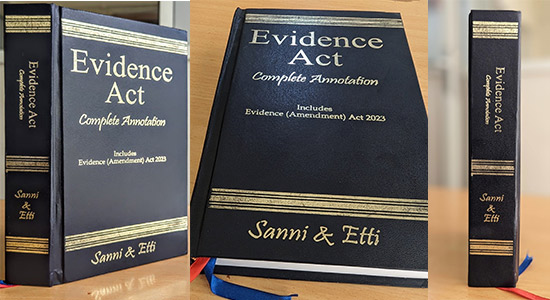
Available now for NGN 40,000 at ASC Publications, 10, Boyle Street, Onikan, Lagos. Beside High Court, TBS. Email publications@ayindesanni.com or WhatsApp +2347056667384. Purchase Link: https://paystack.com/buy/evidence-act-complete-annotation
______________________________________________________________________ “Enhance Legal Practice With Authoritative Reports” — Alexander Payne Offers Comprehensive Law Reports, Spanning Over A Century Of Nigerian Jurisprudence Interested buyers are encouraged to place their orders and enquiries via:
0704 444 4777, 0704 444 4999, 0818 199 9888
Website: www.alexandernigeria.com
“A Comprehensive Guide To Evidence Law” — Releases Second Edition In Three Volumes, Covering 4,051 Cases
For enquiries and orders, contact: 08035526491 Email: jerryamadisilk@gmail.com
 Prof. Jerry Amadi’s Evidence Law, Second Edition (2026), contains 3,314 pages in three volumes, covering the Evidence Act 2011, its 2023 amendment, and 4,051 Nigerian and English cases.