

*Urges Lawyers To Embrace Made-In-Nigeria Wigs And Gowns

Anambra State Governor, Prof. Chukwuma Soludo, has called for the immediate reopening of the Court of Appeal in Anambra State, arguing that the state’s high volume of litigation, which he said was second only to Lagos, made the continued closure of the appellate court unjustifiable.
The governor also challenged Nigerian lawyers and judicial officers to reconsider the legal profession’s traditional dress code by embracing locally manufactured wigs, gowns and other courtroom attire instead of imported alternatives, which he said were creating employment opportunities abroad at the expense of Nigeria’s economy.
Soludo made the remarks during a special church service marking the commencement of the 2026/2027 Legal Year of the Anambra State Judiciary, where he reaffirmed his administration’s commitment to improving justice delivery, strengthening judicial infrastructure and supporting the welfare of judicial officers.
The service, presided over by the Bishop of Aguata, Supervising Bishop of the Diocese of Awka and Coordinating Bishop of the Province on the Niger, Rt. Rev. Samuel Ezeofor, brought together judicial officers, legal practitioners and government officials to assess the judiciary’s performance and discuss its future.
Addressing the gathering, Soludo expressed dissatisfaction with the continued closure of the Court of Appeal in Anambra, insisting that the volume of cases originating from the state justified the presence of a functioning appellate court.
“Anambra, after Lagos, generates more cases. We are more deserving to have the Court of Appeal,” he said.
The governor maintained that the court should not remain closed when the need for its services was evident.
“The Court of Appeal in Anambra should not be closed for one day if merit and need happen to be the criteria. Come and open your court,” Soludo declared.
He reiterated his administration’s commitment to improving the administration of justice and commended the Anambra State Attorney General for his dedication to justice delivery.
Soludo also assured judicial officers of his government’s continued support in addressing their welfare needs and providing the infrastructure required for the effective functioning of the judiciary.
He highlighted the state’s plea bargain initiative, explaining that the measure was contributing to efforts to decongest correctional facilities.
Turning to the economic implications of the legal profession’s traditional attire, Soludo questioned Nigeria’s continued dependence on imported wigs, gowns and other courtroom regalia when such items could be produced locally.
He argued that the practice denied Nigerian manufacturers and workers opportunities that could otherwise contribute to domestic economic growth.
“Can we change the law regalia into what is made in Nigeria? We are creating jobs abroad by importing all the regalia you wear,” he said.
The governor urged members of the legal profession to promote Nigerian products through their clothing choices and support domestic production.
“Let us eat what we produce and wear what we make. That is the way to help the economy. I wear Akwete to promote Made-in-Nigeria,” he stated.
Soludo explained that his personal decision to wear Akwete fabric was part of his commitment to promoting locally produced goods and encouraging Nigerians to patronise indigenous industries.
He maintained that embracing Nigerian-made products, including professional clothing, would help strengthen the country’s economy and create opportunities for local producers.
The governor also shared his personal admiration for the legal profession, revealing that he had once considered studying law before pursuing a different career.
According to him, he abandoned the ambition after sensing that his father did not approve of the idea.
He recalled that when he informed his father of his intention to obtain an application form to study law, his father’s body language suggested that the decision did not have his support.
Despite taking a different professional path, Soludo described the legal profession as glamorous.
Speaking on the relationship among the arms of government, the governor emphasised the importance of cooperation between the Executive, Legislature and Judiciary in promoting security, justice and the welfare of Anambra residents.
He maintained that although the three arms of government perform different constitutional responsibilities, they share a common obligation to advance the interests of the people.
“We may have different branches of government, but we have one objective: the security and welfare of Ndi Anambra,” he said.
Soludo also credited the state’s Homeland Security Law with transforming Anambra’s security architecture and helping to restore calm across communities.
He stressed the need for continued cooperation among government institutions to sustain improvements in security and public welfare.
The governor further addressed the leadership situation within the Anglican Communion, maintaining that his administration had remained neutral in the matter.
He described the dispute as a private affair of the Anglican Church in Anambra and Nigeria and expressed hope that it would be resolved amicably.
According to Soludo, the government’s responsibility in the matter was to maintain law and order rather than interfere in the Church’s internal affairs.
Meanwhile, the Chief Judge of Anambra State, Justice Onochie Anyachebelu, described the commencement of the Legal Year as an important opportunity for the judiciary to review its performance, identify existing challenges and reposition itself for improved service delivery.
Anyachebelu commended Soludo for maintaining a cordial working relationship with the judiciary but appealed for urgent government intervention in critical areas affecting the institution.
“The Anambra State Judiciary needs help. Your presence today has given us renewed hope,” the Chief Judge stated.
[A MUST HAVE] Evidence Act Demystified With Recent And Contemporary Cases And Materials
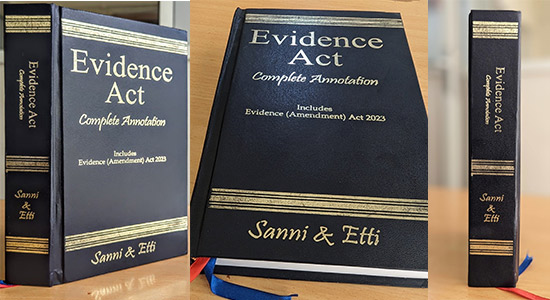
Available now for NGN 40,000 at ASC Publications, 10, Boyle Street, Onikan, Lagos. Beside High Court, TBS. Email publications@ayindesanni.com or WhatsApp +2347056667384. Purchase Link: https://paystack.com/buy/evidence-act-complete-annotation
______________________________________________________________________ “Enhance Legal Practice With Authoritative Reports” — Alexander Payne Offers Comprehensive Law Reports, Spanning Over A Century Of Nigerian Jurisprudence Interested buyers are encouraged to place their orders and enquiries via:
0704 444 4777, 0704 444 4999, 0818 199 9888
Website: www.alexandernigeria.com
“A Comprehensive Guide To Evidence Law” — Releases Second Edition In Three Volumes, Covering 4,051 Cases
For enquiries and orders, contact: 08035526491 Email: jerryamadisilk@gmail.com
 Prof. Jerry Amadi’s Evidence Law, Second Edition (2026), contains 3,314 pages in three volumes, covering the Evidence Act 2011, its 2023 amendment, and 4,051 Nigerian and English cases.