INTRODUCTION “The respect extended to the courts[by obeying its Orders] is an outward expression of the continuing fidelity to the pact embodied in the social contract, when the citizens conceded substantial parts of their sovereignty to government. Thus to denigrate the authority of the court is to assault and violate an aspect of the expression of the collective will of the citizens embodied in the social contract. The court, in this context, therefore, is a symbol of the sovereign will of the people. Hence, any act of discourtesy [or disobedience] is not directed at the judge, but to the institution, itself, an offshoot of the people’s will to be governed by law”. {Per Centus Nweze} Besides, it is premised on the foregoing, that any act which tends to violate the will of the people by justifying disobedience to an order of court (or judicial arm of government) established by their collective prerogative through the Constitution must as a matter of necessity, be viewed with abundance of caution. However, the immutable postulation that a court order remains forever binding, with corresponding obedience by the person concerned until it is set aside, can at least be regarded as an over-generalization of the concept upon a deep and meticulous appraisal of the law of contempt in terms of Civil Disobedience to an order of court made in the course of a civil proceedings. Hence, the objective of this article is to examine in relation to Civil Contempt whether this above over-generalization is for all material purposes helpful and it would be submitted in the negative with recommendations from this writer. THE LAW OF CONTEMPT In Nigerian legal system, the power of the court to punish for contempt is not concentrated in a single statutory enactment but runs through varieties of Laws. See Sections 17(2)(e), 6(6)(a) and 39(3)(a) of the 1999 Constitution; Sections 6 and 133 of the Criminal Code; sections 66 and 72 of Sheriffs and Civil Process Act, and the various Federal/ State High Court Rules. However, contempt of court is the act of putting into disrepute, disdain or denigrating the integrity of the court either directly or constructively which may be civil or criminal. Justice Agbaje JSC (as he then was) in 1990 Judicial Lectures: Continuing Education for the Judiciary, MIJ Publishers, titled “Contempt of Court and Discourtesy” lucidly submitted thus : “Contempt are of two kinds, direct or constructive. When the contempt are(sic:is) direct i.e committed in the immediate view and presence of the court or so near(in) the presence of the court as to obstruct or interrupt the due and orderly course of proceedings they are said to be contempt committed in curiae facie i.e contempt in the face of the court. On the other hand, those contempt (sic) which arise from matters not occurring in or near the presence of the court, (are) said to be constructive or indirect contempt, are referred to as contempt committed ex facie curiae.” The power to punish for contempt inheres in every court of law to the extent that even where a challenge is posed at the jurisdiction of a court in a matter, it must still proceed to determine whether contempt has been committed against it, the jurisdictional challenge notwithstanding . See JOHN EBHODAGHE V. MR. MIKE OKOYE (2004) LPELR-SC.218/2000, where the Supreme Court held : “While it is a settled law that when an issue of jurisdiction is raised by a party the court ought generally to take it first, where however due to a combination of factors an act which would impugn on the majesty of a court and likely to bring the court to odium and disrespect is done, it is I dare say, not just desirable but essential for the court to first look into the matter of contempt before proceeding on the issue of jurisdiction.” Per Ancholonu JSC (as he then was). See also : the American case of Passmore Williamson (1855) 26 Pa 9, 67 Am Dec 374. The sum total of the above therefore reveals the essential reasons why a court must possess the power to punish for contempt although, It is a power which a court must necessarily possess; (but) its usefulness depends on the wisdom and restraint with which it is exercised and employed. See Shandasami v. King Emperor (1945) A.C. 264 at page 268 and Boyo v. AG, Mid West State(1971) LPELR-SC.53/1970. NON COMPLIANCE WITH COURT ORDER & INITIATING CONTEMPT PROCEEDINGS AGAINST THE CONTEMNOR Obviously, from the provision of Section 72 of the Sherriff and Civil Process Act, any person who fails to comply with an order (other than monetary payment) of Court directed against him is to be committed to prison for contempt of court upon issuance of Form 48 (Notice of the Consequence of Disobedience) and Form 49 (Motion for Committal for Contempt) designated for such committal proceedings. However, based on common law, a Contemnor cannot be proceeded against for contempt of the court order irrespective of his deliberate attitude not to comply with same, in two exceptional circumstances below:
- When he challenges/lodges an appeal against the order made in respect of him,
- When he brings an application to the same Court that made the order challenging the validity of such order.
- Having honest regards to our peculiarities in Nigeria, this exception can be deliberately abused by the Judgement debtor against the Judgement Creditor in order to deprive him of the fruit of the Judgement obtained in a case.
- A Judgement Debtor may deliberately file a frivolous appeal or application against an Order or Judgement made against him and at the same time willingly not prosecuting same diligently, at the detriment of the Judgement Creditor.
- The rich may use this exception (because of their ‘means’) by oppressing the poor, thereby using the machinery of justice against the common man.
- Importantly, the undue delay encountered in the administration of justice is a notable factor why a judicial restraint is necessary in applying this common law exception.
- Right to Appeal is a continuous exercise of the right to fair hearing as guaranteed under Section 36(1) of the 1999 Constitution. In Obikoya v. Wema Bank Limited (1989) 1 SC (Pt. 1) 132, the Supreme Court per Oputa, JSC stated thus:
- the general inherent powers donated to the Courts vide Section 6 of the Constitution extend to setting aside an order made by the same court without jurisdiction or in deserving circumstances. See KOLAWOLE v. ADULOJU & ORS : (2018) LPELR-44075(CA), AHMAD v. SAHAB ENTERPRISES (NIG) LTD & ORS: (2016) LPELR-41313(CA), ADEBAYO v. OLAJOGUN : (2016) LPELR-41390(CA).
- where the contemnor acts malafide (in bad faith) by deliberately disobeying an order of court against him, he should not be aided with the application of this exception until he purges himself of his Contempt or
- the circumstances of a case coupled with the conduct of the Contemnor must determine the application of the exception.


Get your copy today and take the first step toward financial growth:👉 https://selar.co/4f16676016
_______________________________________________________________________ The Law And Practice Of Redundancy In Nigeria: A Practitioner’s Guide, Authored By A Labour & Employment Law Expert Bimbo Atilola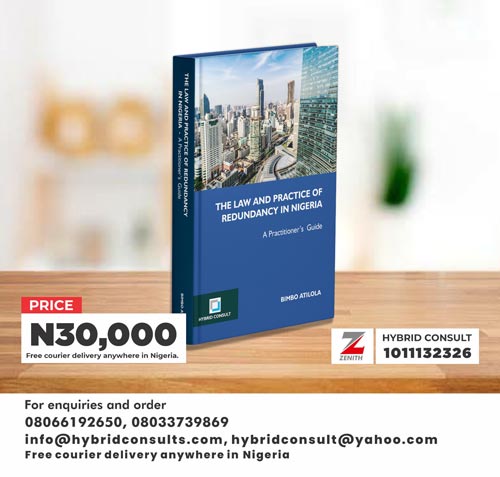 _______________________________________________________________________
[A MUST HAVE] Evidence Act Demystified With Recent And Contemporary Cases And Materials

Available now for NGN 40,000 at ASC Publications, 10, Boyle Street, Onikan, Lagos. Beside High Court, TBS. Email publications@ayindesanni.com or WhatsApp +2347056667384. Purchase Link: https://paystack.com/buy/evidence-act-complete-annotation
______________________________________________________________________ ARTIFICIAL INTELLIGENCE FOR LAWYERS: A COMPREHENSIVE GUIDE
Reimagine your practice with the power of AI “...this is the only Nigerian book I know of on the topic.” — Ohio Books Ltd
Authored by Ben Ijeoma Adigwe, Esq., ACIArb (UK), LL.M, Dip. in Artificial Intelligence, Director, Delta State Ministry of Justice, Asaba, Nigeria.
Bonus:
Get a FREE eBook titled “How to Use the AI in Legalpedia and Law Pavilion” with every purchase.
ARTIFICIAL INTELLIGENCE FOR LAWYERS: A COMPREHENSIVE GUIDE
Reimagine your practice with the power of AI “...this is the only Nigerian book I know of on the topic.” — Ohio Books Ltd
Authored by Ben Ijeoma Adigwe, Esq., ACIArb (UK), LL.M, Dip. in Artificial Intelligence, Director, Delta State Ministry of Justice, Asaba, Nigeria.
Bonus:
Get a FREE eBook titled “How to Use the AI in Legalpedia and Law Pavilion” with every purchase.
How to Order: 📞 Call, Text, or WhatsApp: 08034917063 | 07055285878 📧 Email: benadigwe1@gmail.com 🌐 Website: www.benadigwe.com
Ebook Version: Access directly online at: https://selar.com/prv626