*Urges NBA President-Elect, CJN To Act

Former senator, lawyer and public affairs commentator, Senator Sola Akinyede, has warned that corruption and loss of public confidence in Nigeria’s judiciary have worsened drastically over the years, saying that while about 10 per cent of the judiciary could be described as corrupt around 2005 to 2010, the situation today appears to have reversed, with only about 10 to 15 per cent regarded by some people as clean.
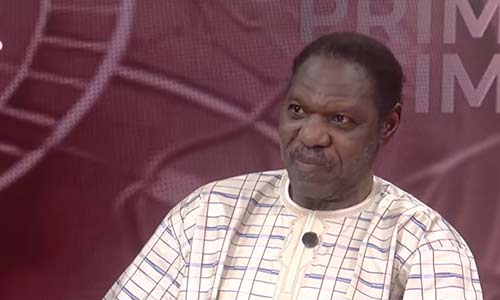
Speaking on Arise Prime Time, Akinyede said the Nigerian judiciary is in urgent need of structural reform, not piecemeal changes, stressing that Nigerians are not blind to what is happening in the courts.
He said the historic moment of women leading both the Bar and the Bench should be used as an opportunity to begin deep reforms in the legal system. According to him, the emergence of Oyinkansola Badejo-Okusanya, SAN, as President-Elect of the Nigerian Bar Association, alongside a female Chief Justice of Nigeria, has created a rare opening for institutional renewal.
Akinyede said he was optimistic because women, in his view, are often better nurturers and may be more inclined to leave a legacy of service. He cited former Chief Justice of Nigeria, Justice Aloma Mariam Mukhtar, whom he described as fearless, independent and incorruptible, adding that more judges were reprimanded and removed during her tenure than in many years before and after her leadership.
Turning to the state of the judiciary, Akinyede said Nigerians now hold the courts in growing contempt because of controversial decisions, conflicting judgments and perceived lack of independence.
He referred to the 2020 Imo governorship judgment, saying it was difficult to justify, and also criticised some political decisions of the Supreme Court which, according to him, had “no bearing with reality.”
He also mentioned cases where some politicians who did not participate in primaries were allegedly given tickets through technical decisions, and the 2023 Kano governorship appeal, where he said the Court of Appeal gave conflicting positions in the oral judgment and the certified true copy.
Akinyede further criticised the handling of the Kano Emirate cases, saying even a young lawyer would know that the Federal High Court lacked jurisdiction, yet the matter proceeded without sanctions.
According to him, no judiciary anywhere is sustained merely by appellate correction, but by decency and integrity.
He also raised concerns about judicial independence, citing the bail conditions imposed in some politically sensitive cases, including those involving former CBN Governor, Godwin Emefiele. He said courts sometimes grant conditions that are practically impossible to meet, thereby indirectly denying accused persons constitutionally guaranteed liberty and creating the impression that the judiciary may be working with the executive.
On judicial corruption, Akinyede accused appellate courts of deploying technicalities to shield judicial officers from prosecution. He said there is no constitutional basis for the argument that a judge must first be investigated by the National Judicial Council before facing criminal prosecution, arguing that in jurisdictions such as the United States and the United Kingdom, judicial officers may be prosecuted first and later subjected to disciplinary processes if found guilty.
He said the tendency of appellate courts to “manufacture immunity” for judicial officers has helped sustain impunity and questionable judgments.
Akinyede recalled that while serving as a senator and member of the Senate Constitution Review Committee, he proposed reforms to the National Judicial Council as far back as 2010 because of the excessive powers concentrated in the office of the Chief Justice of Nigeria.
He said the CJN currently appoints 19 out of 23 members of the NJC, representing about 82 per cent, while about 88 per cent of the Council’s membership consists of serving or retired judicial officers.
According to him, no serious system should allow one person to wield such overwhelming influence over the body responsible for appointment and discipline of judges.
He said the problem is worsened by the fact that the CJN also heads the Federal Judicial Service Commission, which shortlists candidates for judicial appointment, and also chairs the NJC, which interviews, selects and recommends those candidates to the President.
Akinyede said such a structure discourages accountability because members are unlikely to challenge the same person who appointed them.
He described the NJC as operating like a “gentleman’s club,” saying the structure has enabled judicial officers to allegedly promote relatives and children into judicial offices.
He cited the FCT High Court appointment process, alleging that eight out of 12 appointments were children or relatives of senior judicial officers or former judicial officers, a situation he described as statistically improbable without manipulation.
Akinyede proposed that the headship of the Federal Judicial Service Commission and the NJC should be separated, with the CJN heading the FJSC while the NBA should head the NJC.
He also proposed that judicial and former judicial officers on the NJC should not be appointed solely by the CJN, but by justices of the Supreme Court collectively, to disperse and diffuse appointing powers.
He further faulted the provision that allows the CJN to appoint the five NBA members of the NJC, saying they should be appointed by the NBA itself. He also criticised the exclusion of NBA representatives from disciplinary proceedings involving judges.
On non-lawyer membership of the NJC, Akinyede suggested that instead of the CJN appointing three non-lawyers, such members should come from institutions such as the Trade Union Congress, ASUU and the Nigeria Labour Congress, provided they are educated to at least university level.
He said the goal is to avoid a situation where almost all NJC members are appointed directly or indirectly by one person.
He urged the incoming NBA President and the CJN to jointly propose reforms to the National Assembly, saying his own reform proposals may not carry enough institutional weight unless backed by the leadership of both the Bar and the Bench.
Akinyede also said the NBA must show more courage in defending judicial independence and criticising bad judgments. He said lawyers in Nigeria are often reluctant to criticise judges because of fear of sanctions, unlike in the UK and the US where judicial decisions are openly criticised.
He alleged that many lawyers seeking to lead the NBA have personal or political agendas and therefore avoid “rocking the boat” because they want to remain close to judges and the NJC.
He said some lawyers also want to influence judicial appointments by placing their own allies in the judiciary, adding that the Bar must stop being overly defensive of the Bench where criticism is justified.
Akinyede also criticised the building of houses for judges by the executive in the Federal Capital Territory, saying such a development would not have happened decades ago because the Constitution was designed to insulate the judiciary from executive influence.
He said if government wanted to provide housing for judges, funds should have been released to the judiciary to determine how to apply them, rather than the executive building houses and handing them over in a manner that creates the perception of closeness between the two arms of government.
Asked whether Nigeria’s justice system can still be reformed from within, Akinyede said he does not believe in incremental or piecemeal reform.
He said even though Justice Aloma Mukhtar introduced important reforms during her tenure, many of those reforms were later discarded because they were not backed by deep structural changes.
According to him, only constitutional and structural reforms can save the judiciary from further decline.
“You need structural reform,” he said. “Justice Mukhtar had a fantastic pedigree, a judge of unimpeachable integrity, but what happens when she leaves? Another judge can come and undo all that she has done.”
[A MUST HAVE] Evidence Act Demystified With Recent And Contemporary Cases And Materials

Available now for NGN 40,000 at ASC Publications, 10, Boyle Street, Onikan, Lagos. Beside High Court, TBS. Email publications@ayindesanni.com or WhatsApp +2347056667384. Purchase Link: https://paystack.com/buy/evidence-act-complete-annotation
______________________________________________________________________ “Enhance Legal Practice With Authoritative Reports” — Alexander Payne Offers Comprehensive Law Reports, Spanning Over A Century Of Nigerian Jurisprudence Interested buyers are encouraged to place their orders and enquiries via:
0704 444 4777, 0704 444 4999, 0818 199 9888
Website: www.alexandernigeria.com
Interested buyers are encouraged to place their orders and enquiries via:
0704 444 4777, 0704 444 4999, 0818 199 9888
Website: www.alexandernigeria.com