

*“Technology Has Improved Election Transparency, But New Threats Are Emerging”

The Chairman of the Independent National Electoral Commission (INEC), Professor Joash Amupitan, has warned that the increasing use of artificial intelligence-generated deepfakes and digital misinformation presents emerging challenges for electoral litigation and the administration of justice ahead of Nigeria’s 2027 general elections.
Amupitan raised the concerns on Monday, November 9, 2026, during a three-day capacity-building workshop for Justices and members of Election Petition Tribunals held at the Body of Benchers Auditorium in Abuja.
The workshop, which coincided with the inauguration of Election Petition Tribunal members and the launch of the second edition of the Judicial Electoral Manual, formed part of preparations for the adjudication of disputes arising from the forthcoming general elections.
Speaking at the event, the INEC Chairman described election petition tribunals as essential constitutional mechanisms for resolving political disputes, reducing political tensions and maintaining public confidence in the electoral process.
He emphasised that the tribunals play an important role in safeguarding democratic stability by providing a lawful avenue for aggrieved candidates and political parties to challenge election outcomes.
According to Amupitan, the existence of credible and effective electoral dispute resolution mechanisms is essential to ensuring that political disagreements are addressed through established judicial processes rather than confrontation.
The INEC Chairman also highlighted the growing influence of technology on election administration and electoral litigation, noting that technological innovations had improved transparency in the conduct of elections.
He specifically identified the Bimodal Voter Accreditation System (BVAS) and the INEC Result Viewing Portal (IReV) as technological tools that had enhanced transparency in Nigeria’s electoral process.
However, he cautioned that advancements in technology were also creating new challenges, particularly through the emergence of artificial intelligence-generated deepfakes and the spread of digital misinformation.
Amupitan drew attention to the need for the judiciary to recognise and address these emerging threats as electoral disputes increasingly involve technologically generated information and digital materials.
His observations underscored the importance of equipping judicial officers with the knowledge required to navigate the changing technological environment surrounding election petitions.
The INEC Chairman maintained that the effective resolution of electoral disputes remained central to public confidence in Nigeria’s democratic institutions.
He stressed the importance of election petition tribunals in maintaining the rule of law and providing a credible framework for addressing grievances arising from electoral contests.
The workshop brought together judicial officers expected to participate in election petition proceedings following the 2027 general elections.
Amupitan’s remarks highlighted the dual role of technology in Nigeria’s electoral system, where digital innovations have strengthened aspects of election administration while emerging tools such as artificial intelligence have introduced additional challenges relating to information credibility.
With preparations for the 2027 elections gathering momentum, the INEC Chairman’s intervention placed renewed attention on the relationship between electoral technology, judicial preparedness and public confidence in the resolution of election disputes.
The presidential and National Assembly elections are scheduled for January 16, 2027, while governorship and State Houses of Assembly elections are scheduled for February 6, 2027.
Election petition tribunals will be responsible for determining disputes arising from the elections in accordance with the applicable constitutional and statutory provisions.
[A MUST HAVE] Evidence Act Demystified With Recent And Contemporary Cases And Materials
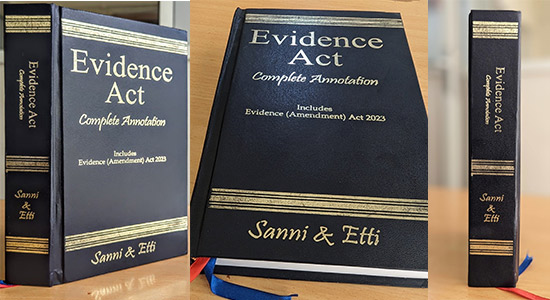
Available now for NGN 40,000 at ASC Publications, 10, Boyle Street, Onikan, Lagos. Beside High Court, TBS. Email publications@ayindesanni.com or WhatsApp +2347056667384. Purchase Link: https://paystack.com/buy/evidence-act-complete-annotation
______________________________________________________________________ “Enhance Legal Practice With Authoritative Reports” — Alexander Payne Offers Comprehensive Law Reports, Spanning Over A Century Of Nigerian Jurisprudence Interested buyers are encouraged to place their orders and enquiries via:
0704 444 4777, 0704 444 4999, 0818 199 9888
Website: www.alexandernigeria.com
“A Comprehensive Guide To Evidence Law” — Releases Second Edition In Three Volumes, Covering 4,051 Cases
For enquiries and orders, contact: 08035526491 Email: jerryamadisilk@gmail.com
 Prof. Jerry Amadi’s Evidence Law, Second Edition (2026), contains 3,314 pages in three volumes, covering the Evidence Act 2011, its 2023 amendment, and 4,051 Nigerian and English cases.