*Urges African Lawyers To Embrace Industry, AI, Cross-Border Practice

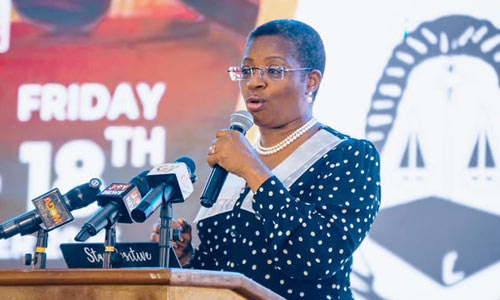
President of the Nigerian Bar Association, Mrs Oyinkansola Badejo-Okusanya, SAN, FCIArb, has called on lawyers across Africa to prepare deliberately for a changing professional landscape driven by technology, industry, cross-border commerce and artificial intelligence, while insisting that innovation must never displace professional independence, conscience and accountability.
Badejo-Okusanya made the call in a goodwill address delivered at the Annual Conference of the Ghana Bar Association on September 14, 2026, themed “150 Years of Ghana’s Legal Evolution: Transforming the Profession and Driving Its Future with Industry.”
The NBA President, who described the engagement as her first international assignment since assuming office, said Ghana’s 150-year legal history should not merely be celebrated as a record of the past, but should serve as a guide for the future of the profession.
She began by acknowledging the role of supportive spouses in professional leadership, paying tribute to Mr Joe Ghartey, husband of Ghana Bar Association President Efua Ghartey, and also sending greetings from her own husband, Mr Yomi Badejo-Okusanya, whom she described as a public relations practitioner.
According to her, the support of spouses and family members often plays an important role in leadership journeys and should not be overlooked.
“Your support is critical to our leadership journeys. We celebrate you,” she said.
She also paid tribute to veteran Ghanaian lawyer Sam Okudzeto, whom she described as a mentor and an exemplar of lifelong learning, recalling that she first met him at an International Bar Association conference in Prague in 2005.
Badejo-Okusanya said Okudzeto’s continued participation in international legal conferences despite his seniority demonstrated the importance of continuous learning throughout a lawyer’s career.
She also praised his habit of taking Ghanaian chocolate to international gatherings, describing the gesture as a simple but meaningful act of African identity and promotion.
“Every time we promote Africa, in whatever little way – be it in our dress, our food or our products – we drop a little more of the colonial mentality that has tended to hold us hostage for decades,” she said.
Turning to women’s leadership in the legal profession, Badejo-Okusanya recalled that the Ghana Bar Association made history on September 11, 2024, when it elected Efua Ghartey as its first female president.
She said Ghartey’s election had a personal significance for her because, at the time, she herself was aspiring to become President of the Nigerian Bar Association.
She recalled meeting Ghartey in Accra in January 2025 during the inauguration of Ghana’s President and sharing her own ambition with her.
According to her, after she subsequently won the NBA presidency, Ghartey travelled from Ghana to Nigeria to attend her swearing-in.
“You came to celebrate a milestone in my life. Today, I have come to celebrate a milestone in the life of your profession,” she told the Ghana Bar President.
Badejo-Okusanya said the emergence of women at the head of both the Ghanaian and Nigerian Bars imposed a responsibility beyond personal achievement.
She described herself as the second woman to lead the NBA and the first woman to be elected to the position, while Ghartey became the first woman to lead the Ghana Bar Association after more than six decades.
“Being first is an honour. Making sure you are not the last is a responsibility,” she said.
She noted that young women, female law students and experienced practitioners were watching their leadership journeys and should be able to see professional advancement as genuinely attainable.
“Our presence should help her imagine what is possible. Our leadership must help make it possible,” she said.
Badejo-Okusanya therefore called for greater access to mentorship, professional opportunity and leadership, insisting that legal institutions must create fair opportunities for both men and women to contribute and thrive.
Reflecting on Ghana’s legal history, the NBA President cited the example of John Mensah Sarbah and the Aborigines’ Rights Protection Society, whose resistance to proposed colonial land legislation helped defend customary land rights.
She said Sarbah understood that the implications of law extended beyond the wording of legislation to livelihoods, inheritance, identity and the future of communities.
According to her, that history presents every generation of lawyers with a continuing question: what will lawyers do with the knowledge they possess?
“Will our knowledge help people secure their rights? Will it help businesses grow responsibly? Will it strengthen institutions? Will it give someone who has almost lost hope a reason to believe that justice is still possible?” she asked.
Badejo-Okusanya said the relationship between the legal profession and industry had become urgent because modern businesses increasingly need lawyers long before disputes arise.
She noted that businesses developing new products require legal advice before reaching the market, entrepreneurs seeking investment need agreements that protect their enterprises without stifling growth, creatives require advice on intellectual property, technology companies need guidance on data and responsibility, while communities affected by industrial activity require protection and representation.
“There is work for lawyers across this entire landscape,” she said.
She however cautioned that lawyers could only provide meaningful advice if they understood how their clients’ businesses operate and how technology is changing commercial risk.
“We cannot guide tomorrow’s enterprises with yesterday’s understanding,” she said.
The NBA President warned that greater engagement with industry must not erode the profession’s independence.
“Industry needs our expertise. Society needs our independence. The future needs both,” she said.
She stressed that lawyers advising powerful clients must retain the ability to say when proposed conduct cannot lawfully be undertaken and must also remain conscious of persons and communities affected by corporate decisions.
Badejo-Okusanya also addressed the growing use of artificial intelligence in legal practice, saying the profession must remain responsible for the accuracy, integrity and humanity of work produced with emerging technologies.
“The profession that embraces artificial intelligence must remain accountable for the accuracy, integrity and humanity of its work,” she said.
She further called on Bar associations to ensure that technological transformation and new areas of practice translate into actual professional opportunities and improved livelihoods for lawyers, particularly younger practitioners.
“Young lawyers should be able to see a future in the profession they worked so hard to enter. Talent needs opportunity. Commitment needs a fair chance. Professional dignity needs an economic foundation,” she said.
According to her, Bar associations can help by linking continuing professional education to livelihoods, connecting members with industry and equipping them for emerging areas of practice capable of sustaining viable careers.
Badejo-Okusanya also called for closer cooperation between the Nigerian and Ghanaian Bars and, more broadly, among Bar associations across Africa.
She said the continent’s increasing emphasis on intra-African trade required a more connected legal profession capable of helping businesses navigate different jurisdictions, structure transactions, protect investments and resolve disputes.
“As we seek to grow trade within our continent, our profession has a pivotal role to play: helping businesses navigate different legal systems, structure transactions, protect investments and resolve disputes,” she said.
According to her, closer collaboration among African Bars could expand professional networks, promote knowledge-sharing and create opportunities for lawyers while helping African businesses operate confidently across borders.
“Our entrepreneurs are looking beyond national boundaries. Our profession must be ready to accompany them. And if we want a more connected African economy, we must build a more connected African legal profession,” she said.
Concluding, the NBA President said the lawyers who shaped Ghana’s legal history could not have foreseen every modern challenge, but understood that professional knowledge carried obligations to society.
She urged lawyers to make room for the talent that will shape the next era of the profession and to build institutions capable of serving young lawyers, entrepreneurs seeking sound legal advice and citizens waiting for justice.
“One hundred and fifty years from now, others will look back on us. They will read about what we celebrated. May they also have reason to celebrate what we changed,” she said.
“May they see what we did with what we knew.
[A MUST HAVE] Evidence Act Demystified With Recent And Contemporary Cases And Materials

Available now for NGN 40,000 at ASC Publications, 10, Boyle Street, Onikan, Lagos. Beside High Court, TBS. Email publications@ayindesanni.com or WhatsApp +2347056667384. Purchase Link: https://paystack.com/buy/evidence-act-complete-annotation
______________________________________________________________________ “Enhance Legal Practice With Authoritative Reports” — Alexander Payne Offers Comprehensive Law Reports, Spanning Over A Century Of Nigerian Jurisprudence Interested buyers are encouraged to place their orders and enquiries via:
0704 444 4777, 0704 444 4999, 0818 199 9888
Website: www.alexandernigeria.com
Interested buyers are encouraged to place their orders and enquiries via:
0704 444 4777, 0704 444 4999, 0818 199 9888
Website: www.alexandernigeria.com