*Announces Plan To Implement Practice Directions To Minimise Delays And Reinforce Arbitral Award Finality
Attorney-General of the Federation and Minister of Justice, Chief Lateef Fagbemi, SAN, has called for a historic shift toward Africa-led dispute resolution, declaring that Nigeria is ready to lead the continent in strengthening arbitration institutions and ending decades of outsourcing commercial disputes to foreign jurisdictions.
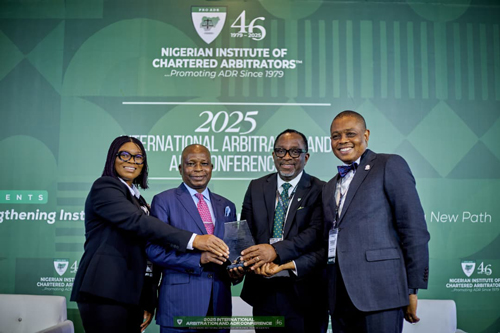
Fagbemi made the call while addressing senior legal practitioners, policymakers, and arbitration experts during the 2025 Annual Conference and Investiture Ceremony of the Nigerian Institute of Chartered Arbitrators (NICArb).
The two-day conference, held on November 27 and 28, 2025, in Lagos, was themed “Strengthening Institutional Arbitration in Africa and India: Charting a New Path.”
It brought together top arbitration scholars, judges, business leaders, and global ADR experts to examine reforms needed to enhance the credibility, efficiency, and ethical standards of arbitration in Nigeria and across Africa.
Discussions throughout the conference focused on reforming arbitrator-appointment practices, using AI and virtual hearing systems, reducing dependence on foreign arbitration venues, and promoting stronger ethical structures in ADR practice.
Capacity building and youth inclusion were also identified as critical to sustaining the next generation of arbitration leaders.
Fagbemi said the continent had reached a turning point in its dispute resolution history and must now build robust institutions that inspire global confidence.
“For too long, African disputes have been exported abroad. Too much of our intellect and confidence have been outsourced. Today, Africa stands at a turning point, our arbitration institutions are growing, our practitioners are rising to global prominence, and our business environment is becoming increasingly sophisticated. A new path is not only possible, it is necessary.”
He stressed that arbitration is not merely a technical process but an economic stabiliser essential to trade integration under the African Continental Free Trade Area. He announced ongoing collaboration with the National Judicial Council to strengthen enforcement of arbitral awards and eliminate delays that undermine confidence.
“The credibility of arbitration depends on enforcement, and no arbitral institution can thrive where enforcement is unpredictable.
“We are developing practice directions that will minimise unnecessary adjournments, discourage frivolous tribunal challenges, reinforce party autonomy, and promote the finality of arbitral awards. We intend to do everything possible to change the current narrative.”
Fagbemi also disclosed that the Federal Government will begin work on a National Alternative Dispute Resolution Policy to streamline standards and harmonise accreditation of arbitrators, enhance institutional capacity, integrate ADR into government processes, and establish sector-specific mechanisms for oil and gas, construction, and finance.
“This policy will harmonise efforts, eliminate fragmentation, and guide the long-term development of dispute resolution in our country,” he added.
The AGF further directed that all government agencies adopt modern ADR clauses in public contracts and comply strictly with enforceable awards. He emphasised human capacity development, vowing increased judicial training, strengthened accreditation systems, and active inclusion of women and young arbitrators.
“Government cannot promote arbitration and then be the source of delay,” he warned. “Investors’ confidence can only be guaranteed when government demonstrates discipline, and that is a commitment I fully intend to uphold.
“Africa’s voice must be heard, not only in its submissions but also in leadership,” he stated.
In his goodwill message, President of the Nigerian Bar Association, Afam Osigwe, lamented the persistent delays plaguing both litigation and arbitration in Nigeria.
He described the Supreme Court as “one of the most overburdened in the world,” warning that the country’s slow dispute resolution culture causes financial and psychological hardship for litigants and damages investor confidence.
Osigwe also expressed concern that arbitration had become very expensive and no longer time-saving, urging practitioners to prioritise efficiency and reduce reliance on court processes.
“The law can only be as effective as we, the practitioners, allow it to be. We must stop losing huge revenue to foreign countries by strengthening local arbitration institutions and reversing the trend of exporting disputes abroad.”
NICArb President and Chairman of the Governing Council, Professor Fabian Ajogwu, SAN, in his opening address, described the institute as a base and national cause, highlighting discipline, accountability, and integrity as foundation stones of institutional leadership.
He warned that arbitration in Africa must move beyond talk and theory toward tangible culture change. He identified institutional credibility, judicial partnership, strong ethical standards, structured capacity building, and continental collaboration as pillars for Africa’s arbitration future.
“Trust is the currency of ADR. Without it, even the best statutes will fail,” he said. “Strong arbitration does not emerge by chance; it is built on consistency and sustained by principle.”
Representing Lagos State Governor Babajide Sanwo-Olu, the Attorney-General of Lagos State, Lawal Pedro, SAN, reaffirmed the state’s commitment to strengthening Lagos as a major arbitration hub in West Africa.
He noted that dispute-resolution mechanisms must evolve alongside modern business realities.
“This conference is not just about arbitration; it is about Africa’s economic future and its ability to stand as an equal among global players.
“Integrity, fairness, efficiency, and readiness are non-negotiable for institutions that seek to inspire trust among investors, citizens, and international partners.”
The event attracted 11 Senior Advocates of Nigeria, members of NICArb’s Governing Council, senior corporate executives, international delegates, and global ADR authorities.
Stakeholders unanimously agreed on the need to transition from fragmented excellence to institutional cohesion, positioning arbitration as a pillar of economic governance rather than an elite dispute mechanism.
The 2025 investiture ceremony also recognised newly inducted fellows and members, reinforcing NICArb’s deepening commitment to raising arbitration standards and promoting Africa-led dispute resolution.

 ARTIFICIAL INTELLIGENCE FOR LAWYERS: A COMPREHENSIVE GUIDE
Reimagine your practice with the power of AI “...this is the only Nigerian book I know of on the topic.” — Ohio Books Ltd
Authored by Ben Ijeoma Adigwe, Esq., ACIArb (UK), LL.M, Dip. in Artificial Intelligence, Director, Delta State Ministry of Justice, Asaba, Nigeria.
Bonus:
Get a FREE eBook titled “How to Use the AI in Legalpedia and Law Pavilion” with every purchase.
ARTIFICIAL INTELLIGENCE FOR LAWYERS: A COMPREHENSIVE GUIDE
Reimagine your practice with the power of AI “...this is the only Nigerian book I know of on the topic.” — Ohio Books Ltd
Authored by Ben Ijeoma Adigwe, Esq., ACIArb (UK), LL.M, Dip. in Artificial Intelligence, Director, Delta State Ministry of Justice, Asaba, Nigeria.
Bonus:
Get a FREE eBook titled “How to Use the AI in Legalpedia and Law Pavilion” with every purchase.
How to Order: 📞 Call, Text, or WhatsApp: 08034917063 | 07055285878 📧 Email: benadigwe1@gmail.com 🌐 Website: www.benadigwe.com
Ebook Version: Access directly online at: https://selar.com/prv626
________________________________________________________________________ The Law And Practice Of Redundancy In Nigeria: A Practitioner’s Guide, Authored By A Labour & Employment Law Expert Bimbo Atilola _______________________________________________________________________
"You Don't Need To Be Rich, You Just Need To Start" — Victoria Ezeigwe, Esq Launches Investment Handbook For Nigerians Starting With ₦5,000
_______________________________________________________________________
"You Don't Need To Be Rich, You Just Need To Start" — Victoria Ezeigwe, Esq Launches Investment Handbook For Nigerians Starting With ₦5,000

Get your copy today and take the first step toward financial growth:👉 https://selar.co/4f16676016
_______________________________________________________________________