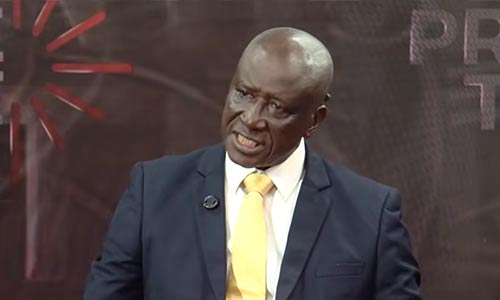
A Senior Advocate of Nigeria, Oba Maduabuchi, SAN, has said the David Mark-led leadership of the African Democratic Congress effectively “shot itself in the foot” by repeatedly pursuing interlocutory appeals instead of allowing the substantive leadership dispute instituted by Nafiu Bala Gombe to be determined.

Maduabuchi said the judgment delivered this week by Justice Peter Lifu of the Federal High Court in Abuja represented the first substantive determination of Gombe’s central claim that, following the resignation of former ADC National Chairman Ralph Nwosu, he was entitled as Deputy National Chairman, North-East, to assume leadership of the party.
Speaking on the television programme News Night, the senior lawyer stressed that he was analysing the matter professionally and had not read Justice Lifu’s full judgment.
He therefore declined to pronounce on whether the trial judge was right or wrong on the merits, but said the appropriate course for the Mark-led ADC, if dissatisfied, was to pursue an appeal.
“As far as I am concerned, I have not seen the judgment. If I read the judgment, I will tell you whether Lifu is right or wrong. As it is now, all I know is that Lifu is a judge of the Federal High Court. He has given a judgment, and if the ADC is not satisfied with it, move ahead and go on appeal,” Maduabuchi said.
The Federal High Court had on Thursday nullified the David Mark-led ADC leadership and invalidated decisions taken under it, including the process that produced former Vice-President Atiku Abubakar as the party’s presidential candidate for the 2027 general elections.
Justice Lifu also nullified the emergence of Rauf Aregbesola as National Secretary and other national officers, as well as nominations made under the disputed leadership. The suit, marked FHC/ABJ/CS/1819/2025, was instituted by Gombe, who challenged the process through which Mark and other members of the caretaker structure assumed control of the party.
Reacting separately to the judgment, the ADC National Executive Committee and State Chairmen Forum aligned with Gombe welcomed the ruling and demanded that the Independent National Electoral Commission give effect to it.
The faction asked INEC to replace the names of the Mark-led officers on its portal and make the platform available to the Gombe leadership to enable it upload candidates and, where necessary, conduct what it described as “mini-primaries”.
The group maintained that it already had candidates produced through congresses and primaries which it considered valid and argued that those candidates should now be recognised.
It threatened further protests against INEC if the commission failed to comply with the judgment.
Abia State ADC Chairman Don Norman Obinna, speaking for the state chairmen’s bloc, said the faction had maintained throughout the dispute that the coalition elements that entered the ADC could not disregard the party’s existing structures and procedures.
He cited Delta State as an example where, according to him, primaries conducted by the existing party structure were monitored by INEC, security agencies and the media, with candidate lists subsequently submitted to the commission.
Obinna alleged that some politicians who entered the ADC through the opposition coalition did not properly integrate into the party’s existing structure before dealing with the Mark-led national leadership.
The Gombe-aligned group also described the latest judgment as vindication of its position and praised the judiciary for what it called adherence to the law.
Maduabuchi, however, approached the controversy from the standpoint of the litigation history.
According to him, the central question raised by Gombe had always been straightforward.
“Bala Gombe is saying something very simple. When the national chairman is not there, I am the deputy national chairman, I move in. That is his case. That point has not been resolved by any court,” he said.
He rejected suggestions that previous decisions involving other ADC figures necessarily disposed of Gombe’s individual claim.
Maduabuchi said that in determining whether one case forecloses another, attention must be paid to the parties, the reliefs sought, the grounds of the action and the legal standing of the person who instituted it.
“If Abejide goes to court and loses, that does not mean that Bala Gombe has lost,” he said, while emphasising that courts of coordinate jurisdiction cannot sit on appeal over one another but that the actual issues decided in each case must first be identified.
The senior lawyer traced the dispute through the Federal High Court, Court of Appeal and Supreme Court, arguing that the substantive controversy remained unresolved while the parties fought over interlocutory questions.
The litigation reached the Supreme Court after Mark challenged an appellate decision arising from proceedings before the Federal High Court.
On April 30, 2026, the Supreme Court set aside the Court of Appeal’s order directing the parties to maintain the status quo ante bellum and ordered them to return to the Federal High Court for an expeditious hearing of the substantive dispute.
Maduabuchi had also publicly argued at the time that the Court of Appeal went beyond the issues placed before it when it made the status quo order, and that the ADC ought to have allowed the substantive matter to proceed instead of extending the interlocutory dispute to the apex court.
Recalling that history on News Night, he said the Supreme Court effectively returned the parties to the trial court because the real leadership dispute had yet to be adjudicated.
“So Nafiu Bala Gombe’s case has been pending for a long time. And it has not been decided. It was only decided yesterday,” he said.
Maduabuchi said the ADC itself triggered much of the procedural journey when it challenged an order that merely required the opposing side to be put on notice.
“How can you go on appeal because a court says put your opponent on notice?” he asked.
He said that after the Court of Appeal went beyond the immediate issue before it, the same ADC leadership proceeded to the Supreme Court to challenge the additional orders.
“So who shot themselves in the foot? Is it APC or ADC?” he asked, making clear that he was referring to the Mark-led ADC.
The history of the matter shows that Mark’s interlocutory appeal travelled to the Supreme Court before the apex court on April 30 directed the parties back to the Federal High Court for determination of the pending substantive processes.
The News Night discussion also examined the effect of the appeal now filed against Justice Lifu’s judgment.
Asked whether merely filing an appeal automatically suspends the judgment, Maduabuchi indicated that it did not, leaving the issue of a stay of execution as a separate legal step.
He nevertheless maintained that the Mark-led ADC should pursue the appellate process if it believes the Federal High Court reached the wrong conclusion.
The SAN rejected the suggestion that the Supreme Court should be blamed for the current uncertainty.
According to him, had the Court of Appeal confined itself to the issues properly placed before it during the earlier interlocutory proceedings, the journey to the Supreme Court might not have become necessary.
He said the apex court had to determine the questions properly brought before it and then returned the substantive controversy to the trial court.
Maduabuchi also argued that the ADC could have prevented much of the dispute through an internal political solution.
He said the party could simply have convened a properly constituted convention, accepted the resignation of the existing executive where necessary and then validly elected new national officers with INEC observing the process.
“It was only a very simple thing. Call convention, a mini convention like that. The whole executive resign. Then the convention accepts their resignation. Then it is proposed that this man and this be national chairman, this one is voice vote. National chairman, national secretary, national everything. INEC is there. We wouldn’t be going through all this nonsense,” he said.
With the 2027 elections approaching, Maduabuchi argued that proximity to the polls would not necessarily prevent courts from enforcing the law.
He cited previous election disputes where candidates or parties lost their positions very close to inauguration or after electoral victories had already been recorded.
Among the examples he referenced were the Bayelsa governorship dispute involving David Lyon and the 2019 Zamfara elections, where judicial decisions altered the beneficiaries of victories already recorded at the polls.
His point, he said, was that courts apply what he described as “hard law” without allowing electoral timing or political expectations to determine legal rights.
“When we are talking and doing law, we are talking without emotions, no sentiments. Hard law,” Maduabuchi said.
The programme also discussed criticism of Justice Lifu and Professor Chidi Odinkalu’s description of the judgment as “transactional justice”.
Maduabuchi declined to adopt the criticism, saying Odinkalu was entitled to his opinion while he preferred to examine the judgment itself before reaching a conclusion on whether the trial judge was legally correct.
“Chidi is entitled to his opinion. I am entitled to mine,” he said.
He added that questions about the political optics of the judgment should not replace examination of the actual law and facts.
Maduabuchi further criticised what he described as the repeated sacrifice of political party structures to individual presidential ambitions.
Drawing a comparison with the crisis that weakened the Peoples Democratic Party, he argued that unresolved leadership and zoning disputes had contributed to the PDP’s internal breakdown.
He specifically referred to Atiku’s continued presidential ambition and suggested that political parties suffer when institutional arrangements are subordinated to the ambitions of individuals.
“Why did PDP die? The PDP died because somebody wanted to be president,” Maduabuchi said, before asking why political parties should repeatedly be placed at risk because of personal ambitions.
Turning to the possibility of the Mark-led ADC and its candidates remaining on the ballot if Justice Lifu’s judgment survives the appellate process, Maduabuchi said he believed alternative political arrangements could still be explored.
He suggested that candidates could potentially move to a smaller political party within the period legally available for candidate substitution or replacement, if the relevant electoral requirements could still be satisfied.
“Yes, it’s feasible,” he said when asked whether the Atiku camp could still find a route to the ballot.
According to him, one possibility would be for candidates of another smaller party to withdraw and make way for the affected ADC candidates, describing such a party as a possible contingency or “placeholder” arrangement.
The suggestion was Maduabuchi’s assessment of the political options available and not an order made by the Federal High Court.
Meanwhile, the Gombe-aligned ADC leadership has insisted that its own candidates should be placed on the ballot rather than those produced by the Mark-led structure.
The faction has asked INEC to open its portal and recognise the leadership and candidates it considers valid, warning that continued refusal could trigger renewed protests against the electoral commission.
The Mark-led ADC, on the other hand, has rejected Justice Lifu’s judgment and indicated its intention to pursue an appeal, leaving the leadership and candidate dispute set for another round of litigation ahead of the 2027 elections.
[A MUST HAVE] Evidence Act Demystified With Recent And Contemporary Cases And Materials

Available now for NGN 40,000 at ASC Publications, 10, Boyle Street, Onikan, Lagos. Beside High Court, TBS. Email publications@ayindesanni.com or WhatsApp +2347056667384. Purchase Link: https://paystack.com/buy/evidence-act-complete-annotation
______________________________________________________________________ “Enhance Legal Practice With Authoritative Reports” — Alexander Payne Offers Comprehensive Law Reports, Spanning Over A Century Of Nigerian Jurisprudence Interested buyers are encouraged to place their orders and enquiries via:
0704 444 4777, 0704 444 4999, 0818 199 9888
Website: www.alexandernigeria.com