By Victor Sunday

Introduction
The ‘marriage’ of Aboy Chibuzor, solemnized on the 29th day of March 2026 by Apostle Chibuzor Gift Chinyere of Omega Power Ministries, Port Harcourt has sparked widespread reactions.
Aboy is a young autistic man who was, by the pastor’s own public admission, abandoned at the gate of the ministry’s premises as a child and subsequently raised. He is non-verbal. He cannot understand spoken instructions. He requires full-time assistance to feed, bathe, and perform every basic act of daily living. Yet on the date aforesaid, he was dressed in a suit, placed before an altar, and declared a husband.
What motivated the cleric stated motivations were a concern for Aboy’s uncontrolled sexual urges, and a desire to provide him with a permanent carer. To secure the latter, he publicly offered the prospective wife ten million naira immediately, a house, an overseas vacation, and twenty million naira payable after ten years, dependent on Aboy’s survival.
This article attempts to analyze the validity of the marriage, the capacity of an autistic person to give consent to marriage under the Nigerian law and the issue of rape.
2.The Position of the Law.
2.1.Under the Matrimonial Causes Act
The primary statute governing the validity of marriages in Nigeria is the Matrimonial Causes Act. Section 3(1) of the Act enumerates the exclusive grounds upon which a statutory marriage shall be void. The provision most directly applicable to the present case is Section 3(1)(d)(iii), which declares a marriage void where , “… the consent of either of the parties is not a real consent because … that party is mentally incapable of understanding the nature of the marriage contract.”
Three propositions can be drawn from the above provision. First, that consent is a substantive requirement with a specific cognitive assent. Second, where that cognitive content or assent is absent by reason of mental incapacity, the marriage is is void. And third, the void-ness commences from the moment of the ceremony. That is, in the eyes of the law, the marriage never existed.
Also, the Act separately provides, under Section 5(1)(b), that a marriage is voidable where either of the parties is of unsound mind or mentally defective at the time of the marriage. Section 5(2) defines a mentally defective person as one who, owing to an arrested or incomplete development of mind, whether arising from inherent causes or induced by disease or injury, requires oversight, care or control, and is by reason of that fact unfit for the responsibilities of marriage.
The English Probate Division’s decision in Durham v Durham (1885) 10 PD 80 is quite instructive. In that case, Sir James Hannen P. was called upon to determine whether a marriage contracted by a person of diminished mental capacity was valid. His Lordship held that to validly enter into the contract of marriage, a person must be mentally capable of appreciating that it involves the duties and responsibilities normally attached to marriage. He was careful to acknowledge that the contract of marriage is one of relative simplicity, not requiring a high degree of intelligence but equally emphatic that it demands genuine mental appreciation of its nature and obligations.
Can Aboy appreciate the nature, obligations and permanence of marriage?
2.2. The Marriage Act
The Marriage Act which governs the procedural requirements for statutory marriages, is equally instructive. The Act proceeds on the assumption that the parties to a marriage possess the mental capacity to enter into it. Significantly, Section 18 of the Act requires written parental or guardian consent for the marriage of persons under twenty-one years of age. However, that consent authority is expressly limited to consenting on behalf of persons who can and do understand the marriage and wish to enter into it. Therefore, the permission of the law for parental consent in the case of minors is a protective measure, not a template for the wholesale substitution of another person’s will.
2.3. The Violence Against Persons (Prohibition) Act 2015
Interestingly, it is possible that Aboy might be a victim of rape.
Section 1 of the Violence Against Persons (Prohibition) Act 2015 (VAPP Act) defines rape in terms that are deliberately broad and gender-neutral. It provides that a person commits the offence of rape where sexual penetration occurs and the other person does not consent, or where consent is obtained by force, threats, intimidation, or by any circumstance that negates genuine will. Section 2 of the same Act prescribes life imprisonment as the punishment.
The implications for the present case are as clear as day. A person who lacks the mental capacity to consent to the institution of marriage lacks, a fortiori, the capacity to consent to sexual intercourse within that marriage because marital status does not (and has never, under Nigerian statutory law) constitute blanket consent to sexual activity. Therefore, any sexual consummation of this marriage is rape under Section 1 of the VAPP Act, regardless of the religious or ceremonial packaging in which the union was presented.
It is important to note that Nigeria’s Persons with Disabilities Act 2025 affirms the legal capacity of persons with disabilities and mandates that decisions affecting them be made in their best interests, with appropriate safeguards against exploitation.
The Act, consistent with Article 12 of the United Nations Convention on the Rights of Persons with Disabilities (CRPD), to which Nigeria is a signatory, draws a striking distinction between supporting a person with a disability in the exercise of their legal capacity, and substituting one’s own judgment for theirs entirely.
3.0. The Question Nobody is Asking
As stated earlier under the VAPP Act, if this marriage is consummated i.e, if Aboy is made to engage in sexual intercourse as part of this arrangement, that act constitutes rape under Section 1 of the VAPP Act 2015, punishable by life imprisonment under Section 2.
However, this liability extends also to the question of facilitating the commission of an offence. Where a person arranges, funds, and officiates a ceremony that creates the conditions for the repeated commission of rape upon a severely disabled person, questions of complicity and accessorial liability under the Criminal Code Act arise.
Would this be overlooked or swept under the carpet? Would this be same when the girl child is involved?
I do not know. Or, do you? (Apologies, Prof Ozekhome, SAN).
4.0. Conclusion
Section 3(1)(d)(iii) of the Matrimonial Causes Act is clear. A marriage is void where a party is mentally incapable of understanding the nature of the marriage contract. What was solemnised in Port Harcourt on the 29th of March 2026 was not a marriage. It was a nullity. The law is the law.
Victor Sunday is a law graduate, orator, legal writer, speech trainer and public affairs analyst.
 Reimagine your practice with the power of AI “...this is the only Nigerian book I know of on the topic.” — Ohio Books Ltd
Authored by Ben Ijeoma Adigwe, Esq., ACIArb (UK), LL.M, Dip. in Artificial Intelligence, Director, Delta State Ministry of Justice, Asaba, Nigeria.
Bonus:
Get a FREE eBook titled “How to Use the AI in Legalpedia and Law Pavilion” with every purchase.
Reimagine your practice with the power of AI “...this is the only Nigerian book I know of on the topic.” — Ohio Books Ltd
Authored by Ben Ijeoma Adigwe, Esq., ACIArb (UK), LL.M, Dip. in Artificial Intelligence, Director, Delta State Ministry of Justice, Asaba, Nigeria.
Bonus:
Get a FREE eBook titled “How to Use the AI in Legalpedia and Law Pavilion” with every purchase.
How to Order: 📞 Call, Text, or WhatsApp: 08034917063 | 07055285878 📧 Email: benadigwe1@gmail.com 🌐 Website: www.benadigwe.com
Ebook Version: Access directly online at: https://selar.com/prv626
_______________________________________________________________________ [A MUST HAVE] Evidence Act Demystified With Recent And Contemporary Cases And Materials
 ______________________________________________________________________
“Bridging Theory And Courtroom Practice” — Hagler Sunny Okorie, Nathaniel Ngozi Ikeocha Unveil ‘Functional’ Tort Law Book For Nigerian Legal System
______________________________________________________________________
“Bridging Theory And Courtroom Practice” — Hagler Sunny Okorie, Nathaniel Ngozi Ikeocha Unveil ‘Functional’ Tort Law Book For Nigerian Legal System
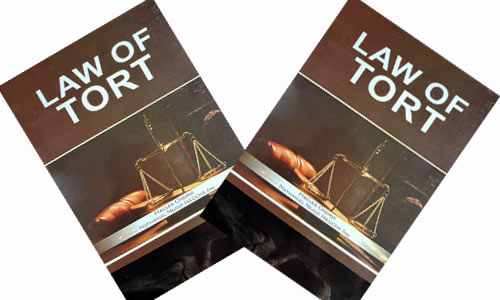 The book, titled The Law of Torts in Nigeria: A Functional Approach, authored by Professor Hagler Sunny Okorie Ph.D and Ikeocha, Nathaniel Ngozi Esq, offers law students, practitioners, and academics a comprehensive guide to understanding and applying tort law in Nigerian courts. Interested buyers can place orders via the following contact numbers: 08028636615, 08037667945, 08032253813, or +234 902 196 2209.