

Ebonyi State Governor, Francis Nwifuru, has stressed the importance of judicial independence in sustaining constitutional democracy, declaring that an independent judiciary serves as a critical safeguard against government excesses and must be allowed to discharge its constitutional responsibilities without interference.

The governor also advocated the adoption of technology-driven processes in the administration of justice, particularly electronic filing and digital transcription, to improve efficiency, reduce delays and enhance access to judicial services.
Nwifuru made the remarks at the weekend during the Special Court Session marking the commencement of the 2026/2027 Legal Year at the State High Court in Abakaliki, Ebonyi State.
Speaking on the role of the judiciary in a democratic society, the governor maintained that an independent judicial system was essential to ensuring accountability and preventing the abuse of governmental powers.
He emphasised that, as governor, he recognised the constitutional responsibility of the judiciary and the need to respect its independence.
“An independent judiciary checkmates the government as well as its excesses. As a Governor, I recognise that the independence of the judiciary must be respected and allowed to perform its constitutional and professional mandate,” Nwifuru stated.
The governor also expressed concern over delays in the administration of justice, noting that a judicial system unable to resolve disputes promptly would inevitably waste valuable resources.
He maintained that the deployment of modern technology offered significant opportunities to improve the speed and effectiveness of judicial proceedings.
“A justice system that cannot resolve disputes timely wastes resources. Technology offers us the opportunity to resolve some of these things. Digital filings and digital transcriptions help,” he said.
Nwifuru explained that the benefits of digitalising judicial processes extended beyond improving government operations, as electronic systems would enable legal practitioners, litigants and other court users to transact with court registries without being physically present.
“The significance goes beyond governance. It helps to transact with various registries without recourse to location,” he added.
The governor reiterated his administration’s commitment to strengthening the justice sector through reforms under the People’s Charter of Needs Agenda.
According to him, the government had introduced several initiatives aimed at improving judicial administration, expanding access to justice and strengthening the capacity of institutions responsible for delivering justice in the state.
He identified the ongoing adoption of electronic filing, the establishment of the Moot Court, the creation of the Office of the Public Defender and the adoption of the Sexual Assault Bill as measures demonstrating his administration’s commitment to justice sector reforms.
Nwifuru explained that the initiatives were intended to address existing challenges in the administration of justice and ensure that the judicial system remained responsive to the needs and expectations of the people.
He maintained that an effective justice system required not only adequate infrastructure and institutional support but also the independence necessary for judicial officers to discharge their duties in accordance with the Constitution and the law.
Earlier, the Chief Judge of Ebonyi State, Justice Elvis Ngene, highlighted the progress recorded by the state judiciary in various aspects of judicial administration.
Justice Ngene informed the governor that the judiciary had continued to pursue reforms aimed at modernising the machinery of justice, strengthening institutional integrity and improving service delivery.
He identified the deployment of technology, improvement of access to justice, protection of judicial integrity and appointment of deserving judicial officers as key areas receiving attention under his leadership.
The Chief Judge also listed official visits to correctional centres, regular human capital development, professional capacity building, infrastructural development and improvements in court facilities among the significant activities undertaken by the judiciary within the preceding year.
Justice Ngene stressed that judicial integrity remained fundamental to the credibility, effectiveness and public confidence of the justice system.
He maintained that judicial officers and other personnel entrusted with responsibilities within the justice sector must uphold the highest ethical standards in the discharge of their duties.
The Chief Judge acknowledged the financial limitations facing the judiciary but assured that the institution would continue to prioritise professional development, administrative competence and responsible technological innovation.
“As part of our efforts to promote this, we shall, notwithstanding the leanness of our resources, continue to encourage continuous legal education and professional learning, strengthen administrative competence, promote responsible use of technology and insist upon the highest ethical standards from every person entrusted with judicial responsibilities,” he stated.
Justice Ngene further assured that the state judiciary would continue to recognise the dedication of its workforce while implementing measures aimed at strengthening professionalism, institutional discipline and effective service delivery.
The commencement of the 2026/2027 Legal Year provided an opportunity for the governor and the Chief Judge to emphasise judicial independence, technological advancement, ethical standards and institutional reforms as essential components of an effective justice system in Ebonyi State.
[A MUST HAVE] Evidence Act Demystified With Recent And Contemporary Cases And Materials
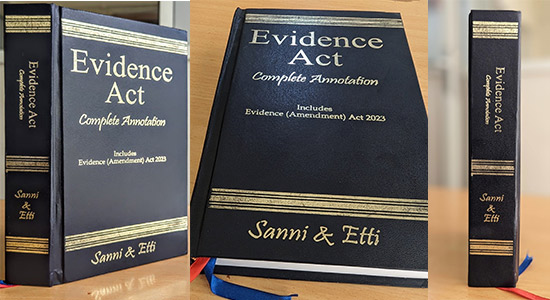
Available now for NGN 40,000 at ASC Publications, 10, Boyle Street, Onikan, Lagos. Beside High Court, TBS. Email publications@ayindesanni.com or WhatsApp +2347056667384. Purchase Link: https://paystack.com/buy/evidence-act-complete-annotation
______________________________________________________________________ “Enhance Legal Practice With Authoritative Reports” — Alexander Payne Offers Comprehensive Law Reports, Spanning Over A Century Of Nigerian Jurisprudence Interested buyers are encouraged to place their orders and enquiries via:
0704 444 4777, 0704 444 4999, 0818 199 9888
Website: www.alexandernigeria.com
“A Comprehensive Guide To Evidence Law” — Releases Second Edition In Three Volumes, Covering 4,051 Cases
For enquiries and orders, contact: 08035526491 Email: jerryamadisilk@gmail.com
 Prof. Jerry Amadi’s Evidence Law, Second Edition (2026), contains 3,314 pages in three volumes, covering the Evidence Act 2011, its 2023 amendment, and 4,051 Nigerian and English cases.