By Punch Editorial Board

IT is no longer in doubt that public confidence in Nigeria’s courts has been badly shaken. Too many Nigerians believe, often with reason, that judicial outcomes are shaped by influences far removed from the law. The cynical refrain is that it is no longer about knowing the law, but knowing the judge. This perception is profoundly dangerous: when citizens lose faith in the courts, self-help and lawlessness inevitably follow.
The President of the Nigerian Bar Association, Afam Osigwe (SAN), has recently echoed this fear, warning that judicial corruption poses an existential threat to democracy, social justice, and the rule of law. Speaking at the Ralph Opara Memorial Lecture organised by the National Association of Sea Dogs in Enugu, Osigwe lamented the steady erosion of public trust in the justice system.
In his paper, Judicial Corruption in Nigeria: A Menace to Democracy and Social Justice, he painted a grim picture of a judiciary that should be the last hope of the common man but is increasingly perceived as a marketplace, where justice is delayed, manipulated, or even purchased by the highest bidder.
To underscore his point, he cited a 2024 joint survey by the United Nations Office on Drugs and Crime and the National Bureau of Statistics, which found that judges were among public officials who received an estimated N721 billion in cash bribes in 2023.
Osigwe also referenced a 2018–2020 survey by the Independent Corrupt Practices and other Related Offences Commission, which estimated that of the N9.4 billion paid as bribes within the justice sector, lawyers accounted for the highest proportion of bribe-givers.
That finding merely reinforces a widely held belief within the profession itself. Many lawyers privately liken courtrooms to auction houses, where verdicts go to the highest bidder.
A top lawyer, Joe-Kyari Gadzama (SAN), however, challenged Osigwe to name names. That demand, however, is largely futile. The problem is systemic, not anecdotal.
Indeed, the National Judicial Council has in recent years disciplined several judges for misconduct, including the abuse of ex parte orders. Those sanctioned included judges of the Federal High Court, the Delta State High Court, and the Yobe State High Court.
In 2022, the Lagos State Government dismissed a former Customary Court member for hurriedly dissolving the marriage between Olayemi Ayeni and his wife, Doyin Okunubi. The scandal deepened when Adeyemi later took the woman as his own partner, impregnated her, and assumed custody of her children.
In 2023, a senator, Adamu Bulkachuwa, openly recalled on the floor of parliament that his wife, Zainab Bulkachuwa, might have helped his colleagues during her tenure as President of the Court of Appeal. Such remarks only reinforced public suspicion that justice is not always blind.
Nigerian courts are littered with judgements so strange that they inevitably invite disbelief. In 2022, the Federal High Court in Abuja discharged and acquitted Andrew Yakubu, former Group Managing Director of the Nigerian National Petroleum Corporation, of fraud relating to $9.77 million and £74,000 recovered by the Economic and Financial Crimes Commission from his Kaduna home in 2017.
The court accepted his claim that the money was a collection of “gifts” from friends upon his retirement and ordered the funds returned, without addressing how much a public officer could reasonably receive in gifts.
Forum shopping has also become endemic, with courts of coordinate jurisdiction issuing conflicting judgements on the same matter.
Even more troubling is the growing perception that the judiciary has hijacked political and electoral processes. Voters may cast their ballots, only for courts to overturn their will and hand mandates to others.
A former Senate President, Ahmad Lawan, who lost the All Progressives Congress presidential primaries to Bola Tinubu and did not contest the 2023 senatorial election in his constituency, emerged as a senator by virtue of a Supreme Court judgement.
Earlier, Rita Ofili-Ajumogobia of the Federal High Court repeatedly adjourned a pre-election matter filed in 2011 by Victoria Ayeni against Olusola Sonuga and others until the lifespan of the Ogun State House of Assembly expired.
Judges are expected to be above reproach. They should not be seen hobnobbing at social functions or receiving questionable gifts from lawyers, litigants, politicians, or the executive.
Yet when he was governor of Rivers State, the current Federal Capital Territory Minister, Nyesom Wike, purchased luxury vehicles and built houses for judges, a practice he has continued in Abuja. Other governors act in a similar manner.
Unsurprisingly, some multinational companies have little faith in Nigeria’s courts and insist on resolving disputes abroad.
Corruption exists everywhere, but what distinguishes functional systems is how it is punished.
In the United States and the United Kingdom, judicial integrity is fiercely protected; corruption is rare and treated as a grave crime. In 2010, a UK court convicted senior Crown Prosecution Service barrister Sarfraz Ibrahim for accepting a share of a £20,000 bribe. A year later, court clerk Munir Patel was jailed under the Bribery Act for taking £500 to suppress a traffic penalty.
The contrast is stark in the case of former Delta State governor James Ibori, whose prosecution floundered in Nigeria until British courts secured his conviction.
Political interference in judicial appointments remains a major flaw. A retired Supreme Court Justice, Amina Augie, has publicly lamented the corrosive role of corrupt registry staff who hide files to manipulate outcomes.
To be fair, the judiciary has begun some self-cleansing. Last year, a judge nominee from the Nigeria Police Force, Blessing Ezeala, was dropped after allegations that she demanded and received a ₦1 million bribe to secure a detainee’s release.
The Federal Judicial Service Commission also rejected 33 of 62 nominees for failing integrity tests.
The Chief Justice of Nigeria, Kudirat Kekere-Ekun, has introduced stricter appointment measures, including a public feedback system that allows citizens to comment on nominees. This transparency is welcome.
Still, more must be done. The NJC should not only de-robes judges and lawyers found culpable of corruption; it must ensure their prosecution.
A country saddled with a tainted judiciary is in trouble. The courts must also be properly funded and granted real independence, so they can reclaim the spirit of judicial activism exemplified by revered jurists like Chukwudifu Oputa, Kayode Eso, Andrew Obaseki, Augustine Nnamani, and Mohammed Bello, who delivered courageous judgements, even against military regimes.
Justice is meant to be blind and fair to all. When it is bought and sold, society rots from the core. A judiciary perceived as cash-and-carry is not merely a professional embarrassment; it is a national emergency.
 The promotion, which commenced on January 8 and runs until February 8, 2026, offers five core maritime law books authored by Dr. Emeka Akabogu, SAN, ordinarily valued at N405,000, for just N150,000 — a 63% discount.
Interested buyers can place their orders through the following channels:
Phone: 0704 329 3271
Online Store: https://paystack.shop/aa-bookstore
Website: www.akabogulaw.com
_______________________________________________________________________
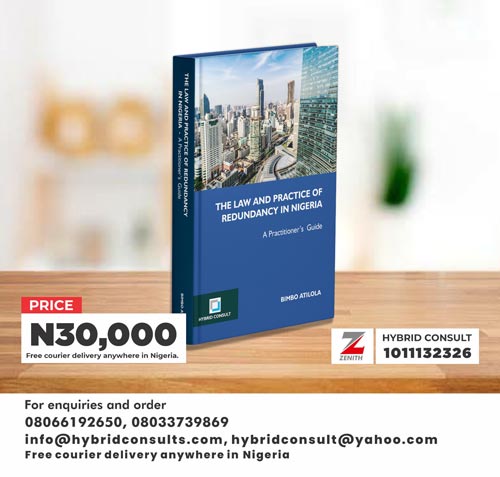
The Law And Practice Of Redundancy In Nigeria: A Practitioner’s Guide, Authored By A Labour & Employment Law Expert Bimbo Atilola
The promotion, which commenced on January 8 and runs until February 8, 2026, offers five core maritime law books authored by Dr. Emeka Akabogu, SAN, ordinarily valued at N405,000, for just N150,000 — a 63% discount.
Interested buyers can place their orders through the following channels:
Phone: 0704 329 3271
Online Store: https://paystack.shop/aa-bookstore
Website: www.akabogulaw.com
_______________________________________________________________________
The Law And Practice Of Redundancy In Nigeria: A Practitioner’s Guide, Authored By A Labour & Employment Law Expert Bimbo Atilola
 _______________________________________________________________________
[A MUST HAVE] Evidence Act Demystified With Recent And Contemporary Cases And Materials

Available now for NGN 40,000 at ASC Publications, 10, Boyle Street, Onikan, Lagos. Beside High Court, TBS. Email publications@ayindesanni.com or WhatsApp +2347056667384. Purchase Link: https://paystack.com/buy/evidence-act-complete-annotation
______________________________________________________________________ ARTIFICIAL INTELLIGENCE FOR LAWYERS: A COMPREHENSIVE GUIDE
Reimagine your practice with the power of AI “...this is the only Nigerian book I know of on the topic.” — Ohio Books Ltd
Authored by Ben Ijeoma Adigwe, Esq., ACIArb (UK), LL.M, Dip. in Artificial Intelligence, Director, Delta State Ministry of Justice, Asaba, Nigeria.
Bonus:
Get a FREE eBook titled “How to Use the AI in Legalpedia and Law Pavilion” with every purchase.
ARTIFICIAL INTELLIGENCE FOR LAWYERS: A COMPREHENSIVE GUIDE
Reimagine your practice with the power of AI “...this is the only Nigerian book I know of on the topic.” — Ohio Books Ltd
Authored by Ben Ijeoma Adigwe, Esq., ACIArb (UK), LL.M, Dip. in Artificial Intelligence, Director, Delta State Ministry of Justice, Asaba, Nigeria.
Bonus:
Get a FREE eBook titled “How to Use the AI in Legalpedia and Law Pavilion” with every purchase.
How to Order: 📞 Call, Text, or WhatsApp: 08034917063 | 07055285878 📧 Email: benadigwe1@gmail.com 🌐 Website: www.benadigwe.com
Ebook Version: Access directly online at: https://selar.com/prv626