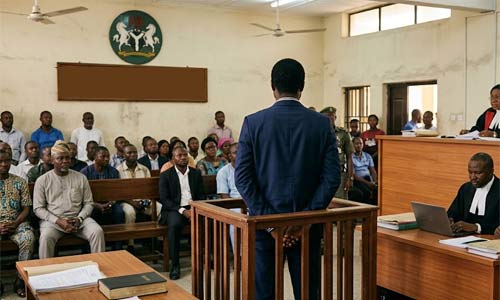
The Lagos State High Court has discharged and acquitted a 54-year-old man, Taiwo Oyelabi, of raping his 21-year-old biological daughter after finding that the prosecution failed to establish the absence of consent, an essential ingredient of the offence, despite evidence that sexual intercourse occurred between them.

Justice Rahman Oshodi, who delivered the judgment in Charge No. ID/8787C/2019, also expressed concern that the defendant had spent more than eight years in custody while the prosecution called only one witness.
The judge consequently urged the Lagos State Government to immediately constitute the Lagos State Victim Assistance and Witness Protection Agency, warning that the continued failure to operationalise the body had left victims of crime, particularly children subjected to sexual abuse, without adequate institutional protection.
The agency is provided for under the Lagos State Victim Assistance and Witness Protection Law, enacted by the Ninth Lagos State House of Assembly and assented to by Governor Babajide Sanwo-Olu in 2024.
Justice Oshodi observed that although the law had been enacted to provide assistance, support and compensation to victims of crime, as well as protection for witnesses against intimidation, reprisals and other forms of harm, the agency responsible for implementing those provisions had yet to be constituted.
He maintained that establishing the body was necessary to ensure that the protections guaranteed by the law were available in practice.
The judge’s call followed concerns arising from the prosecution of sexual offences, particularly allegations of abuse within family settings, where victims and witnesses may require institutional support to participate effectively in criminal proceedings.
In the case before the court, Oyelabi was accused of raping his biological daughter in November 2017 at their residence on Community Road, Obadore, Igando, Lagos.
However, after examining the evidence, Justice Oshodi held that the prosecution had failed to prove the offence beyond reasonable doubt.
The judge explained that although the evidence established that the defendant had sexual intercourse with his daughter, it did not establish that the act occurred without her consent or that any consent was obtained through force, threat, fraud or deceit.
He particularly faulted the prosecution for failing to call the alleged victim, who was 21 years old at the time, to testify before the court.
According to the judge, she was the person who could provide direct evidence concerning whether she consented to the sexual intercourse.
“The prosecutrix was 21 years old. She was the only person who could tell the court whether she consented, and she was not called,” Justice Oshodi held.
The court consequently distinguished proof of sexual intercourse from proof of rape, explaining that establishing the former did not automatically satisfy the legal requirements of the latter.
“The evidence shows that the defendant had sexual intercourse with his daughter. It does not show that he raped her,” the judge declared.
Justice Oshodi further observed that the prosecution called only one witness, Assistant Superintendent of Police Iyabo Bakare, who testified that the defendant admitted having sexual intercourse with his daughter.
Although the judge accepted the police officer’s testimony concerning the defendant’s oral admission, he held that the admission did not establish that the intercourse was non-consensual.
The court also rejected the defendant’s written confessional statement following a trial-within-trial.
Justice Oshodi ruled that the statement had not been recorded in compliance with Section 9(3) of the Administration of Criminal Justice Law of Lagos State 2015.
The judge explained that the provision required compliance with prescribed safeguards relating to the recording of a suspect’s statement, including the presence of a legal practitioner and a family member or video recording.
Consequently, the written statement could not be admitted as evidence against the defendant.
The court also rejected portions of the investigating police officer’s testimony concerning statements allegedly made by the complainant and her twin sister during the investigation.
Justice Oshodi held that the officer’s account of what the two women reportedly told her amounted to hearsay and could not establish the truth of the allegations.
He further observed that although the officer claimed to have noticed that the alleged victim was pregnant, no medical evidence was tendered to confirm the pregnancy or establish its age.
A medical report said to have been transferred to the Gender Unit of the Lagos State Police Command was also not produced before the court.
The judge consequently found that the prosecution had failed to present essential evidence capable of establishing the ingredients of the offence.
In reaching his decision, Justice Oshodi referred to the Court of Appeal’s judgment in Kabiru Oriyomi v. Federal Republic of Nigeria (2023), which addressed the requirement to prove the absence of consent in a prosecution for rape.
He reiterated that proof of sexual intercourse alone was insufficient where the prosecution failed to establish the absence of consent.
Justice Oshodi also relied on the presumption of innocence guaranteed under Section 36(5) of the 1999 Constitution and the requirement under Section 135(1) of the Evidence Act 2011 that criminal offences must be proved beyond reasonable doubt.
“However grave the allegation, a defendant cannot be convicted on suspicion,” he declared.
The judge expressed concern about the length of time Oyelabi had remained in custody, particularly considering the limited evidence presented during the trial.
According to the court, the defendant had been detained since his arrest on April 16, 2018, and remained in custody for more than eight years before the conclusion of the proceedings.
“The record shows that the defendant has been in custody since his arrest on 16 April 2018. He has spent more than eight years awaiting the outcome of a trial in which the prosecution called a single witness,” Justice Oshodi observed.
He stressed that cases involving serious sexual allegations required thorough investigation and proper preparation to ensure that relevant evidence was presented before the court.
“Such cases deserve better preparation, so that the available evidence is placed before the court and no defendant spends years in custody on a charge that cannot be proved,” he stated.
Justice Oshodi also commended defence counsel Onome Akpeneye for representing Oyelabi pro bono since his arraignment before the court on December 9, 2021.
Beyond the immediate case, the judge examined a series of sexual offence proceedings involving allegations of abuse within family settings that came before his court between October and December 2025.
He referred to six other cases, including that of Michael Segun Odumabo, who was sentenced to life imprisonment for defilement.
The judge also cited the conviction of Godwin Udo Akpan, who received a 14-year prison sentence for attempted sexual assault by penetration, and Sola Lawson, who was sentenced to seven years’ imprisonment for indecent treatment of a child.
In other cases reviewed by the court, defendants were discharged or acquitted, while one proceeding was struck out for want of diligent prosecution.
Justice Oshodi described the cases as reflecting a “deeply disturbing pattern of alleged sexual violence within the family setting”.
He maintained that the recurring nature of such allegations demonstrated the importance of effective victim assistance, witness protection and proper criminal investigation.
The judge therefore called on the Lagos State Government to take immediate steps to constitute the Victim Assistance and Witness Protection Agency established under the 2024 law.
He warned that leaving the agency unconstituted would continue to undermine the practical protections intended for victims and witnesses, particularly vulnerable persons involved in sexual offence proceedings.
Justice Oshodi subsequently found Oyelabi not guilty of rape under Section 260 of the Criminal Law of Lagos State 2015 and discharged and acquitted him.
[A MUST HAVE] Evidence Act Demystified With Recent And Contemporary Cases And Materials

Available now for NGN 40,000 at ASC Publications, 10, Boyle Street, Onikan, Lagos. Beside High Court, TBS. Email publications@ayindesanni.com or WhatsApp +2347056667384. Purchase Link: https://paystack.com/buy/evidence-act-complete-annotation
______________________________________________________________________ “Enhance Legal Practice With Authoritative Reports” — Alexander Payne Offers Comprehensive Law Reports, Spanning Over A Century Of Nigerian Jurisprudence Interested buyers are encouraged to place their orders and enquiries via:
0704 444 4777, 0704 444 4999, 0818 199 9888
Website: www.alexandernigeria.com
“A Comprehensive Guide To Evidence Law” — Releases Second Edition In Three Volumes, Covering 4,051 Cases
For enquiries and orders, contact: 08035526491 Email: jerryamadisilk@gmail.com
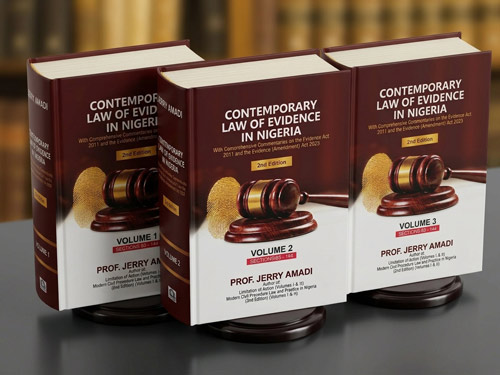 Prof. Jerry Amadi’s Evidence Law, Second Edition (2026), contains 3,314 pages in three volumes, covering the Evidence Act 2011, its 2023 amendment, and 4,051 Nigerian and English cases.