The African Group of Negotiators on Climate Change (AGN), representing 54 African countries, has rejected any attempt to renegotiate the Paris Agreement, warning that reopening the global climate pact, particularly provisions relating to countries’ obligations, could undermine existing commitments to address climate change.

The group insisted that developed countries must honour their obligations under the agreement rather than seek changes to the framework governing international climate action.
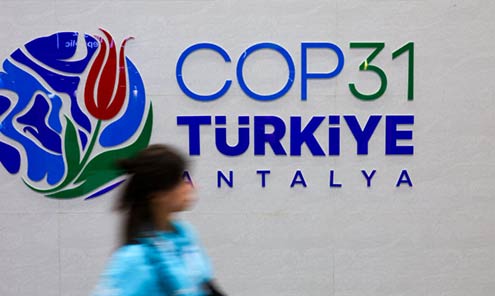
Africa’s position comes as negotiations at the 31st United Nations Climate Change Conference (COP31) in Antalya, Türkiye, enter their final stages, with African countries demanding stronger commitments on climate finance, adaptation and financial support for vulnerable economies.
Speaking at a press conference on the state of negotiations on Thursday, November 19, 2026, the Chairman of the African Group of Negotiators, Nana Dr Antwi-Boasiako Amoah, declared that renegotiating the Paris Agreement was unacceptable to the continent.
According to him, African countries remain committed to the existing agreement and expect other participating nations, particularly developed economies, to fulfil the obligations already undertaken.
“There’s one message that I also want to put across, which is about renegotiating the Paris Agreement. I think this is something that is a big red line for the African continent,” Amoah stated.
He stressed that the continent would resist any proposal that could alter the responsibilities previously agreed upon by countries under the international climate framework.
“Any attempt to renegotiate the Paris Agreement, especially when it comes to obligations, is something that the African continent rejects. We need to stay within the confines of the agreement because that is what we all have agreed in the past to do business with,” he declared.
The position reflects concerns among developing countries that reopening existing climate commitments could weaken the obligations of developed nations to provide financial and other forms of support to countries disproportionately affected by climate change.
African countries have maintained that although the continent contributes relatively little to global greenhouse gas emissions, its economies remain vulnerable to the effects of climate change.
Consequently, negotiations over climate finance and adaptation support have remained central to Africa’s demands at COP31.
The disagreement has intensified following changes to the proposed adaptation finance target contained in the latest draft decision released on November 19.
The revised draft removed an earlier proposal that would have required adaptation finance for developing countries to reach at least $120 billion annually by 2035.
The $120 billion figure was based on tripling the $40 billion annual adaptation finance commitment associated with the Glasgow Climate Pact agreed at COP26 in 2021.
Under the Glasgow commitment, developed countries agreed to double adaptation finance from approximately $20 billion provided in 2019 to $40 billion annually by 2025.
However, the revised COP31 draft no longer specifies the $120 billion target or expressly identifies the $40 billion Glasgow commitment as the baseline for calculating the proposed increase.
Instead, paragraph 40 of the draft retains a commitment to at least triple adaptation finance by 2035 without specifying the financial baseline.
Paragraph 43 requests the Standing Committee on Finance of the United Nations Framework Convention on Climate Change to prepare a technical report identifying possible baselines for the proposed increase.
Paragraph 44 also proposes the development of an implementation pathway for achieving the adaptation finance target.
The removal of the specific $120 billion figure has raised concerns about how the proposed tripling of adaptation finance would be calculated, funded and implemented.
For African countries and other developing economies, the uncertainty surrounding the financial baseline has added to concerns about whether international climate finance commitments will translate into accessible resources.
African negotiators have repeatedly maintained that climate financing must be predictable, accessible and provided largely through grants or highly concessional arrangements rather than commercial loans.
They argue that relying heavily on commercial borrowing could increase the debt burdens of countries already struggling with the financial consequences of climate change.
Addressing questions about Africa’s capacity to implement its climate commitments despite limited financing, Amoah explained that the continent’s concerns extended beyond the amount of money being pledged.
According to him, the structure of the international climate finance system and the conditions attached to accessing funds are equally important.
He maintained that African countries needed a financing framework capable of delivering resources on affordable terms to support adaptation and other climate-related commitments.
[A MUST HAVE] Evidence Act Demystified With Recent And Contemporary Cases And Materials

Available now for NGN 40,000 at ASC Publications, 10, Boyle Street, Onikan, Lagos. Beside High Court, TBS. Email publications@ayindesanni.com or WhatsApp +2347056667384. Purchase Link: https://paystack.com/buy/evidence-act-complete-annotation
______________________________________________________________________ “Enhance Legal Practice With Authoritative Reports” — Alexander Payne Offers Comprehensive Law Reports, Spanning Over A Century Of Nigerian Jurisprudence Interested buyers are encouraged to place their orders and enquiries via:
0704 444 4777, 0704 444 4999, 0818 199 9888
Website: www.alexandernigeria.com
“A Comprehensive Guide To Evidence Law” — Releases Second Edition In Three Volumes, Covering 4,051 Cases
For enquiries and orders, contact: 08035526491 Email: jerryamadisilk@gmail.com
 Prof. Jerry Amadi’s Evidence Law, Second Edition (2026), contains 3,314 pages in three volumes, covering the Evidence Act 2011, its 2023 amendment, and 4,051 Nigerian and English cases.