Civil rights groups have berated the Senate over a bill that recommends death sentence for any person found guilty of hate speech. The bill, which is sponsored by Senate spokesperson, Senator Aliyu Sabi-Abdullahi (APC-Niger), recommends the death penalty for any hate speech that results in the death of a person. The bill passed the first reading at the Senate on Wednesday. Groups, including the Committee for the Defence of Human Rights, the Centre for Anti-Corruption and Open Leadership and the Human Rights Writers Association of Nigeria, described the bill as draconian. CDHR and CACOL said capital punishment was becoming unpopular all over the world, noting that there were provisions in the law to duly prosecute perpetrators of hate speech rather than a death sentence. The CDHR President, Malachy Ugwummadu, said, “I think there have been very desperate and sinister moves on the part of the Senate, hiding under the cloak of a nebulous term such as hate speech, to whittle down and undermine the fundamental rights of Nigerians. The first challenge about that bill is to know who defines hate speech. Is it the senators or the people? “You will certainly harvest abuses if we go by the Senate’s definition of hate speech. Every Nigerian, including those who are alleged to have indulged in hate speech, enjoys a constitutional right to freedom of expression. It will only take a court to take away those rights in specific circumstances. Anything short of that will amount to a breach of that right. “Also, there are still bodies of legislation on defamation, slander and libel which carry their own punishments and penalties, but not the death penalty. They, more often than not, attract payment of damages. The Senate must not tamper with this arrangement. We recommend that the bill on capital punishment be abolished.” Also, CACOL Director, Debo Adeniran, said, “First of all, most of the laws being put forward by the Senate are self-serving. They are the worst culprits when it comes to hate speech. Even within their own ranks, you see how they address one another and other arms of government. “If they define hate speech, you will wonder if they will factor their own behaviours into it. Hate speech must not attract the death penalty because we cannot be sure of the prosecution leading to it. The bill is unwarranted and self-serving.” In its own reaction, HURIWA accused the National Assembly of working together with enemies of democracy who were bent on destroying civil rule. The National Coordinator of the group, Mr. Emmanuel Onwubiko, in a telephone interview with our reporter, said HURIWA had warned the National Assembly to stop using subterranean tactics of sponsoring tyrannical legislation that could strengthen the oppressive style and the dictatorial tendencies of the present government. Onwubiko stated, “HURIWA is of the position that the draconian bill before the national legislature purportedly meant to check hate speech is aimed at destroying freedom of speech and media rights. It is one of the latest weapons being used by haters of free speech to demonise and attack perceived political opponents.” He added that the bill was designed to criminalise “independent voices that are critical and vocal about the gross misgovernance that has become the hallmark of the current Federal Government and most state governments.” Meanwhile, a Senior Advocate of Nigeria, Yusuf Ali, said the bill by the Senate should not be totally discarded because hate speech had led to very grievous consequences in the country. Ali said, “There is no absolute freedom of speech anywhere in the world; there is none – not even in the United States of America. Now, if we have got to this level where ethnic and tribal strife has led to deaths because someone spread a rumour, should we not do anything about it? “Nigeria has a heterogeneous population. Should people not be held accountable for what they say? While I believe that a death penalty may be too draconian, people should be able to face the consequences of their actions.” Why I sponsored death-for-hate-speech bill — Senate spokesman But Sabi-Abdullahi, in an interview with one of our correspondents, said he sponsored the bill to correct the failures of existing laws. He explained that the existing laws on defamation and public conduct had failed to check hate speech among Nigerians. The APC senator stated that the bill was intended to prevent a Rwanda-type genocide in Nigeria. He cited the example of Kenya, which had set up a commission to manage civil crisis in the East African country. The Senate spokesman added, “Many people will say some of these things are in the existing laws but the fundamental question I ask as a lawmaker is: how come they have not been able to stop the tide that we are seeing with respect to what is being tagged hate speech? “I looked at the rate at which people say things anyhow just to get at another person. Yes, somebody will tell you that there is law on defamation but you may not even say a word to defame a character. What we are saying here is that today, the various divisions within our country, from religious to ethnic and other societal strata, try to distinguish themselves from others. “Arising from what you represent, somebody may come out and be saying things that are very hurtful. There are things you say to somebody that hurts them deeply. It was hate speech that led to the genocide in Rwanda. “The biggest challenge with hate speech is the fact that it is usually along two prominent lines. And Nigeria is so prominent with them: religion and ethnicity.” The bill states, “A person who uses, publishes, presents, produces, plays, provides, distributes and/or directs the performance of any material, written and/or visual, which is threatening, abusive or insulting or involves the use of threatening, abusive or insulting words or behaviour, commits an offence, if such person intends thereby to stir up ethnic hatred, or having regard to all the circumstances, ethnic hatred is likely to be stirred up against any person or person from such an ethnic group in Nigeria. “A person subjects another to harassment on the basis of ethnicity for the purposes of this section where, on ethnic grounds, he unjustifiably engages in a conduct which has the purpose or effect of (a) violating that other person’s dignity or (b) creating an intimidating, hostile, degrading, humiliating or offensive environment for the person subjected to the harassment. “Conduct shall be regarded as having the effect specified in subsection (1) (a) or (b) of this section if, having regard to all the circumstances, including in particular the perception of that other person, it should reasonably be considered as having that effect.”]]>


 Interested buyers are encouraged to place their orders and enquiries via:
0704 444 4777, 0704 444 4999, 0818 199 9888
Website: www.alexandernigeria.com
Interested buyers are encouraged to place their orders and enquiries via:
0704 444 4777, 0704 444 4999, 0818 199 9888
Website: www.alexandernigeria.com

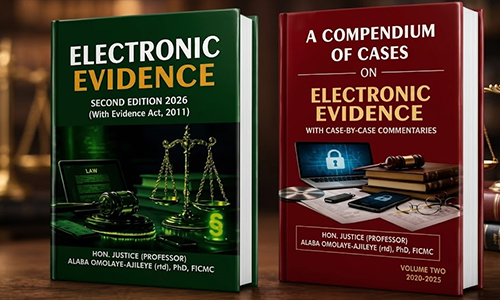
“Order Justice Omolaye-Ajileye’s Electronic Evidence Books Now” — Essential Guides On Evidence Act, Case Law And Digital Proof
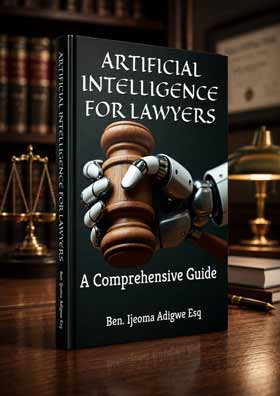 The book also examines Nigeria's legal ecosystem, focusing on the LPELR and NBA AI Guidelines. As a bonus, every purchase comes with a FREE eBook titled: How to Use the AI Features in LegalPedia and LawPavilion.
Ohio Books Ltd praises the publication, stating:
"....this is the only Nigerian book I know of on the topic."
How to Order:
📞 Call, Text, or WhatsApp: 08034917063 | 07055285878
📧 Email: benadigwe1@gmail.com
🌎 Website: www.benadigwe.com
Ebook Version: Access it directly online at https://selar.com/prv626
Authored by Ben Ijeoma Adigwe Esq., ACIarb (UK), LL.M, Dip. in Artificial Intelligence, Director at the Delta State Ministry of Justice, Asaba, Nigeria.
_______________________________________________________________________
The book also examines Nigeria's legal ecosystem, focusing on the LPELR and NBA AI Guidelines. As a bonus, every purchase comes with a FREE eBook titled: How to Use the AI Features in LegalPedia and LawPavilion.
Ohio Books Ltd praises the publication, stating:
"....this is the only Nigerian book I know of on the topic."
How to Order:
📞 Call, Text, or WhatsApp: 08034917063 | 07055285878
📧 Email: benadigwe1@gmail.com
🌎 Website: www.benadigwe.com
Ebook Version: Access it directly online at https://selar.com/prv626
Authored by Ben Ijeoma Adigwe Esq., ACIarb (UK), LL.M, Dip. in Artificial Intelligence, Director at the Delta State Ministry of Justice, Asaba, Nigeria.
_______________________________________________________________________