The word “charge” in connection with criminal law is used in two senses- one, as a noun and the other as a verb. As a noun, the Black’s Law Dictionary defines “charge” as a formal accusation of an offence as a preliminary step to prosecution. As a verb the Black’s Law Dictionary defines “charge” as “to accuse (a person) of an offence”. These definitions from the legal perspective are similar to the definitions provided in the Oxford Advanced Learner’s Dictionary. Our Administration of Criminal Justice Act defines “charge” (noun) as “means the statement of offence or statement of offences with which a defendant is charged in a trial…” When you charge someone in court it means that you have accused him formally by reading to him the allegations made against him or her. Once that is done, it means that the person has been charged with an offence. It would then likely not be correct to say that, that person was “charged to court”. Surely that person cannot be “accused to court” but can be “accused in court”. The word “charge” in a criminal legal sense has been extended outside the courts to include the constitutional requirement that “a person who is arrested or detained shall be informed in writing within twenty-four hours (and in a language that he understands) of the facts and grounds for his arrest or detention.” To accuse any person arrested or detained is also to charge the person. So a person can be charged at a police station, in his or her home, in a car, or on the road just as he or she can be charged in court and not “to court”.]]>


 Interested buyers are encouraged to place their orders and enquiries via:
0704 444 4777, 0704 444 4999, 0818 199 9888
Website: www.alexandernigeria.com
Interested buyers are encouraged to place their orders and enquiries via:
0704 444 4777, 0704 444 4999, 0818 199 9888
Website: www.alexandernigeria.com

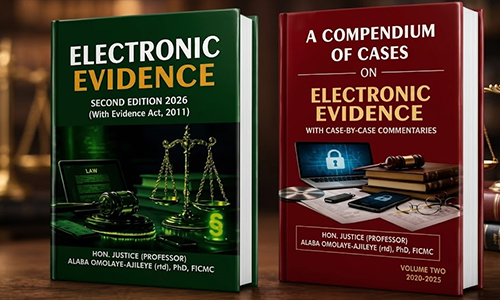
“Order Justice Omolaye-Ajileye’s Electronic Evidence Books Now” — Essential Guides On Evidence Act, Case Law And Digital Proof