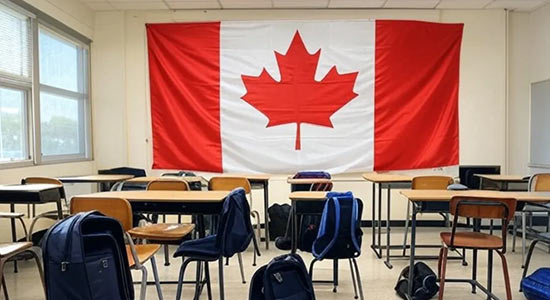
The International Credential Assessment Service of Canada (ICAS) has stopped accepting applications for the assessment of academic qualifications obtained from four Nigerian universities, raising concerns among graduates seeking educational, employment and immigration opportunities in Canada.

The affected institutions are Imo State University (IMSU), Owerri; Federal University of Technology, Owerri (FUTO); Enugu State University of Science and Technology (ESUT); and the University of Benin (UNIBEN), Edo State.
The Canadian credential assessment organisation confirmed the restriction in a notice published on its official website, warning that qualifications obtained from the four institutions would not be included in its assessment reports.
However, ICAS did not disclose the reason for the decision, whether the restriction arose from concerns about the authentication of academic records or any other issue, or when it would resume accepting applications involving the affected universities.
The development became public knowledge in Nigeria on Saturday, November 28, 2026, generating concern about its possible implications for graduates who require their academic qualifications to be evaluated for use in Canada.
In its official notice, ICAS stated:
“Please note that ICAS is not currently accepting applications for study completed at Imo State University, the Federal University of Technology, Owerri, Enugu State University of Science and Technology and the University of Benin.
“If you submit documentation for study completed at one of the above institutions, it will not be included in the assessment.”
The notice appears in the organisation’s documentation requirements for Nigerian applicants seeking immigration-related assessments and assessments for college applications.
The development means that graduates of the four institutions who submit their academic certificates or transcripts to ICAS cannot presently obtain an assessment of those qualifications through the organisation.
The restriction could affect individuals who intend to use their Nigerian university degrees to demonstrate Canadian educational equivalence for immigration applications, admission into educational institutions and other purposes requiring independent credential evaluation.
ICAS is one of the organisations designated by Immigration, Refugees and Citizenship Canada (IRCC) to evaluate foreign academic qualifications.
It provides Educational Credential Assessment (ECA) reports, which establish how academic qualifications obtained outside Canada compare with credentials awarded within the Canadian educational system.
For some Canadian immigration programmes, including certain applications under Express Entry, candidates with foreign qualifications must obtain an ECA from an approved organisation to establish eligibility or claim points for their education.
The reports may also help Canadian employers, educational institutions and other organisations understand the level and comparability of academic qualifications obtained overseas.
Under its regular documentation procedures, ICAS requires applicants to provide copies of their qualifications while requesting official academic records, including transcripts and confirmation of graduation, directly from the institutions that awarded them.
However, the notice concerning IMSU, FUTO, ESUT and UNIBEN specifically states that applications involving studies completed at those institutions are not currently being accepted.
The restriction therefore goes beyond a routine request for additional documents, as the organisation has expressly excluded the listed institutions from its present assessment process.
One of the major questions arising from the development is why the Canadian organisation singled out the four Nigerian universities.
Despite identifying the affected institutions, ICAS did not provide an explanation in its published notice.
The organisation did not indicate whether the restriction was connected to difficulties verifying academic records, documentation procedures, institutional communication or other concerns relating to credential assessment.
It also did not publicly identify any particular certificate, academic programme, graduating class or individual whose qualifications had prompted the decision.
Consequently, there is no official basis for concluding that the restriction was imposed because of certificate forgery, academic fraud or wrongdoing by the management of any of the four universities.
The absence of an explanation has nevertheless raised questions about academic record verification and the international evaluation of Nigerian university qualifications.
Education technologist Alex Onyia, who drew public attention to the development, expressed concern about alleged irregularities in Nigeria’s university system and the possible consequences for graduates.
Onyia argued that students who legitimately completed their academic programmes could suffer if concerns about academic integrity affected the acceptance of certificates issued by their institutions.
He also expressed apprehension that other international credential assessment organisations, including World Education Services (WES), might eventually introduce similar restrictions.
However, Onyia’s comments represent his concerns and interpretation of the development, not an official explanation from ICAS.
There is also no indication in the Canadian organisation’s notice that WES or other assessment bodies have adopted equivalent restrictions against the four universities.
For graduates of IMSU, FUTO, ESUT and UNIBEN, the immediate concern is the possible disruption of applications requiring an ICAS credential assessment.
Individuals who have already completed their university education and are preparing to pursue opportunities in Canada may need to reconsider their assessment arrangements.
Those who intended to submit their academic records to ICAS would need to verify the current status of the restriction before making payments or requesting transcripts from their institutions.
The development may be particularly significant for graduates seeking immigration through programmes in which foreign educational qualifications must be evaluated by a designated organisation.
Without an acceptable assessment report, affected applicants could encounter difficulties establishing the Canadian equivalence of their qualifications or claiming the relevant educational points.
However, the ICAS decision does not mean that Canada has imposed a nationwide ban on certificates issued by the four universities.
It also does not establish that the qualifications are invalid or that graduates of the institutions are prohibited from studying, working or applying for immigration to Canada.
The restriction is specific to ICAS and concerns the organisation’s present willingness to assess studies completed at the named institutions.
Other organisations designated to conduct educational credential assessments for Canadian immigration include World Education Services (WES), the Comparative Education Service (CES) of the University of Toronto, the International Qualifications Assessment Service (IQAS) and the International Credential Evaluation Service (ICES) of the British Columbia Institute of Technology.
Applicants may explore these alternatives, subject to the documentation requirements, institutional acceptance policies and procedures of each assessment organisation.
The availability of other designated providers does not automatically guarantee that every qualification from the affected universities will be accepted or evaluated.
Graduates would therefore need to confirm directly with their preferred assessment organisation whether their university and programme are eligible before proceeding with an application.
The development also raises questions for the management of the four universities and Nigeria’s higher education regulatory authorities.
An explanation from ICAS would help clarify whether the decision concerns document verification, institutional processes or other matters requiring corrective action.
Such clarification would also help affected universities determine whether any administrative measures are necessary to restore the organisation’s acceptance of their academic records.
For graduates who completed their studies in accordance with university requirements, the uncertainty creates concern about whether their qualifications can be assessed through ICAS despite the time and resources invested in obtaining them.
The situation is particularly significant because credential assessment is an important requirement for some international academic and immigration processes.
While universities award academic qualifications, international credential assessment organisations independently evaluate those qualifications for equivalence within their respective systems.
The decision by one assessment organisation not to process a particular institution’s credentials does not, by itself, cancel the degrees awarded by that institution.
Nevertheless, the restriction could delay applications where an ICAS assessment is required or where an applicant has already chosen ICAS as the designated provider.
Another unresolved issue is the duration of the restriction.
ICAS used the expression “not currently accepting applications,” indicating its present position, but did not disclose when the policy began or provide a timetable for reviewing or reversing it.
The organisation also did not explain whether graduates who had previously received assessments would be affected.
In the absence of a specific announcement concerning existing reports, the notice should not be interpreted as an automatic cancellation of assessments already issued to graduates of the affected institutions.
For now, the four universities remain specifically identified in ICAS’s published restriction.
The situation highlights the importance of clear communication between Nigerian universities, international credential assessment organisations and graduates who depend on the recognition and evaluation of their academic qualifications.
It also underscores the need for transparent procedures governing the verification of certificates and transcripts, particularly where graduates are required to submit official academic records directly from their universities.
The central question remains why ICAS has stopped accepting studies completed at the four institutions.
Until the organisation provides an official explanation, any suggestion that the decision resulted from academic fraud, certificate irregularities or other specific misconduct remains unverified.
Graduates seeking educational or immigration opportunities in Canada may therefore need to explore other designated credential assessment providers while awaiting clarification from ICAS and the affected universities.
The four institutions affected by the restriction remain Imo State University, Federal University of Technology, Owerri, Enugu State University of Science and Technology, and the University of Benin.
[A MUST HAVE] Evidence Act Demystified With Recent And Contemporary Cases And Materials
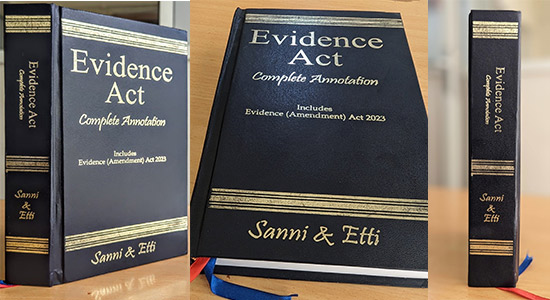
Available now for NGN 40,000 at ASC Publications, 10, Boyle Street, Onikan, Lagos. Beside High Court, TBS. Email publications@ayindesanni.com or WhatsApp +2347056667384. Purchase Link: https://paystack.com/buy/evidence-act-complete-annotation
______________________________________________________________________ “Enhance Legal Practice With Authoritative Reports” — Alexander Payne Offers Comprehensive Law Reports, Spanning Over A Century Of Nigerian Jurisprudence Interested buyers are encouraged to place their orders and enquiries via:
0704 444 4777, 0704 444 4999, 0818 199 9888
Website: www.alexandernigeria.com
“A Comprehensive Guide To Evidence Law” — Releases Second Edition In Three Volumes, Covering 4,051 Cases
For enquiries and orders, contact: 08035526491 Email: jerryamadisilk@gmail.com
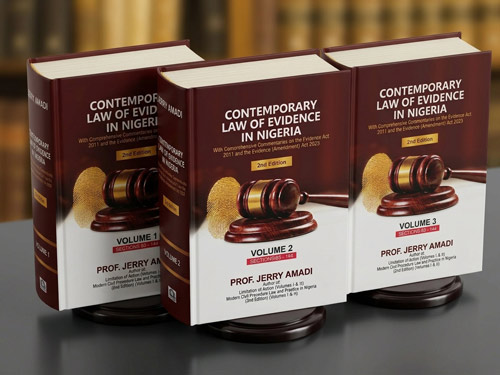 Prof. Jerry Amadi’s Evidence Law, Second Edition (2026), contains 3,314 pages in three volumes, covering the Evidence Act 2011, its 2023 amendment, and 4,051 Nigerian and English cases.