

By Festus Okoye

Widespread anxiety persists, and Nigerians are unsure whether the Independent National Electoral Commission (INEC)’s clean-up of the Preliminary Voters Register has removed all AI-generated voters from the list. They also do not know whether more AI voters remain on the voters’ roll, what they will do on election day, or what issues they will face.
Some Nigerians believe the voter register is not credible and that Nigeria should not use it for the 2027 general election until an independent audit is completed. In other words, some Nigerians insist that AI-generated voters will decide the 2027 general election because they are robotic Nigerians. They insist that the election will not be credible if such a register is used for the 2027 general election.
The controversy surrounding the independent discovery of AI-generated images on the voters’ roll raises a more fundamental question than whether AI-generated images have entered the voters’ roll. It concerns the integrity of the registration process, the effectiveness of the Commission’s verification mechanisms, and the extent to which such records can compromise an election’s credibility.
It is important to emphasize that AI-generated or manipulated photographs, fictitious identities, and fraudulent registrations are not necessarily the same. The discovery of artificial images in the register will not translate into votes on election day if polling agents, domestic election observers, and other critical stakeholders are vigilant and insist that the Bimodal Voter Accreditation System (BVAS) is used to verify and authenticate every voter on election day. Nevertheless, it exposes vulnerabilities that demand credible investigation, institutional accountability, and effective safeguards ahead of the 2027 general election.
For context, the Independent National Electoral Commission conducted the Continuous Voter Registration Exercise (CVR) between August 25, 2025, and July 26, 2026. At the end of the exercise, the Commission compiled 11,088,238 records across the three phases of the 2025/2026 CVR. The Preliminary Voters Register was displayed in 8,838 Registration Areas (Nigeria had 8,809 Registration Areas during the 2023 general election).
Unfortunately, due to an oversight, a delay, or a deliberate policy decision, the Commission did not post the register on its website or any associated websites. This contravenes Section 19(1) of the Electoral Act, 2026, which provides that, subject to Section 9(6) of the Act, the Commission shall, no later than 90 days before a general election, designate a seven-day period during which a copy of the voters’ register for each Local Government, Area Council, or Ward shall be displayed or published for public scrutiny at every registration area and on its official website or any website established by the Commission for that purpose.
The Nigerian people protested, insisting that the Commission display the Register in accordance with section 19 of the Act. Unfortunately, by the time the protests peaked, the statutorily prescribed display period had expired.
On October 26, 2026, the Commission issued an update stating that it had conducted the physical display of the Register at Registration Areas nationwide from 9th to 15th October, 2026, allowing registered voters to inspect their particulars and submit claims and objections as prescribed by law. The Commission further stated that it had taken note of concerns raised by Nigerians and other stakeholders about making the Register accessible through its online platform, in addition to the physical display already conducted. It added that this additional measure complements the physical display and is intended to facilitate wider public access to the Register.
The display of the voters’ register confirmed the suspicions of most Nigerians. Nigerians found AI-generated images on the register and wondered how they had gotten into it. Some analysts claimed that the Commission knew about the register and chose to hide it from digitally savvy voters.
Thereafter, the Commission (INEC) announced that it had removed 1,609,553 records from the national voter register following a cleanup of the 2025/2026 Continuous Voter Registration (CVR) exercise. It also revealed that 54 people across ten states had been identified as complicit in the irregularities and would face disciplinary action and possible prosecution. The Commission stated that the figure comprised 1,608,660 confirmed invalid registrations and 873 records belonging to verified deceased persons, which were removed as a separate category. The Commission further stated that it had harvested 11,088,238 records from the three phases of the 2025/2026 CVR, and that the Automated Biometric Identification System (ABIS) had initially flagged 1,545,052 of these for examination.
The Commission further stated that before the Preliminary Register was published, 1,277,052 registrations had been confirmed invalid and excluded. An additional 268,000 cases were then referred to adjudication following objections, claims and complaints received during the display. Of these, 217,722 were confirmed invalid and removed, while 50,278 were cleared as valid and retained. Additional screening identified 113,886 more invalid registrations, which were also removed, bringing the total post-display removals to 331,608.
According to the Commission, the technical assessment examined suspected multiple registrations, unusual registration patterns, substituted photographs, and irregularities in registration transactions, and found that some registration personnel acted deliberately. The records include artificial or manipulated photographs, duplicate registration attempts, unusual names and registration patterns, and deceased persons still listed on the register.
Before the release, or forced release, of the Preliminary Voters Register for the 2027 general election, Nigerians heard only about ghost registrations, underage registrants, duplicate and multiple registrations, and community registration. They did not know that robots could also register, or that computers could generate robotic human beings.
While the concerns expressed by Nigerians are genuine, there is no gainsaying that politicians have always been interested in the voter register. Some saw it as another form of census and sought to increase the populations of their constituencies. Some collected temporary voter cards, and their foot soldiers used them to vote multiple times. Some knew the legal challenges of proving overvoting and dared their opponents to go to court.
The opacity of the voter’s register has been a source of concern and embarrassment for the Commission. Unfortunately, over the years, the culprits and beneficiaries of this opacity have feigned ignorance and pretended that the Commission is the ultimate beneficiary of their misbehavior. People have engaged in community registration, underage registration, double and multiple registration, and registration using almanacs, photos harvested from photo studios, and the internet.
Politicians seeking to compromise the voters’ register also compromised some INEC Registration Officers. Between January 15 and February 5, 2011, the Commission registered 73.5 million voters. Thereafter, it used in-house registration software and the Automated Fingerprint Identification System (AFIS) to identify 870,000 cases of duplicate registration ahead of the 2011 general election.
The Commission then carried out additional de-duplication, reducing the figure from 73.5 million to 70,383,427 registered voters. In his briefing to the African Union (AU) Election Observer Delegation in Abuja on Thursday, March 26, 2015, ahead of the 2015 general election, INEC Chairman Professor Attahiru Jega stated, “Now we’ve done a clean-up of the Register of Voters, and in that process we have eliminated over 4 million cases of people who did multiple registrations—some, although in isolated cases, up to 20 times; but in most cases, two or three times.”
Between June 28, 2021, and July 31, 2022, the Commission conducted the Continuous Voter Registration Exercise and registered 12,298,944 new registrants.
The Commission used the Automated Biometric Identification System (ABIS) to deduplicate records. First, it used ONLY PHOTOS to determine whether anyone was registered more than once. Pairs with high similarity were flagged. Second, it deduplicated using fingerprints and flagged pairs with high similarity.
If a pair is suspected of being duplicates based on their faces and is also marked as duplicates based on fingerprints, then that pair is marked as CONFIRMED DUPLICATE. If only one method is used, the pair undergoes physical adjudication.
In total, 2,780,756 records were duplicates, accounting for 22.6% of the registration records. This reduced the number of valid registrations to 9,518,188.
The Commission initially identified 10 registration officers as culpable, and as of 2022, the Human Resources Department was investigating them. The Commission also identified 13 additional officers. Some registrations still used images such as passport photographs, photos taken from almanacs, and images downloaded from the internet.
The Commission must conduct its investigation into those suspected of compromising the register in an open and transparent manner to demonstrate that bad behavior has consequences. Those behind the mask must also be unmasked, as these officials acted in concert with those who stand to benefit most from an opaque voters’ register.
Beyond removing invalid registrations, the Commission must demonstrate that the final register is credible and that the vulnerabilities exposed by the clean-up have been adequately addressed. This requires greater transparency in the registration process, effective supervision of registration personnel, stronger safeguards against unauthorized alterations, and a credible investigation of those implicated in the irregularities.
Political parties, polling agents, domestic election observers, and voters must display courage, remain vigilant, and insist that only those whose names are on the register and whose passes are verified through the biometric accreditation system are allowed to vote at polling units. This presupposes that political parties must train their agents to have a basic understanding of the law and the Commission’s processes and procedures.
An ignorant polling agent threatens the electoral process and is of no help to the political party or the candidates. With a sound understanding of the law and electoral procedures, properly trained polling agents can help ensure that questionable registrations do not result in fraudulent votes. Although biometric accreditation remains an important safeguard, it must be complemented by vigilance, effective monitoring, and strict adherence to established electoral procedures.
[A MUST HAVE] Evidence Act Demystified With Recent And Contemporary Cases And Materials
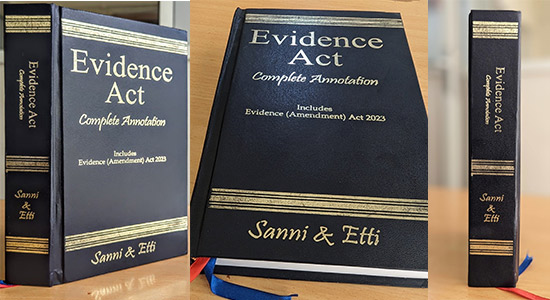
Available now for NGN 40,000 at ASC Publications, 10, Boyle Street, Onikan, Lagos. Beside High Court, TBS. Email publications@ayindesanni.com or WhatsApp +2347056667384. Purchase Link: https://paystack.com/buy/evidence-act-complete-annotation
______________________________________________________________________ “Enhance Legal Practice With Authoritative Reports” — Alexander Payne Offers Comprehensive Law Reports, Spanning Over A Century Of Nigerian Jurisprudence Interested buyers are encouraged to place their orders and enquiries via:
0704 444 4777, 0704 444 4999, 0818 199 9888
Website: www.alexandernigeria.com
“A Comprehensive Guide To Evidence Law” — Releases Second Edition In Three Volumes, Covering 4,051 Cases
For enquiries and orders, contact: 08035526491 Email: jerryamadisilk@gmail.com
 Prof. Jerry Amadi’s Evidence Law, Second Edition (2026), contains 3,314 pages in three volumes, covering the Evidence Act 2011, its 2023 amendment, and 4,051 Nigerian and English cases.