

The Chief Justice of Nigeria (CJN), Justice Kudirat Kekere-Ekun, and the Independent Corrupt Practices and Other Related Offences Commission (ICPC) have urged judges to exercise greater caution when evaluating digital evidence in corruption cases, warning that artificial intelligence, deepfakes and manipulated electronic records pose growing challenges to the administration of justice.

They stressed that the increasing sophistication of technology and its use in financial transactions and criminal activities require judicial officers to develop the technical expertise necessary to distinguish authentic electronic evidence from fabricated, misleading or manipulated information.
The warning was issued on Tuesday during the opening of a two-day capacity-building workshop for judges organised by the ICPC in collaboration with the National Judicial Institute (NJI) in Abuja.
The workshop, themed “Adjudicating Corruption in the AI Era: Enhancing Judicial Capacity for Digital Evidence and Tech-Driven Corruption Trials,” was designed to strengthen the ability of judicial officers to handle complex corruption cases involving digital evidence and emerging technologies.
Speaking at the event, the Chairman of the ICPC, Dr. Musa Adamu Aliyu, SAN, observed that modern financial transactions increasingly involve electronic payment systems, complex corporate structures and virtual assets, making digital evidence a central component of corruption investigations and prosecutions.
He, however, cautioned that the emergence of deepfakes and manipulated electronic records had introduced new challenges for courts, particularly regarding the authenticity, integrity and reliability of evidence presented during trials.
According to him, judges must pay particular attention to the processes through which digital evidence is obtained, preserved and authenticated before admitting or relying on such material in determining corruption cases.
Aliyu emphasised that although investigative and prosecutorial agencies are responsible for uncovering facts and bringing criminal charges, the ultimate responsibility for evaluating evidence and protecting constitutional rights rests with the judiciary.
“Investigations and prosecutions may uncover facts and bring charges, but the Bench tests evidence, safeguards fundamental rights, resolves complex legal questions, and delivers justice that commands public confidence,” he said.
The ICPC chairman explained that strengthening judicial standards for assessing digital and financial evidence would also improve the quality of investigations and prosecutions, as law enforcement agencies would be required to meet the evidentiary standards demanded by the courts.
In her keynote address, the Chief Justice of Nigeria, Justice Kekere-Ekun, emphasised the need for judicial officers to acquire the technological knowledge required to examine digital records, assess forensic findings and evaluate expert testimony in corruption proceedings.
She acknowledged that artificial intelligence could support investigations by tracing financial transactions and analysing large volumes of data, but warned that the technology’s outputs should not automatically be accepted as accurate or reliable.
According to the CJN, AI-generated information may contain errors, reflect inherent bias or appear convincing despite being inaccurate or misleading.
She consequently urged judges to subject technology-generated evidence to rigorous judicial scrutiny, particularly where such material could influence the determination of criminal responsibility.
Justice Kekere-Ekun further cautioned that the increasing use of sophisticated technologies in criminal proceedings must not undermine the fundamental rights of defendants, including the presumption of innocence and the right to challenge evidence presented against them.
“The seriousness of an allegation cannot be a substitute for proof,” the CJN declared.
She stressed that regardless of the nature or gravity of corruption allegations, courts must remain guided by established legal principles and the requirement that allegations be supported by credible evidence.
The CJN also underscored the importance of effective pretrial management and proper organisation of exhibits, noting that these measures would help prevent unnecessary delays in the adjudication of complex corruption cases.
She encouraged judicial officers to adopt efficient case management practices capable of addressing the challenges associated with voluminous electronic records, technical evidence and expert witnesses.
Earlier, the Administrator of the National Judicial Institute, Justice Babatunde Adeniran Adejumo, OFR, called for a coordinated approach to the application of technology across the investigation, prosecution and adjudication stages of criminal justice administration.
He observed that the strength of cases presented before courts largely depends on the quality of investigations conducted and the evidence assembled by prosecuting agencies.
Adejumo expressed optimism that the workshop would strengthen the technological capacity of judicial officers and build on existing digital tools within the judiciary to improve the handling of corruption trials.
The two-day workshop features practical case studies, forensic demonstrations and discussions covering digital evidence, AI-generated deception, financial and virtual-asset tracing, and judicial case management.
The programme also seeks to equip judges with practical knowledge for assessing electronically generated records and addressing emerging challenges associated with technology-driven corruption.
The engagement underscores the growing emphasis by the judiciary and anti-corruption agencies on ensuring that technological advancement supports effective prosecution without compromising evidentiary standards, fair hearing or the constitutional rights of defendants.
[A MUST HAVE] Evidence Act Demystified With Recent And Contemporary Cases And Materials
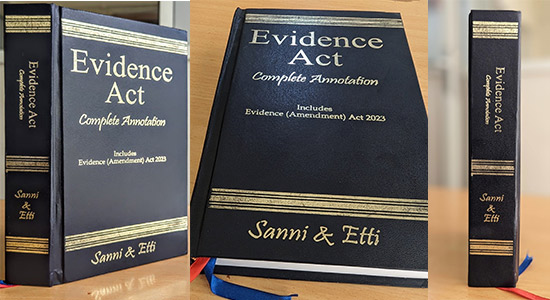
Available now for NGN 40,000 at ASC Publications, 10, Boyle Street, Onikan, Lagos. Beside High Court, TBS. Email publications@ayindesanni.com or WhatsApp +2347056667384. Purchase Link: https://paystack.com/buy/evidence-act-complete-annotation
______________________________________________________________________ “Enhance Legal Practice With Authoritative Reports” — Alexander Payne Offers Comprehensive Law Reports, Spanning Over A Century Of Nigerian Jurisprudence Interested buyers are encouraged to place their orders and enquiries via:
0704 444 4777, 0704 444 4999, 0818 199 9888
Website: www.alexandernigeria.com
“A Comprehensive Guide To Evidence Law” — Releases Second Edition In Three Volumes, Covering 4,051 Cases
For enquiries and orders, contact: 08035526491 Email: jerryamadisilk@gmail.com
 Prof. Jerry Amadi’s Evidence Law, Second Edition (2026), contains 3,314 pages in three volumes, covering the Evidence Act 2011, its 2023 amendment, and 4,051 Nigerian and English cases.