
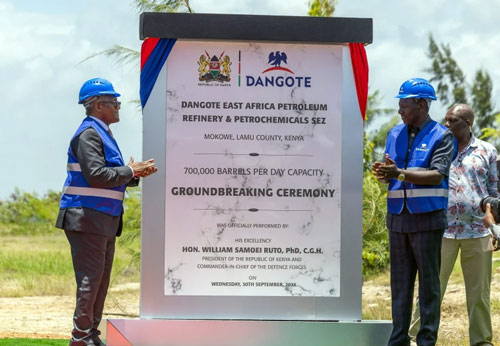
The High Court of Kenya has declined to grant an application seeking immediate restrictions on dealings involving Nigerian billionaire Aliko Dangote’s 24.76 per cent stake in Kenya Pipeline Company (KPC), acquired in a transaction valued at approximately $327 million.

Justice Patricia Nyaundi Mande refused to certify the application as urgent or issue interim orders without first hearing the other parties, leaving the disputed shareholding unaffected by the requested restrictions while the substantive petition remains pending before the court.
The decision, delivered on November 10, 2026, followed a petition filed by Kenyan human rights activist Francis Awino, challenging the processes through which public institutions and pension funds acquired, held and subsequently disposed of shares in Kenya Pipeline Company following its privatisation.
According to reports by Business Daily and The Star, the petitioner sought temporary restrictions on transactions involving Dangote’s shares pending judicial examination of whether the relevant public institutions complied with applicable approval and disclosure requirements.
However, Justice Mande declined to issue the requested orders at that stage of the proceedings.
“This is not an appropriate matter for the grant of ex parte orders,” the court stated.
The judge consequently directed the respondents to file their replies to the petition by November 27, 2026, and fixed November 30 for mention.
The date falls two days before Kenya Pipeline Company’s annual general meeting scheduled for December 2, 2026.
The court’s refusal to grant the interim restrictions means that no immediate judicial order has been imposed preventing dealings in the disputed shares.
However, the ruling does not amount to a final determination of the legality of Dangote’s investment or the transactions involving the public institutions and pension funds identified in the petition.
The High Court has also not made any finding that the institutions involved acted improperly.
The underlying dispute remains before the court, with the respondents expected to address the allegations and disclosure requests raised by the petitioner.
Following the decision, Dangote’s investment vehicle is expected to proceed towards nominating a director to the board of Kenya Pipeline Company ahead of the scheduled shareholders’ meeting.
The nomination could result in the National Social Security Fund being replaced on the company’s board, although the outcome of the proposed board changes remains dependent on the relevant corporate processes.
The dispute concerns the ownership, acquisition and disposal of shares in KPC, particularly those previously held by Kenyan public institutions and pension funds.
In his petition, Awino seeks greater transparency regarding the circumstances surrounding the transactions.
He wants the court to examine whether the relevant public institutions obtained the necessary authorisations before acquiring, retaining or selling their shares in the company.
The petitioner also seeks disclosure of financial records and institutional decisions relating to the transactions.
Among the information requested are the identities of the institutions involved, the number of shares transferred, the dates of the transactions, the proceeds realised and the approvals obtained.
Awino further requested investment appraisals, board and trustee resolutions, instructions issued to fund managers, transaction agreements and payment records.
The documents are intended to establish how the transactions were authorised, the manner in which they were executed and how the proceeds were accounted for.
Public institutions identified in the reports include the National Social Security Fund, Public Service Superannuation Fund, County Pension Fund, Lapfund and Laptrust.
Other institutions mentioned include pension schemes associated with Kenya Power, Kenya Pipeline Company and Kenya Ports Authority.
The respondents named in the proceedings include the National Treasury, Privatisation Authority, Capital Markets Authority, Kenya Pipeline Company, pension institutions and a Dangote-linked refinery company.
The petition raises questions about whether these institutions followed the applicable procedures in dealing with their interests in the company.
However, the allegations remain unproven, and the High Court has yet to determine whether any breach of the law or regulatory requirements occurred.
The latest proceedings come amid Dangote’s expanding investment interests in Kenya’s energy industry.
In October 2026, Dangote acquired approximately 25 per cent of Kenya Pipeline Company for $327 million, securing a significant shareholding in infrastructure connecting Kenya’s coastal petroleum facilities with inland markets and other destinations in the region.
The transaction forms part of his wider business interests in East Africa’s petroleum and energy sectors.
Beyond the Kenya Pipeline Company investment, Dangote is also associated with a proposed $16 billion refinery project in Lamu, Kenya.
That project has faced separate legal challenges involving land ownership and environmental concerns.
In October 2026, a Kenyan court lifted an earlier restriction on the Lamu refinery project, allowing development activities to proceed while the underlying dispute continued.
The Lamu proceedings are distinct from the latest case involving Dangote’s shareholding in Kenya Pipeline Company.
While the Lamu dispute concerns the proposed refinery development and related land and environmental issues, Awino’s petition focuses on transparency, authorisation and accountability in transactions involving shares held by public institutions and pension funds.
A separate issue has also arisen over Kenya’s proposed $500 million investment in the Dangote refinery.
A consumer organisation previously sought details of the planned public investment, following proposals for East African governments to participate in the refinery project.
That disclosure request concerns a different investment arrangement and is not the subject of the interim orders refused by Justice Mande.
The Kenya Pipeline Company proceedings therefore remain centred on whether the acquisition and disposal of the disputed shares complied with the necessary institutional and legal requirements.
Although the court declined to impose immediate restrictions on Dangote’s 24.76 per cent stake, it left open the questions raised by the petitioner for consideration after the respondents have been heard.
The respondents are required to file their replies by November 27, while the matter will return to court on November 30, ahead of the company’s December 2 annual general meeting.
[A MUST HAVE] Evidence Act Demystified With Recent And Contemporary Cases And Materials
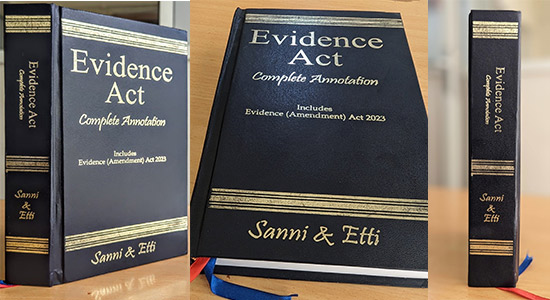
Available now for NGN 40,000 at ASC Publications, 10, Boyle Street, Onikan, Lagos. Beside High Court, TBS. Email publications@ayindesanni.com or WhatsApp +2347056667384. Purchase Link: https://paystack.com/buy/evidence-act-complete-annotation
______________________________________________________________________ “Enhance Legal Practice With Authoritative Reports” — Alexander Payne Offers Comprehensive Law Reports, Spanning Over A Century Of Nigerian Jurisprudence Interested buyers are encouraged to place their orders and enquiries via:
0704 444 4777, 0704 444 4999, 0818 199 9888
Website: www.alexandernigeria.com
“A Comprehensive Guide To Evidence Law” — Releases Second Edition In Three Volumes, Covering 4,051 Cases
For enquiries and orders, contact: 08035526491 Email: jerryamadisilk@gmail.com
 Prof. Jerry Amadi’s Evidence Law, Second Edition (2026), contains 3,314 pages in three volumes, covering the Evidence Act 2011, its 2023 amendment, and 4,051 Nigerian and English cases.