
The Abu Dhabi Global Market (ADGM) Courts have granted cryptocurrency exchange Binance a $6.5 billion worldwide freezing injunction as part of efforts to trace, preserve and recover cryptocurrency assets stolen during a security breach on October 29, 2026.

The order, described by lawyers representing Binance as potentially the largest publicly known freezing order of its kind, is intended to prevent the dissipation of assets linked to the theft and facilitate their recovery through legal and technological mechanisms.
Justice William Stone SBS KC granted the relief in proceedings instituted by Binance against unidentified perpetrators, described as “Persons Unknown”, and certain named defendants holding assets allegedly connected to the theft.
In a statement dated November 20, 2026, Binance disclosed that the court also granted interim proprietary injunctions and delivery-up orders against different categories of unidentified defendants, alongside interim proprietary orders against certain named defendants holding some of the stolen assets.
The various orders are intended to complement one another in facilitating the recovery of the stolen cryptocurrency.
While the worldwide freezing injunction restricts dealings with assets covered by the order up to $6.5 billion, the interim proprietary injunctions are intended to preserve specific assets claimed to constitute stolen property or traceable proceeds.
The delivery-up orders provide an additional legal mechanism for requiring the surrender of assets covered by those orders.
Binance explained that the orders would enable it to pursue every lawful avenue to identify, trace, freeze and recover the stolen cryptocurrency.
The company added that the court’s intervention would provide the necessary legal backing required by some financial institutions and cryptocurrency industry partners before assets already frozen could be returned.
The exchange also disclosed that all customer assets affected by the October 29 security incident had been fully replenished, adding that users had been protected and that the company had absorbed the financial impact of the theft.
However, Binance stressed that compensating affected customers did not bring its recovery efforts to an end, maintaining that it remained committed to recovering the stolen funds and preventing the perpetrators from benefiting from the attack.
The company’s Deputy General Counsel, Dugan Bliss, said Binance would continue to deploy available legal mechanisms to pursue the stolen assets.
“Users are protected, and Binance has absorbed the financial impact, but our responsibility does not stop there. We will continue using every lawful tool available to trace, freeze and recover stolen assets, support our partners in returning funds where possible, and keep those assets out of the hands of the attackers,” Bliss stated.
One of the notable features of the court’s intervention is the provision for service of court orders through blockchain networks and the publication of a continually updated list of cryptocurrency wallet addresses identified as holding stolen assets.
According to Gibson Dunn, the international law firm representing Binance in the proceedings, the list currently covers approximately 26,000 cryptocurrency wallet addresses.
The law firm explained that the list would be updated as additional wallet addresses linked to the stolen assets were identified.
The arrangement is intended to enable cryptocurrency exchanges, token issuers, custodians and other industry participants to identify and freeze assets linked to the theft, particularly where those responsible attempt to transfer or launder the cryptocurrency.
Given the speed at which digital assets can be transferred between wallets, exchanges and blockchain networks, the continually updated list is designed to assist recovery efforts as investigators identify additional transactions and addresses.
However, the identification of approximately 26,000 wallet addresses does not necessarily mean that there are 26,000 perpetrators, as a single individual may control multiple cryptocurrency wallets.
M. Kendall Day of Gibson Dunn described the $6.5 billion injunction as one of the largest publicly known freezing orders ever made.
He disclosed that the legal team had also secured proprietary injunctions and delivery-up orders to strengthen Binance’s efforts to recover the stolen property.
Day noted that the ability to serve court orders through blockchain networks and notify market participants through an evolving list of cryptocurrency wallet addresses represented an innovative approach to digital asset recovery.
He also commended the ADGM Courts for granting the orders expeditiously, describing the development as evidence of the court’s willingness to embrace innovative legal processes in addressing disputes involving digital assets.
The proceedings followed a major security breach on October 29, 2026, during which hackers reportedly stole approximately $6.3 billion in cryptocurrency from wallets held at Binance across 10 blockchain networks.
The incident has been described by investigators and media reports as the largest cryptocurrency theft recorded to date.
Multiple blockchain intelligence firms have linked the attack to suspected North Korean cybercriminals, although investigations into the identity of the perpetrators and the circumstances surrounding the breach remain ongoing.
Binance had earlier disclosed that preliminary findings traced the security breach to a compromised laptop belonging to one of its engineers.
According to the company’s initial investigation, the compromised device allegedly enabled an attacker to gain access to an internal service container and initiate unauthorised cryptocurrency withdrawal transactions.
The incident also preceded the departure of Binance’s Chief Financial Officer, Kaiser Ng, who resigned days after the attack.
The company confirmed that Ng, who had spent more than five years with Binance, would be replaced by Justin Yek, a former finance executive at payments company Airwallex.
Reports indicated that approximately $2.85 billion in assets had been frozen or intercepted by third parties during the initial response to the security breach.
However, the freezing or interception of those assets does not necessarily mean that the funds have been returned to Binance.
Similarly, the company’s decision to fully replenish affected customer assets means that it covered the financial shortfall arising from the theft, rather than that the stolen cryptocurrency had been fully recovered.
The $6.5 billion worldwide freezing injunction is an interim asset-preservation measure intended to prevent further dissipation of assets and strengthen Binance’s civil recovery efforts.
It does not constitute a final judgment establishing the liability of all defendants, nor does it establish that the entire amount covered by the injunction has been located, frozen or recovered.
The case combines conventional judicial remedies with blockchain-based tracing, electronic service of court orders and continuous identification of cryptocurrency wallet addresses.
Through these measures, Binance is seeking to translate the identification of stolen digital assets into enforceable recovery steps, particularly where cryptocurrency exchanges, financial institutions and other industry participants can assist in preserving or returning the funds.
The company maintains that its recovery efforts will continue despite having replenished affected customer assets, with the court orders providing additional legal mechanisms to pursue the stolen cryptocurrency and prevent those responsible from benefiting from the breach.
[A MUST HAVE] Evidence Act Demystified With Recent And Contemporary Cases And Materials

Available now for NGN 40,000 at ASC Publications, 10, Boyle Street, Onikan, Lagos. Beside High Court, TBS. Email publications@ayindesanni.com or WhatsApp +2347056667384. Purchase Link: https://paystack.com/buy/evidence-act-complete-annotation
______________________________________________________________________ “Enhance Legal Practice With Authoritative Reports” — Alexander Payne Offers Comprehensive Law Reports, Spanning Over A Century Of Nigerian Jurisprudence Interested buyers are encouraged to place their orders and enquiries via:
0704 444 4777, 0704 444 4999, 0818 199 9888
Website: www.alexandernigeria.com
“A Comprehensive Guide To Evidence Law” — Releases Second Edition In Three Volumes, Covering 4,051 Cases
For enquiries and orders, contact: 08035526491 Email: jerryamadisilk@gmail.com
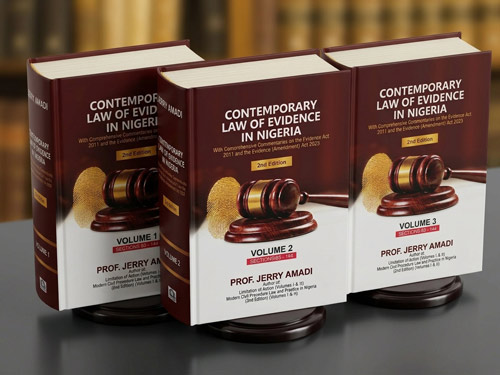 Prof. Jerry Amadi’s Evidence Law, Second Edition (2026), contains 3,314 pages in three volumes, covering the Evidence Act 2011, its 2023 amendment, and 4,051 Nigerian and English cases.