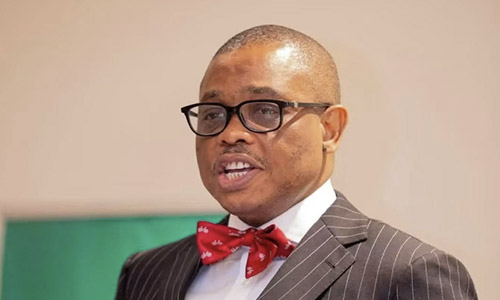
*Calls For End To Judicial Determination Of Party Candidates

Senior Advocate of Nigeria and former President of the Nigerian Bar Association (NBA), Afam Osigwe, SAN, has expressed concern over allegations that money, political influence and other interests sometimes affect judicial decisions in Nigeria, acknowledging that there may be some truth to such concerns while warning that public perceptions of corruption do not always reflect the reality of individual cases.
Osigwe also called for the removal of pre-election disputes over political parties’ choice of candidates from the jurisdiction of the courts, arguing that excessive judicial involvement in the political process has contributed to declining public confidence in Nigeria’s judiciary and electoral system.
The former NBA President made the observations during an interview with PUNCH, conducted by Pelumi Kazeem, in which he reflected on his upbringing, journey into the legal profession, challenges in establishing his law firm, professional achievements, leadership experiences and concerns about the administration of justice in Nigeria.
Speaking on the widespread belief that money and other interests sometimes influence court judgments, Osigwe acknowledged that the concerns could not be entirely dismissed.
“I think there may be some truth to those concerns,” he said.
He explained that judicial officers operate within a political environment where pressures may influence their decisions, even in circumstances where no individual directly approaches or offers them inducements.
According to him, a judge may sometimes feel unable to make an order or deliver a judgment against the government because of the prevailing political environment.
Osigwe also referred to instances of judicial misconduct, stating that there had been “proven cases of judges receiving money to influence decisions”.
He recalled that the National Judicial Council (NJC) had sanctioned judicial officers over allegations of corruption and misconduct.
However, the senior advocate cautioned against treating every allegation or public perception of judicial corruption as an established fact.
He explained that perceptions could sometimes be stronger than the actual evidence available, with members of the public forming conclusions about judicial decisions without sufficient proof of wrongdoing.
Reflecting on his tenure as NBA President, Osigwe maintained that judicial decisions must be consistent with established legal precedents, the facts presented before the court and the applicable law.
He argued that a judgment which disregards those requirements could raise serious questions about the competence or integrity of the judicial officer responsible.
According to him, such a judgment “could be a product of corruption or incompetence”.
“Whichever of the two it is,” he stated, “such a person has no business remaining on the Bench.”
The former NBA President further expressed concern that judicial decisions concerning elections had contributed to diminishing public confidence in both the judiciary and the electoral process.
He described the extent of court involvement in political disputes as an “over-judicialisation of the political process”, maintaining that political parties should have greater responsibility for determining their candidates without routine judicial intervention.
Osigwe argued that disputes concerning the nomination of political party candidates should no longer be justiciable.
In his view, political parties should be allowed to choose their preferred candidates and bear the electoral consequences of those decisions.
“If a political party decides that the least popular person is the candidate it wants to field, it should be allowed to do so without the courts determining who its candidate should be,” he said.
He consequently advocated the removal of provisions of the Electoral Act that permit courts to determine such pre-election disputes, arguing that political parties should be allowed to “succeed or fail based on their decisions”.
According to Osigwe, the large number of political disputes brought before the courts has contributed to negative public perceptions of judicial institutions.
He maintained that improving the transparency and credibility of elections would reduce the number of disputes requiring judicial intervention.
The senior advocate also expressed concern that some judicial decisions had reinforced the belief among Nigerians that their votes did not count.
He explained that when voters believe election outcomes have already been determined or could be manipulated, they may become discouraged from participating in elections.
Osigwe identified several other factors affecting public confidence in the electoral system, including restrictions on opposition political activities, electoral violence, intimidation, the high cost of acquiring political power and the monetisation of elections.
He alleged that in several states, billboards belonging to ruling political parties were more visible, while opposition parties encountered difficulties displaying their own campaign materials.
He also raised concerns about high charges imposed on opposition political activities in circumstances where there was no evidence that members of the ruling party were subjected to similar demands.
The former NBA President further questioned whether Nigerians had sufficient confidence in the Independent National Electoral Commission (INEC) as an independent electoral umpire.
He criticised restrictions on vehicular movement during elections, arguing that such measures could discourage participation without necessarily preventing electoral malpractice.
Osigwe questioned the reasonableness of requiring voters to walk two or three kilometres to their polling units simply because vehicular movement had been restricted on election day.
He maintained that restrictions on movement, when combined with declining public confidence in government and the electoral process, could contribute to low voter turnout.
On the need for electoral reform, Osigwe argued that greater transparency and fairness would encourage political actors to accept election results without necessarily resorting to litigation.
He recalled attending the Osun State governorship election, where, according to him, the outcome was generally expected and unsuccessful candidates did not challenge the result.
He contrasted that experience with elections in which participants believed the process could be manipulated, explaining that such concerns often encouraged candidates and political parties to seek judicial intervention.
According to him, Nigeria “may be one of the countries where electoral disputes are heavily litigated”, a situation he considered indicative of weaknesses in the transparency and credibility of the electoral system.
Addressing the NBA’s responsibility in strengthening the justice system, Osigwe maintained that the association must continue to hold public institutions and officeholders accountable.
He said the NBA, like other civil society organisations, had a responsibility to “speak truth to power”, defend judicial independence, protect the legal profession and insist on respect for the rule of law.
The senior advocate also urged the association to intensify advocacy concerning the poor condition of court infrastructure and the financial independence of the judiciary.
He maintained that Chief Judges and heads of courts should not be placed in positions where they must “beg” the executive for funds required to administer justice.
Osigwe further called for greater protection of the process for appointing judicial officers against political interference, stressing the importance of selecting competent and independent persons for judicial positions.
He argued that judges must resist pressures from political authorities and uphold their obligation to dispense justice independently.
According to him, judicial officers must not “surrender themselves to political authorities”, but should deliver decisions that inspire public confidence.
He maintained that although the three arms of government are interdependent, the judiciary must retain the ability to determine cases “without fear or favour”.
Beyond his concerns about the administration of justice, Osigwe reflected on his journey into the legal profession, revealing that becoming a Senior Advocate of Nigeria remained his proudest professional achievement, even above his emergence as President of the NBA.
“Some people might expect me to say that becoming NBA President was my most fulfilling experience,” he said, “but becoming a Senior Advocate remains the most important professional moment for me.”
He explained that his elevation to the rank of SAN represented years of professional effort, personal sacrifice and commitment to excellence.
Recalling his early years in Abuja, Osigwe disclosed that he arrived in the Federal Capital Territory in 1999 aboard a night bus and initially stayed with friends and colleagues in Gwarinpa before securing accommodation in Karu.
He said he had never imagined becoming a Senior Advocate when he began his professional journey, explaining that his initial ambition was simply to earn a living, establish a successful legal practice and provide financial security for his future.
According to him, attaining the rank demonstrated that “every profession rewards those who work hard and strive for excellence”.
Speaking about his childhood, Osigwe disclosed that he grew up in Nnewi North Local Government Area of Anambra State in a large family.
His mother had nine sons, while his stepmother had one. His father was a trader, and his mother, although primarily a housewife, also operated a shop within the family premises.
He recalled growing up in a community where trading was common and relatively few people pursued formal education, although parents increasingly encouraged their children to remain in school.
According to him, many educational and public facilities in his hometown, including schools, the general hospital and the post office, were established through communal efforts.
Osigwe attended Dennis Memorial Grammar School, Onitsha, before proceeding to the University of Nigeria, Nsukka, where he studied Law.
He said his parents placed considerable emphasis on diligence, honesty, hard work and personal responsibility.
His father’s guiding principle was “Honesty is the best policy”, while dishonesty was strongly discouraged in the family.
He recalled that his father regularly travelled from Nnewi to Onitsha for business and frequently quoted biblical passages warning against laziness and the consequences of excessive sleep.
Osigwe said the values instilled in him during childhood continued to shape his personal and professional decisions.
He also recalled receiving advice when he moved to Abuja in 1999, including the importance of completing tasks promptly, maintaining focus and avoiding conduct that could bring embarrassment to his family.
Interestingly, the former NBA President disclosed that becoming a lawyer was not his original career ambition.
He said he had wanted to become a medical doctor but eventually discovered that his academic strengths were in the arts rather than Mathematics and the sciences.
By the end of his first year in senior secondary school, he realised that pursuing a science-related career would be difficult.
He subsequently developed an interest in Mass Communication because of his admiration for journalism, newspapers and television newscasters.
During his third year in senior secondary school, he secretly selected Mass Communication in a trial Joint Admissions and Matriculation Board examination without informing his parents or siblings.
However, when the results arrived at the post office, his father discovered that he had chosen arts subjects.
Osigwe said his father informed him that although he would not dictate his career choice, he would not finance a Mass Communication programme.
His father preferred that he study a professional course that would enable him to “stand on his own” after graduation.
The decision ultimately influenced Osigwe’s choice of Law, particularly because his elder brother, who graduated from the University of Jos and was called to the Bar in 1987, had established a successful legal practice in Nnewi.
Reflecting on the circumstances, Osigwe said Law came into his life unexpectedly.
“Law happened to me by accident,” he said.
He explained that after gaining admission to study the course, he came to appreciate the profession and eventually concluded that he could not have chosen anything better.
“I could not have studied anything else,” he recalled.
“I believe God directed me to where I was meant to be,” he added.
On the early development of his legal career, Osigwe identified his experience working with the late Chief T.J. Onomigbo Okpoko, SAN, as a major turning point.
Although he worked with the senior advocate for less than two years, he said the experience exposed him to different areas of legal practice, including litigation, commercial transactions and cross-border transactions.
According to him, the experience also taught him the importance of identifying areas of specialisation and continuously developing professional expertise.
He subsequently established his law firm, LAW FORTE, in 2002.
Osigwe recalled that the early years were difficult because clients were not always available, some clients could not afford adequate professional fees and the firm faced challenges involving capital, recruitment and business development.
He also disclosed that he married in 2002 and became a father on March 3, 2003, meaning he was simultaneously raising a young family and developing his legal practice.
Despite those difficulties, he maintained that persistence, professional development and the ability to build relationships were essential to sustaining a successful career.
“God was faithful,” he said.
He advised lawyers to continually develop their client base, recruit suitable personnel, improve their professional knowledge through reading and training, and collaborate with other firms when necessary.
“Life is a race,” he stated, explaining that persistence was necessary “if you want to cross the finish line”.
Reflecting on public perceptions of his personality, Osigwe acknowledged that some people regarded him as arrogant or overly ambitious.
He recalled criticism concerning his aspiration to become NBA President, including questions about whether he was too young to seek the office.
The senior advocate said he was disqualified when he contested the NBA presidency in 2018.
He maintained that he did not consider his ambition unreasonable, particularly given that Nigeria had previously produced heads of state in their 30s and governors in their 40s.
“I do not allow such perceptions to worry me,” he said.
According to him, what mattered was remaining faithful to his principles and “doing what is right rather than acting out of self-interest or simply trying to please people”.
On his future ambitions, Osigwe disclosed that he had no intention of contesting another elective position within the legal profession.
He identified his achievements as including his rank as a Senior Advocate of Nigeria, membership of the Body of Benchers as a life member and his service as NBA President.
However, he maintained that personal growth remained important to him, saying he wanted to become “a better person than I was the previous day”.
He also disclosed that he did not intend to contest political office and was not a member of any political party.
Nevertheless, Osigwe said he might consider a political appointment if an opportunity arose involving responsibilities he believed he could competently discharge.
He expressed a desire to see Nigeria become stronger, the legal profession improve and the judiciary regain the confidence and respect of the people it serves.
Away from legal practice and public affairs, the former NBA President said he enjoyed reading, sightseeing and spending time around nature.
He disclosed that he previously practised photography as a hobby and currently keeps dogs, which he enjoys feeding, grooming and caring for.
Osigwe also said he neither drinks nor smokes and does not particularly enjoy visiting clubs.
Instead, he prefers spending time with friends, engaging in intellectual discussions, watching films or occasionally relaxing without doing anything.
Although he does not consider himself particularly interested in music, he explained that he often prefers having a television or music playing quietly in the background while working rather than remaining in complete silence.
Throughout the interview, Osigwe maintained that professional excellence, personal integrity, judicial independence and public confidence in democratic institutions were essential to the development of Nigeria’s legal and political systems.
He reiterated his position that the judiciary must remain independent of political influence, that electoral processes must become more credible and that political parties should take greater responsibility for their internal decisions rather than routinely turning to the courts to determine their candidates.
[A MUST HAVE] Evidence Act Demystified With Recent And Contemporary Cases And Materials

Available now for NGN 40,000 at ASC Publications, 10, Boyle Street, Onikan, Lagos. Beside High Court, TBS. Email publications@ayindesanni.com or WhatsApp +2347056667384. Purchase Link: https://paystack.com/buy/evidence-act-complete-annotation
______________________________________________________________________ “Enhance Legal Practice With Authoritative Reports” — Alexander Payne Offers Comprehensive Law Reports, Spanning Over A Century Of Nigerian Jurisprudence Interested buyers are encouraged to place their orders and enquiries via:
0704 444 4777, 0704 444 4999, 0818 199 9888
Website: www.alexandernigeria.com
“A Comprehensive Guide To Evidence Law” — Releases Second Edition In Three Volumes, Covering 4,051 Cases
For enquiries and orders, contact: 08035526491 Email: jerryamadisilk@gmail.com
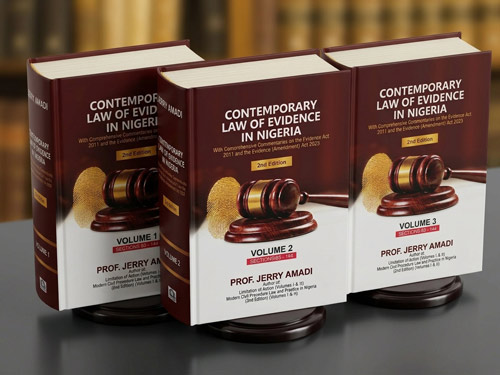 Prof. Jerry Amadi’s Evidence Law, Second Edition (2026), contains 3,314 pages in three volumes, covering the Evidence Act 2011, its 2023 amendment, and 4,051 Nigerian and English cases.