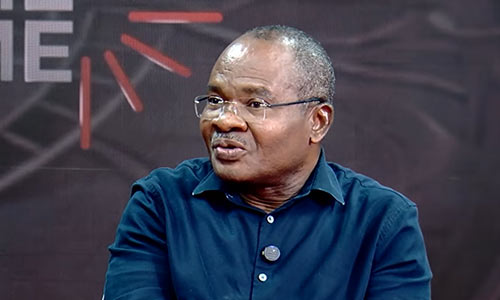
Human rights lawyer and founding Executive Director of the Policy and Legal Advocacy Centre (PLAC), Clement Nwankwo, has expressed concern over the preparedness of the Independent National Electoral Commission (INEC) for the January 16, 2027, presidential election, warning that the commission has yet to demonstrate the transparency and accountability necessary to earn public confidence.

Nwankwo also raised concerns over the increasing involvement of the judiciary in political party leadership disputes, warning that court decisions affecting the legitimacy of opposition parties and their candidates could undermine electoral competition ahead of the general election.
Speaking during a television interview following a briefing at Chatham House in London attended by the INEC Chairman, Professor Joash Amupitan, the human rights advocate maintained that Nigerians could not be expected to trust the electoral commission merely because it demanded public confidence.
According to him, trust must be earned through transparency, accountability, meaningful stakeholder engagement and clear evidence that preparations for the elections are proceeding according to law.
“We want to trust INEC but cannot demand that we trust it. We can only trust INEC by what we see it do,” he said.
Nwankwo argued that the commission’s current level of transparency had not reached the point where Nigerians could confidently declare that they trusted its preparations.
He maintained that some of the commission’s proposed procedures, particularly those relating to election results, required further explanation and public scrutiny.
One of his major concerns was the proposed use of an electronic EC8A form, which he described as legally questionable.
Nwankwo argued that Section 60 of the Electoral Act clearly prescribed the procedure for recording and transmitting election results from polling units.
According to him, results must first be counted and recorded on the prescribed EC8A form at the polling unit, with the document signed by the presiding officer and relevant party agents.
He explained that the statutory form constituted the foundation of the collation process and that the electronic transmission of results must comply with the procedure established by law.
“It is only this document that leads to collation,” he stated.
Nwankwo maintained that Section 60(3) provided for the transmission of polling-unit results to INEC’s Results Viewing Portal (IReV), while Section 60(6), in his interpretation, reinforced the obligation to comply with the prescribed procedure.
He consequently questioned the legal basis for introducing a separate electronic form into the collation process.
According to him, the document being discussed by INEC “is illegal, cannot be used” and “is not in the Electoral Act”.
“We don’t know what it is,” he added.
The presenter suggested that INEC might intend to use the electronic form for administrative documentation after receiving the original EC8A results or after their announcement.
Responding, Nwankwo acknowledged that the electoral law required INEC to maintain electronic records of results but maintained that administrative documentation should not be confused with the statutory process for collation.
He stressed that the central question was whether the proposed electronic form would be used merely for record-keeping or introduced as part of the formal collation process.
Nwankwo also addressed the National Assembly’s consideration of electronic transmission of election results.
He argued that the legislative position did not eliminate the requirement to transmit results to IReV.
According to him, where network difficulties prevented immediate transmission, the results would still have to be transmitted once connectivity became available.
He maintained that the possibility of temporary network challenges did not justify the introduction of an alternative results form outside the process prescribed by law.
The PLAC founder consequently urged political parties, including the APC, ADC, NDC and SDP, to seek clarification from INEC on its intended procedures.
He also called on the commission to engage political parties, civil society organisations and the media before introducing arrangements capable of affecting public confidence in the collation of election results.
“INEC’s plans and preparations for elections are not secret, and they shouldn’t be,” Nwankwo stated.
He argued that information concerning election logistics, including arrangements for printing sensitive electoral materials, should be communicated transparently to the public.
According to him, greater openness would enable Nigerians to understand the commission’s preparations and assess whether the electoral process was being conducted credibly.
“There’s a lot of transparency issues,” he said, adding that the commission’s activities had not yet inspired the confidence expected of an institution preparing to conduct a major national election.
Nwankwo also questioned INEC’s handling of irregularities discovered in the voters’ register.
During the interview, the presenter referred to reports that the commission had removed more than 1.6 million records following the identification of alleged irregularities, including duplicate entries and suspected fictitious profiles.
Responding, Nwankwo said the speed with which the commission announced the clean-up raised questions about the process used to identify and remove the affected records.
He explained that while correcting an inaccurate voters’ register was necessary, INEC also had a responsibility to demonstrate that its review process was transparent, credible and technically sound.
“How did you identify 1.6 million fake voters or AI-generated names in your voter register in a couple of days? What is the process?” he asked.
Nwankwo said that if the exercise was genuine and properly conducted, the commission deserved commendation.
“If that process is genuine, fantastic. We must commend INEC for it. But INEC has to tell us how it came about,” he stated.
He maintained that Nigerians needed to understand the methodology used to identify suspicious entries and the safeguards adopted to ensure that legitimate voters were not wrongly excluded.
The human rights advocate also raised questions about the total number of polling units to be used for the election.
He estimated that the country had approximately 200,000 polling units but acknowledged that he was uncertain of the final number.
According to him, INEC should provide clear information on the number and distribution of polling units to enable voters, political parties and other stakeholders to prepare adequately.
Another issue raised during the interview concerned the collection of Permanent Voter Cards (PVCs).
Nwankwo disclosed that he had transferred his registration to a different polling unit but had not received his PVC.
He said he had been informed that the card was not ready, despite the approaching election.
The lawyer questioned whether such delays indicated broader administrative challenges that could affect voter participation.
He also expressed concern about barriers faced by women, persons with disabilities, internally displaced persons and residents of remote communities in registering and collecting their voter cards.
According to him, INEC must demonstrate that its preparations are sufficiently advanced to guarantee that eligible Nigerians can exercise their voting rights.
“If INEC is not at a point where it is ready, then questions need to be asked. How do you achieve credible elections in that state of unpreparedness?” he queried.
Nwankwo also addressed the growing role of technology and artificial intelligence in electoral processes.
He noted that INEC had discussed the possible deployment of artificial intelligence, but said the applicable electoral legislation did not specifically address its use.
The presenter observed that the law generally permitted the commission to deploy technology.
Nwankwo nevertheless stressed the importance of clarifying how technological innovations would be introduced and regulated.
He also warned about the potential impact of artificial intelligence and coordinated disinformation on the electoral process.
According to him, the commission must prepare for the circulation of fabricated images, manipulated audio and video recordings, false election announcements and forged court documents capable of misleading voters.
He maintained that INEC “needs to be very aware of” the threat posed by such activities.
Turning to the political environment, Nwankwo expressed concern that opposition parties were approaching the election without demonstrating sufficient organisational preparedness.
He described the prevailing situation as one in which the ruling party appeared confident of its position while opposition parties were struggling with internal disagreements and legal challenges.
According to him, there was “the party that feels it has no opponent, and then there is the opposition, which has not been allowed to get its act together”.
He suggested that some court decisions and actions by institutions involved in election administration had contributed to the difficulties confronting opposition political parties.
Nwankwo maintained that the resulting uncertainty was troubling for Nigerians preparing to participate in the election.
He was particularly concerned about the possibility that judicial decisions could exclude leading opposition candidates from the presidential contest.
Explaining his warning that Nigeria could be approaching an effectively uncontested election, he pointed to the numerous leadership disputes involving opposition parties.
He identified the ADC, PDP, NDC and Labour Party among political organisations affected by litigation and internal disputes.
“The courts seem to be getting into the arena in a way that raises major concern,” he said.
Nwankwo questioned why political parties were still involved in litigation over their leadership and legitimacy so close to the general election.
He also expressed concern about situations in which courts of coordinate jurisdiction issued apparently conflicting decisions concerning the same political organisation.
According to him, the consequences could extend beyond party leadership disputes to the validity of candidates already presented for the election.
He stressed that questions concerning a party’s leadership and the eligibility of its nominated candidates were distinct legal issues requiring careful judicial consideration.
“It is very, very frightening what the consequences could be,” he warned.
Nwankwo also acknowledged that some of the disputes ought to have been resolved internally by political parties rather than through repeated court proceedings.
He maintained that the growing dependence on judicial intervention had created uncertainty over the electoral process.
The lawyer further warned about the practice of litigants seeking particular courts in the expectation of obtaining favourable decisions.
According to him, such practices raised serious concerns about judicial independence and the rule of law.
He explained that where courts of coordinate jurisdiction delivered conflicting decisions on the same issues, public confidence in the judiciary could be weakened.
Nwankwo maintained that the judiciary, traditionally regarded as the last hope of the common man, must be protected from practices capable of undermining its credibility.
He argued that judicial independence did not place judges beyond accountability.
“Independence does not mean freedom from accountability,” he stated.
According to him, the judiciary already possessed disciplinary mechanisms and a code of conduct, but the effectiveness of their enforcement remained a matter of concern.
He questioned whether the institutions responsible for judicial accountability were sufficiently active in addressing alleged misconduct and practices undermining confidence in the courts.
The PLAC founder also called for greater transparency in the delivery and publication of judicial decisions.
He maintained that judges should provide properly reasoned written judgments that are accessible to the public rather than merely announcing their conclusions.
According to him, the reasons supporting judicial decisions should be available for examination when judgments are delivered.
“Sometimes decisions are reached but the process leading up to that decision is not available for people to scrutinise, and that is threatening to justice,” he said.
He warned that delays in publishing judgments created opportunities for disputes over what courts actually decided and could encourage the circulation of fabricated court orders.
Despite his concerns about judicial involvement in political disputes, Nwankwo also criticised opposition parties for failing to demonstrate sufficient seriousness in their election preparations.
He particularly questioned whether political parties had recruited enough polling agents to monitor voting and the collation of results across the country.
According to him, any political party aspiring to win the presidential election must establish an effective presence at polling units nationwide.
“Every political party who is running for election, especially if you’re running for the highest office of President, you’re wasting Nigerians’ time if you don’t have 200,000 polling agents,” he said.
He argued that parties seeking national political office should not rely merely on public rallies and political declarations without developing the organisational structures necessary to protect their votes.
“How serious are you? Don’t waste our time. If you don’t have 200,000 polling agents across all of these polling units, then don’t come and campaign to us, because we know you’re not serious,” he stated.
Nwankwo noted that Nigeria had 18 registered political parties and questioned how many were adequately prepared to deploy agents nationwide.
He expressed disappointment that parties presenting themselves as serious contenders had not demonstrated convincing levels of preparation.
According to him, opposition political organisations needed to engage INEC more actively, examine its plans and ensure their members understood the electoral procedures.
He described the parties’ level of organisation as reflecting “deep unpreparedness”.
The human rights advocate maintained that credible elections depended not only on INEC’s performance but also on the preparedness of political parties, the conduct of the judiciary and the willingness of citizens to participate.
He expressed concern that the political atmosphere had not generated the enthusiasm necessary for high voter turnout.
“I worry about the elections,” he said.
Nwankwo explained that his concerns extended to the commission’s preparations, the conduct of political parties and the level of public confidence in the electoral process.
He warned that a failure to conduct credible elections in January 2027 could undermine the legitimacy of Nigeria’s democratic system.
“If this country does not deliver credible elections in January 2027, then the legitimacy of our democracy would be in serious question,” he declared.
[A MUST HAVE] Evidence Act Demystified With Recent And Contemporary Cases And Materials

Available now for NGN 40,000 at ASC Publications, 10, Boyle Street, Onikan, Lagos. Beside High Court, TBS. Email publications@ayindesanni.com or WhatsApp +2347056667384. Purchase Link: https://paystack.com/buy/evidence-act-complete-annotation
______________________________________________________________________ “Enhance Legal Practice With Authoritative Reports” — Alexander Payne Offers Comprehensive Law Reports, Spanning Over A Century Of Nigerian Jurisprudence Interested buyers are encouraged to place their orders and enquiries via:
0704 444 4777, 0704 444 4999, 0818 199 9888
Website: www.alexandernigeria.com
“A Comprehensive Guide To Evidence Law” — Releases Second Edition In Three Volumes, Covering 4,051 Cases
For enquiries and orders, contact: 08035526491 Email: jerryamadisilk@gmail.com
 Prof. Jerry Amadi’s Evidence Law, Second Edition (2026), contains 3,314 pages in three volumes, covering the Evidence Act 2011, its 2023 amendment, and 4,051 Nigerian and English cases.