
The National Association of Nigerian Students (NANS) has called on the National Drug Law Enforcement Agency (NDLEA) to discontinue the ₦10,000 drug testing fee charged to students, insisting that government-led efforts to combat substance abuse should not impose additional financial burdens on Nigerian students.
The association maintained that while it supports measures aimed at addressing drug abuse in tertiary institutions, students should not be compelled to pay for screening exercises initiated by government agencies or imposed as part of institutional requirements.
In a statement issued on Monday, November 16, 2026, and signed by its President, Akinteye Babatunde Afeez, NANS urged the Chairman and Chief Executive Officer of NDLEA, Brigadier General Mohamed Buba Marwa (retd.), to stop the collection of the ₦10,000 fee from students.
The student body argued that the responsibility for funding official government programmes should not be transferred to students, particularly when the tests were not independently requested by them.
According to NANS, introducing additional charges for drug screening would worsen the financial difficulties confronting students who are already struggling with increasing tuition fees and the rising cost of living.
The association explained that its objection was not to drug testing itself or the campaign against substance abuse but to the decision to make students bear the financial cost of an official intervention.
“If the Agency must carry out its official responsibilities, it must do so without imposing any financial burden on Nigerian students,” the statement said.
NANS maintained that initiatives designed to promote drug-free campuses should prioritise students’ health, safety and welfare rather than create additional financial obligations that could affect their ability to pursue education.
The association also warned government institutions against treating student welfare programmes as opportunities to generate revenue.
“The welfare of Nigerian students must not become a revenue-generating venture for government agencies,” it declared.
The demand comes amid efforts to expand drug screening in Nigerian tertiary institutions as part of measures to address substance abuse among young people.
The NDLEA has continued to advocate drug testing as a preventive measure, with attention increasingly directed towards educational institutions and the screening of students.
In May 2026, reports emerged of a government-backed initiative involving the NDLEA and the Federal Ministry of Education to expand drug testing among new and returning students.
However, the available information does not establish that a compulsory drug testing requirement has been uniformly implemented across all tertiary institutions in Nigeria.
Some universities have nevertheless introduced their own requirements for drug screening.
On November 11, 2026, Osun State University was reported to have made drug testing compulsory for students ahead of the 2026/2027 academic session.
Under the university’s reported arrangements, students were directed to register through an NDLEA portal, complete the required payment process, select a testing location and obtain a Drug Integrity Test certificate for submission to the institution.
The development illustrates how drug screening requirements can become an additional financial obligation for students, particularly where proof of testing forms part of institutional registration procedures.
However, NANS did not specifically identify Osun State University as the reason for its latest demand, which was directed more broadly at the collection of the ₦10,000 testing fee.
The student association maintained that public health interventions should be structured in a manner that protects students without creating unnecessary financial barriers.
It argued that where drug screening forms part of an official government programme, the responsibility for financing the exercise should remain with the relevant authorities rather than students who are required to undergo the tests.
NANS consequently urged the NDLEA leadership to review the payment arrangement and discontinue the fee in the interest of Nigerian students.
The association also reaffirmed its commitment to supporting initiatives that promote student safety, welfare and development, including efforts to prevent drug abuse within tertiary institutions.
It, however, insisted that such initiatives must not become an avenue for imposing additional financial burdens on students.
The available information does not establish whether ₦10,000 has been formally approved as a nationwide drug testing fee, whether the same amount applies across all institutions or whether the NDLEA has announced any decision to discontinue the charge.
NANS maintained that its demand was consistent with its responsibility to protect the interests of Nigerian students while supporting measures aimed at creating safer and healthier learning environments.
[A MUST HAVE] Evidence Act Demystified With Recent And Contemporary Cases And Materials
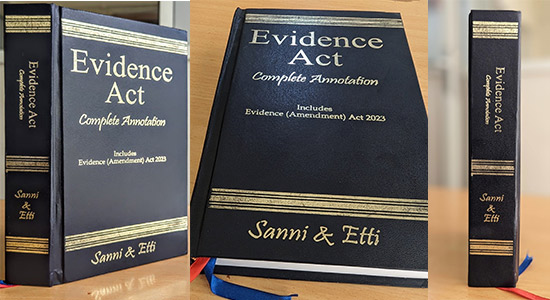
Available now for NGN 40,000 at ASC Publications, 10, Boyle Street, Onikan, Lagos. Beside High Court, TBS. Email publications@ayindesanni.com or WhatsApp +2347056667384. Purchase Link: https://paystack.com/buy/evidence-act-complete-annotation
______________________________________________________________________ “Enhance Legal Practice With Authoritative Reports” — Alexander Payne Offers Comprehensive Law Reports, Spanning Over A Century Of Nigerian Jurisprudence Interested buyers are encouraged to place their orders and enquiries via:
0704 444 4777, 0704 444 4999, 0818 199 9888
Website: www.alexandernigeria.com
“A Comprehensive Guide To Evidence Law” — Releases Second Edition In Three Volumes, Covering 4,051 Cases
For enquiries and orders, contact: 08035526491 Email: jerryamadisilk@gmail.com
 Prof. Jerry Amadi’s Evidence Law, Second Edition (2026), contains 3,314 pages in three volumes, covering the Evidence Act 2011, its 2023 amendment, and 4,051 Nigerian and English cases.